* ESC - close the search window
collection
A new book collects Davyd Chychkan’s portraits of anarchists and socialists defending Ukraine
28.10.2026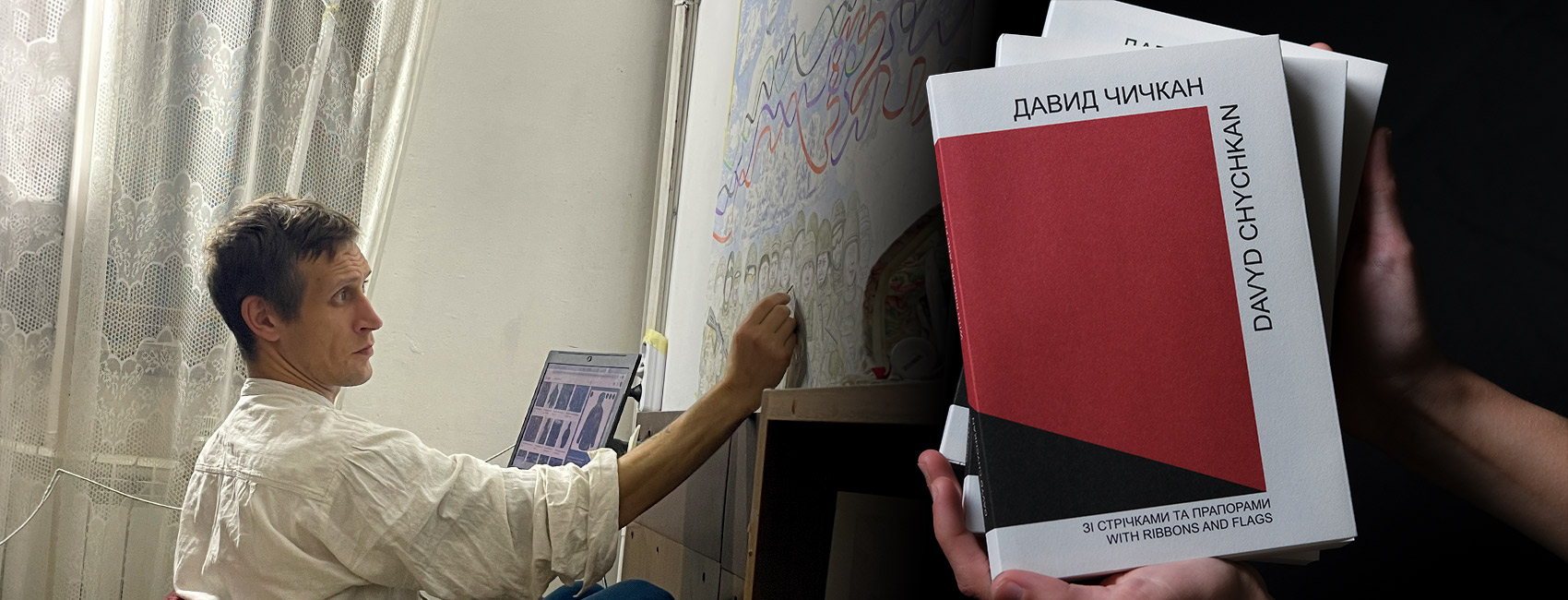

You see an error in the text - select the fragment and press Ctrl + Enter
The anarchist artist abandoned his series “With Ribbons and Flags” when a museum canceled its exhibition. After he was killed at the front, his widow and friends turned it into a book of the same name.
When Denys Pilash sat down to write his essay for a new book about the late Ukrainian artist and anarchist Davyd Chychkan, he faced two problems. One was how to place his friend, who had fought fascism in his art and as a soldier against Russia’s invasion, within Ukrainian leftist thought and history. The other was how to write anything at all in a crowded military tent, where he lacked regular access to a phone, computer, or reliable internet.
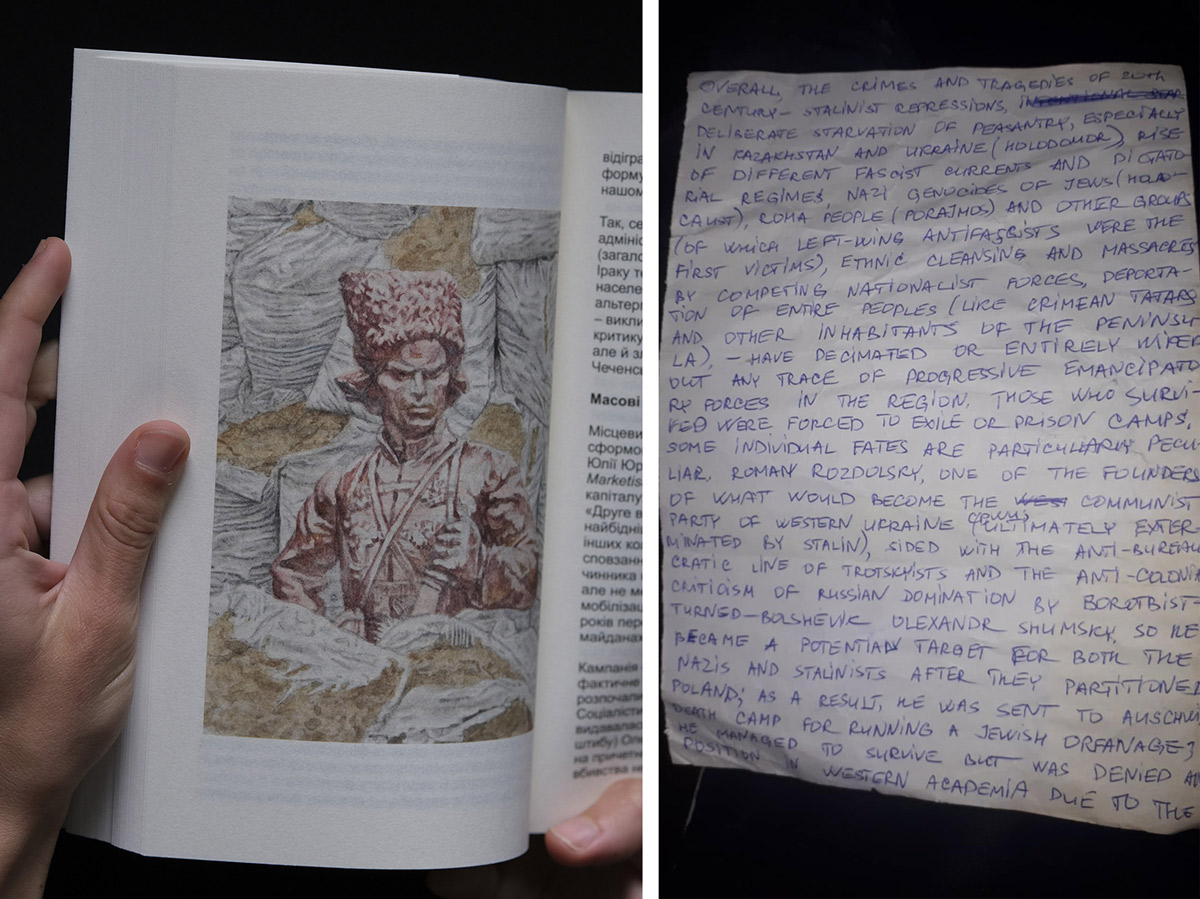
Pilash, a political scientist and member of the democratic socialist group Social Movement (Sotsialnyi Rukh), is now serving in the army. He wrote the essay by hand, photographed the pages, and later sent them to a friend to type up.
The result, the second of two essays in “With Ribbons and Flags,” surveys collective organization and leftist movements on the territory of present-day Ukraine, from prehistoric settlements and the Zaporizhzhian Cossacks to anarchists and socialists fighting Russia today.
“Chychkan’s work wasn’t about art for art’s sake, academic research for its own sake, or activism as a lifestyle. It was about combining everything into something transformative that can make society better,” Pilash said in a recent interview with Chytomo.
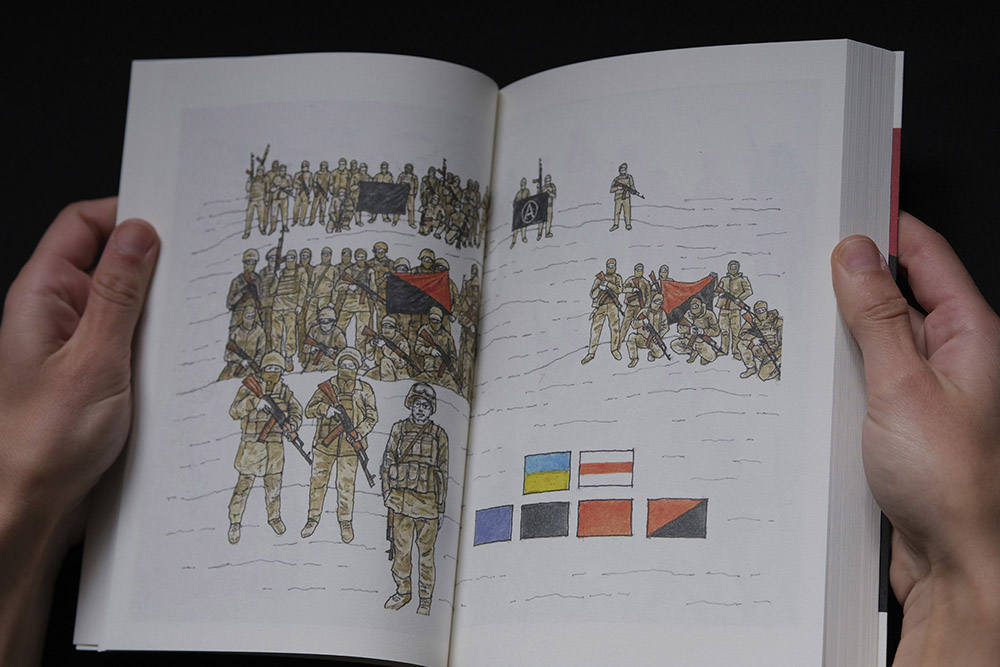
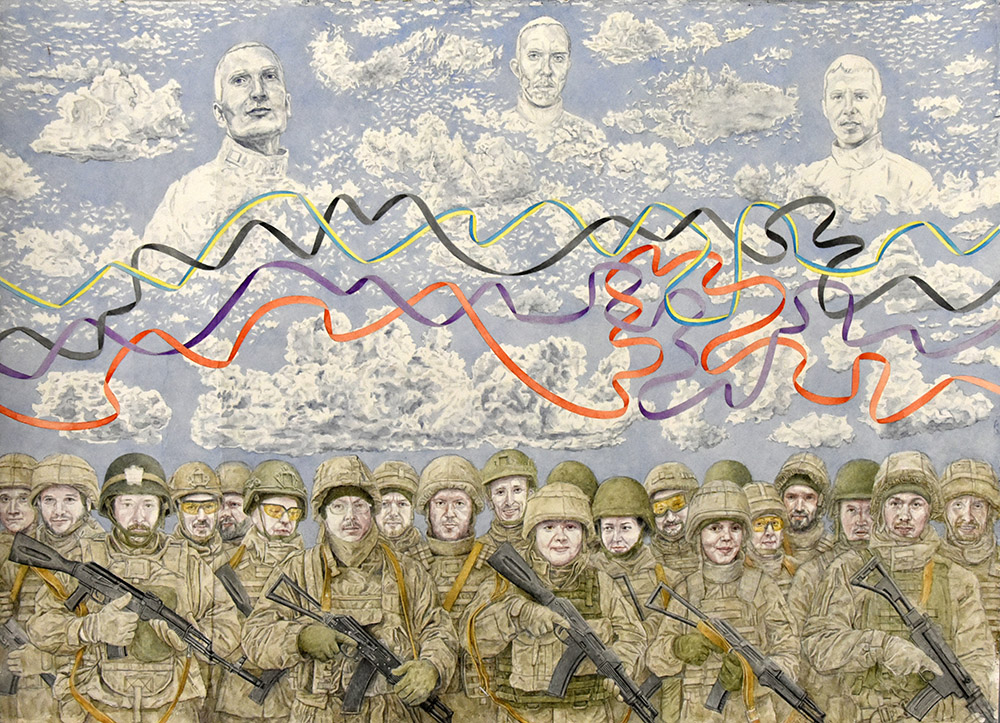
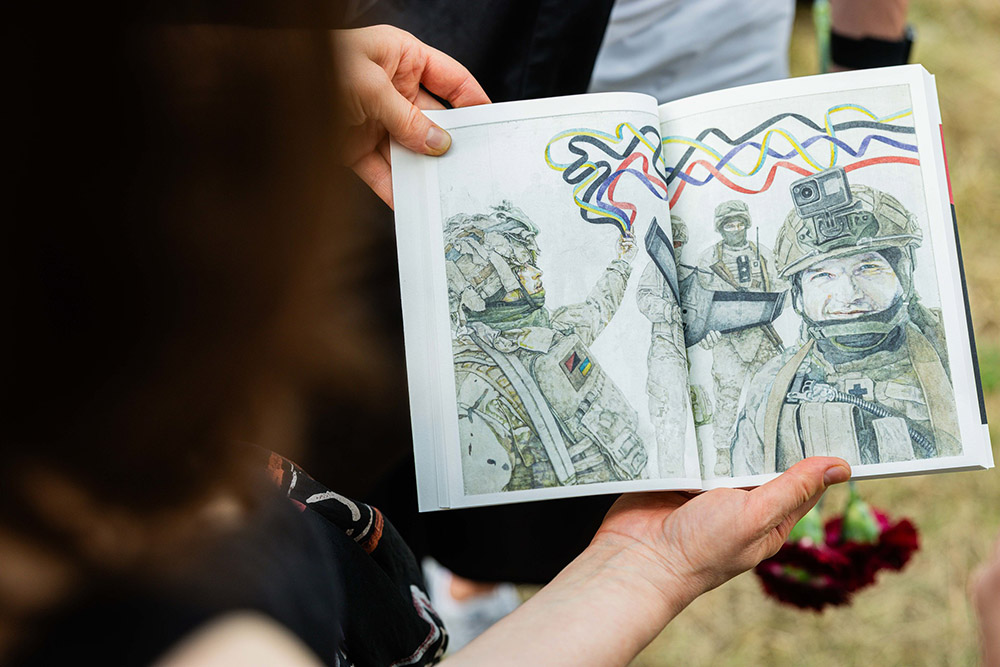
The book reproduces the watercolor series that gave it its title, which Chychkan made between 2022 and 2024. In it, he painted anarchists and other anti-authoritarian leftists defending Ukraine, some of whom had already been killed by Russia. In their introduction, the book’s editors write that the painter wanted the series to emphasize “the fundamental difference between the Ukrainian army of free people” and “the army of Russian occupiers, who hold no other beliefs apart from imperial-fascist ones.”
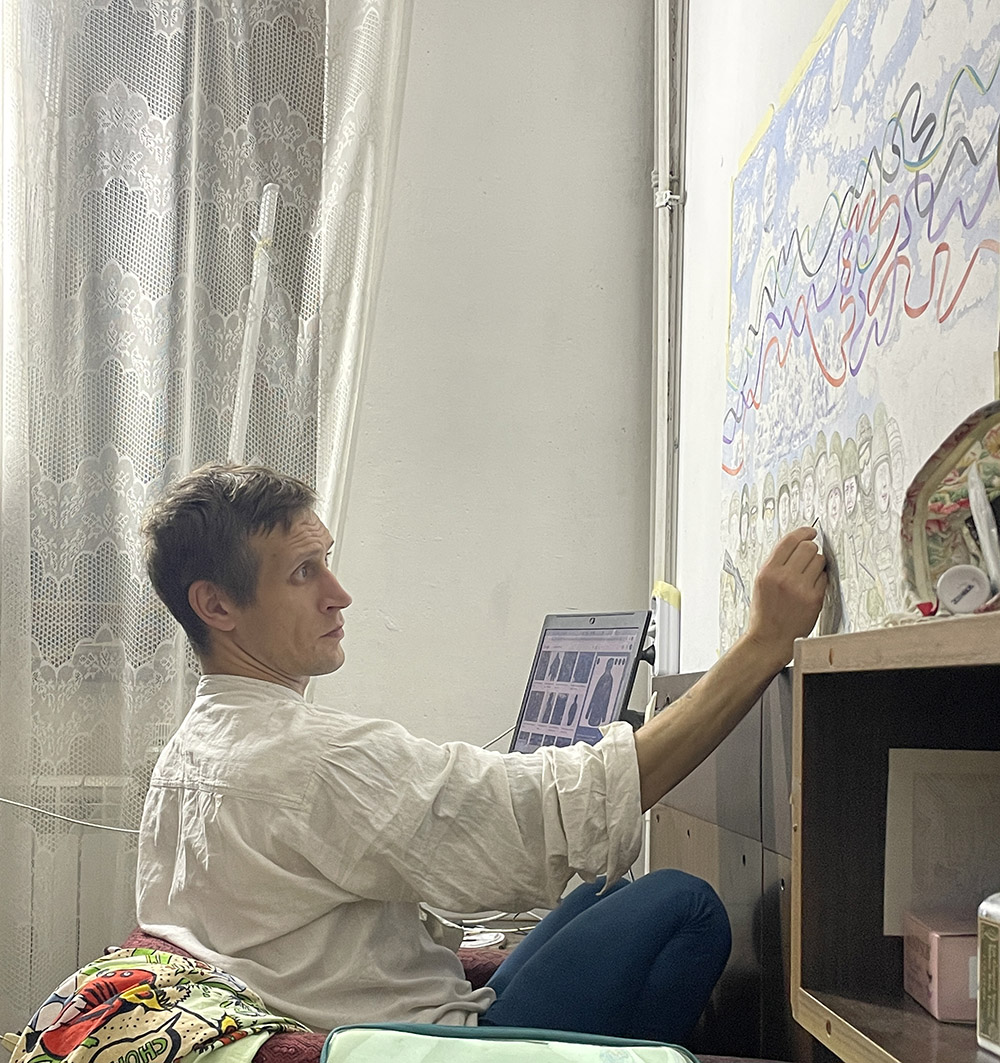
He worked in an apartment in Kyiv’s Darnytsia district that belongs to the family of his widow, Hanna Tsyba, and that “during the war became more of his studio,” she told Chytomo. He stapled big sheets of paper to the wall, projected photos of the fighters to sketch their faces in pencil, then painted the rest by hand. Each piece took a month or two. In the group portraits, he placed fighters from different brigades side by side.
The painting that means most to Andrii Bozhok, one of the book’s co-editors, shows four armed soldiers standing over three kneeling captives with their hands behind their backs, one in the striped undershirt of a Russian paratrooper. Ukrainian blue-and-yellow ribbons wind through the sky, twisted together with the white-red-white ribbons of Belarus’ democratic opposition. On the ground lie ribbons in the colors of Russia’s flag, as well as the red and green of Lukashenko’s Belarus. It shows “the direction of history I would like,” he said.
RELATED: Ways of memory and struggle: Five new photo books about Ukraine
The book’s opening essay by translator and writer Yustyna Kravchuk begins by describing Chychkan’s alternative designs for Ukraine’s 20- and 200-hryvnia notes, which bear portraits of Ivan Franko and Lesia Ukrainka, two of the country’s most revered writers, whose socialist beliefs are less widely remembered. He added quotations from their political writings alongside their faces.
“I think that since we decided to glorify these personalities, let’s glorify not only their faces but also their intellectual contributions,” Chychkan said, as quoted in the essay.
Kravchuk said she set out to do the same for Chychkan because his works and positions had so often been misinterpreted or oversimplified. She wrote with what she called a “documentary intention,” drawing from interviews he gave to media outlets.
He saw it as his mission, she said, to convince Ukrainians that progressive, anti-authoritarian leftist ideas “are not something they should be afraid of” and that democratic leftists “are not their enemies.”
He also had “a lot of self-irony,” Kravchuk said, something she finds missing in many leftist circles. Through his art, Chychkan invented anarchist groups, including the Libertarian Club of Clandestine Dialectics, made stickers bearing their logos, and imagined their alliances and splits. He joked that having so many groups, even with scarcely any members, made it seem as though there were more anarchists than actually existed.
Kravchuk was at Kyiv’s Visual Culture Research Center in February 2017 for Chychkan’s exhibition “Lost Opportunity,” which argued in part that Maidan could have become more of a social revolution, “not only to defend dignity, but rather finally gain dignified living conditions.” Those who raised social demands, Chychkan told Ukrainska Pravda that month, “were pushed out by the far right.” He had gone to the protests “almost every day,” Chychkan told Hromadske.
Far-right groups had called online for the show to be destroyed. When the exhibition, briefly closed, was reopened, about 15 masked people stormed the center, stealing, damaging, or destroying eight of the exhibition’s 10 paintings, according to the center. He never held a grudge over the attack, Kravchuk said. But it would not be the last time his work was targeted.
In early 2024, the Odesa National Fine Arts Museum was preparing to show “With Ribbons and Flags,” the soldier portraits now collected in the book. Ahead of the opening, critics circulated Chychkan’s earlier works online, accusing him of equating Ukraine with Russia.
RELATED: Hanna Hrabarska’s photo book about her refugee experience to be published in the Netherlands
One of them, made years before the full-scale invasion, shows Ukrainian and Russian nationalists facing each other across a heap of bodies, under banners bearing the same four words: power, faith, honor, glory. Beneath them, anarchists march under the slogan “Everything for everyone, here and now.” Kravchuk said the artist meant to show how far-right ideologies on both sides overlapped, not to suggest the two countries were the same.
Citing threats over his “previous projects,” the museum canceled the exhibition.
Tsyba said Chychkan was upset on behalf of the fighters he had painted. He canceled a planned exhibition abroad so that people there would not learn what had happened. He did not want “Western skeptics, those European leftists who were saying that Ukraine is a fascist state, to have another reason to say so,” she said.
Afterward, Chychkan painted black over the space he had left for additional faces in a group portrait of the dead. He ended the series. He had always tried to sell a series to a single buyer so all the works could be shown together. This time, he gave and sold the works “into different hands, like [the series] never existed,” Tsyba said.
The book now includes an account of the cancellation. “I made the decision that we would tell the truth,” Tsyba said. “I think Davyd would like this book, even though he probably wouldn’t like the truth it brings to the world.”
After the cancellation, Kravchuk said, Chychkan felt he could not accomplish enough through art and needed to join the fighting himself.
He had tried to join territorial defense on the first day of the full-scale invasion but was sent home because he had no experience, Tsyba said. A bad back and their plans to have a child held him back after that. Once the series was over, “he had nothing more to keep him out of the army,” she said.
In the summer of 2024, two months into Tsyba’s pregnancy and against his doctor’s advice, Chychkan joined a mortar unit in Kyiv’s 241st Territorial Defense Brigade, where a group of anarchists was already serving. In an interview quoted in Kravchuk’s essay, he explained why: “I have leftist political views, which means that I’m against exclusivity. I’m the same as peasants, teachers, or proletarians. I’m no better than they are.”
Chychkan was mortally wounded while repelling a Russian infantry assault near Orikhiv, on the Zaporizhzhia front, and died Aug. 10, 2025. He was 39. Tsyba was in Berlin with their 7-month-old son, Nestor, cleaning an apartment she had just rented. They took a bus back to Ukraine that day. At his farewell on the Maidan, mourners held up his paintings. Kravchuk said she and his friends still talk about him often.
“Among our common friends … there are people who were very close with him, like very close friends, and for them it’s even unimaginable to write coherently about him,” she said.
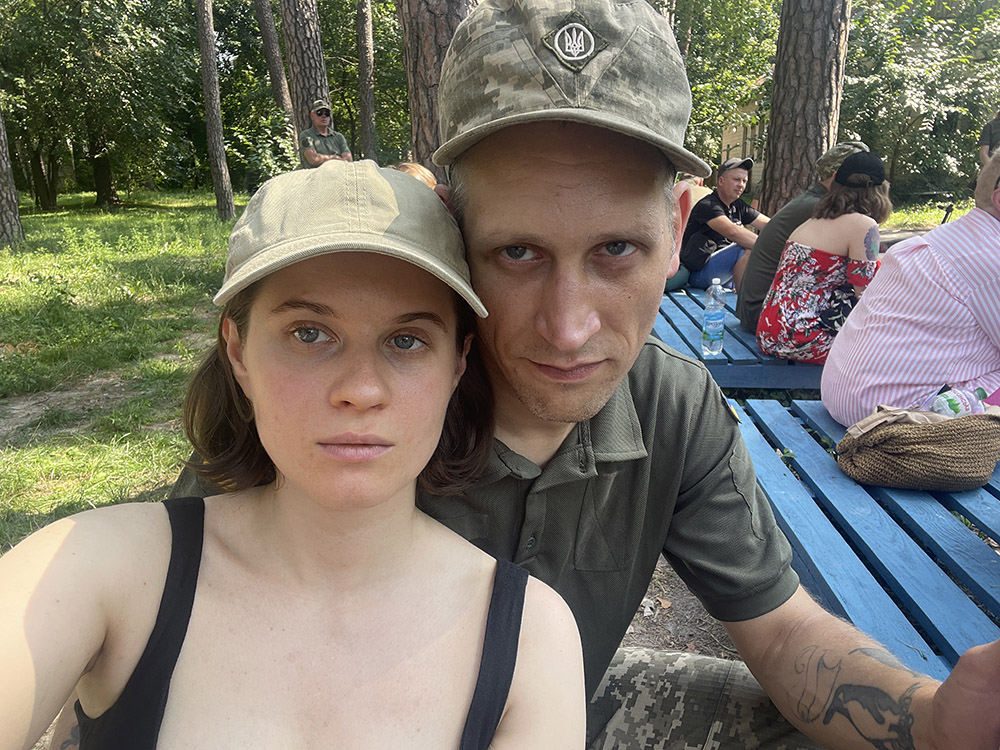
“For me, the biggest shame is that Davyd paid too much attention and time to agitating people for left ideas, and he showed them too little of himself,” Tsyba said. To her, he was “a whole planet.”
Work on the book began before Chychkan’s death. In September 2024, while fighting in Donbas, he asked Bozhok, a friend and collector of his work, to print posters from the series for his fellow soldiers. Bozhok kept a set. When Berlin artist Stefan Klein saw it in Bozhok’s apartment, he suggested a book. Chychkan agreed, but he was at the front and unsure how the book should present the series, Tsyba said. The project stalled.
After Chychkan was killed, Bozhok met Tsyba, who is a contemporary art curator, researcher, and journalist, through a friend, and they revived it. Bozhok, Tsyba, and Klein became the book’s co-editors, and Klein designed it.
Bozhok, who produced the book, then brought the project to Alona Karavai, a curator whose publishing project, ilostmylibrary, grew out of Asortymentna Kimnata, the arts organization she co-founded in Ivano-Frankivsk. With the essays and translations already done, her team took on the editing, printing, and distribution.
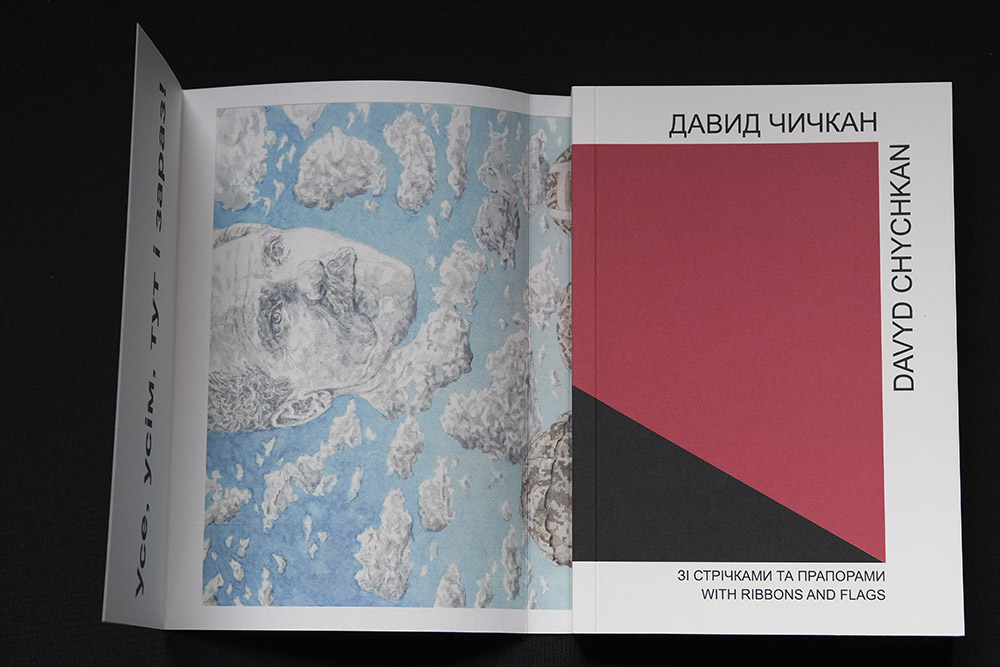
Karavai said they wanted the book to look unfinished, like the series itself. It is spare and, in her words, “a bit like a zine,” but they paid nearly twice the usual price for offset printing so the watercolors would come out right.
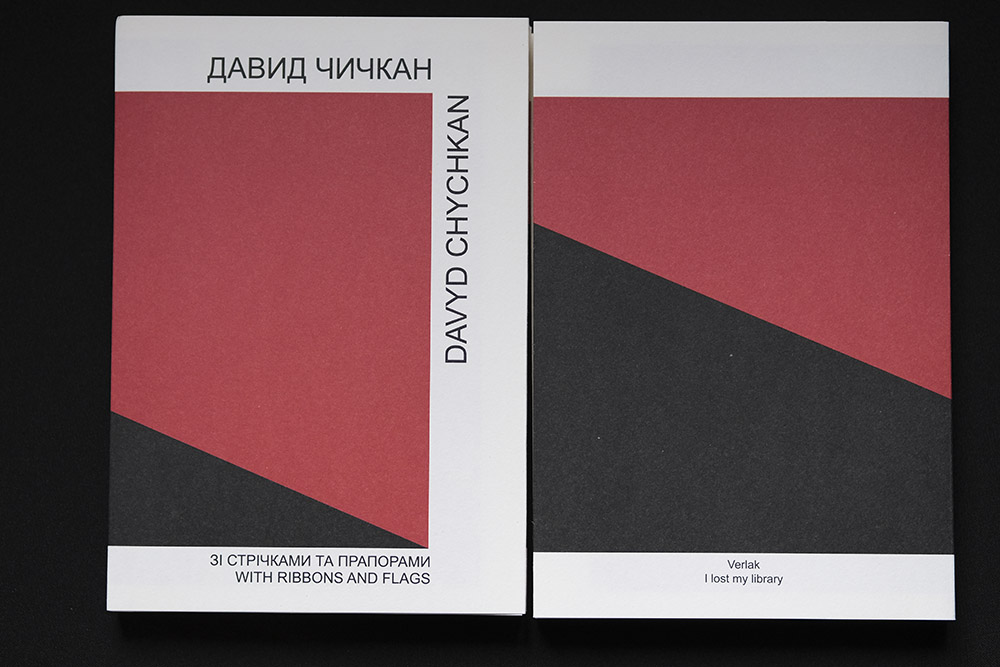
The removable cover sleeve unfolds into a poster bearing Chychkan’s slogan, “Усе, усім, тут і зараз!” (“Everything for everyone, here and now”). A note in the book invites readers to “hang it up as a poster at home, gift it to friends, or distribute it on the streets.” Karavai said it was a way to make the book useful, as Chychkan wanted his art to be.
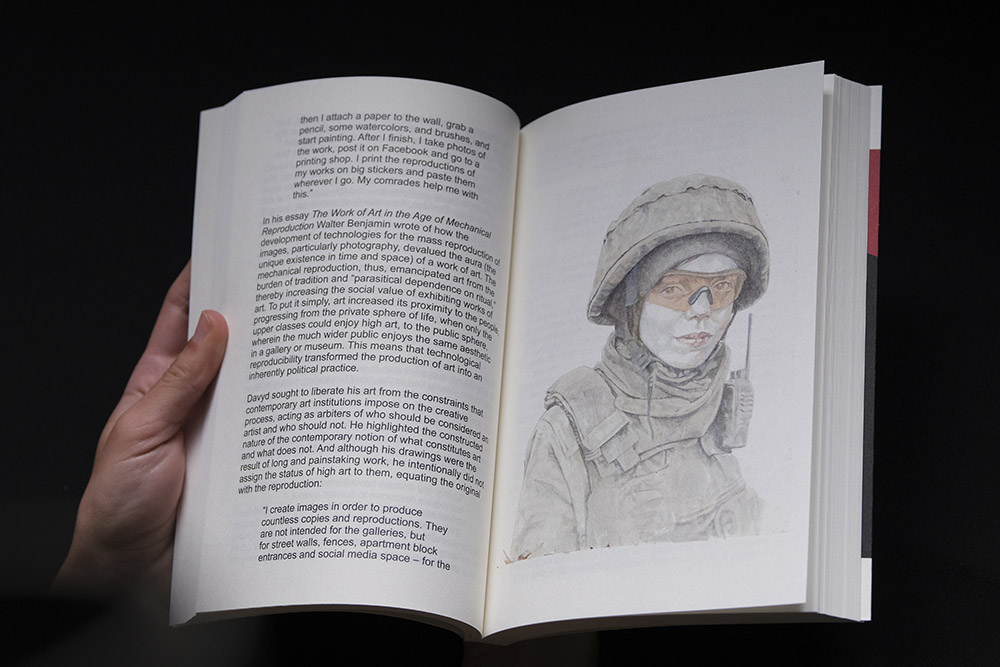
“In his practice, the original was the copy,” she said. In another interview quoted in the essay, he explained how that worked: “After I finish, I take photos of the work, post it on Facebook, and go to a printing shop. I print the reproductions of my works on big stickers and paste them wherever I go. My comrades help me with this.”
After the Odesa exhibition was canceled, others took up his method. Leftist groups in Odesa and across Ukraine reproduced the series as posters and stickers. The editors call the book “a continuation of this trajectory.”
The Berlin publisher Verlak and ilostmylibrary printed 500 copies of the bilingual Ukrainian-English edition. “We never had such demand for any other book that we are working with,” Karavai said.
Even before the book came out, the slogan was circulating on T-shirts made by a self-organized anarcho-feminist initiative that began after he was killed, with profits going to Solidarity Collectives, a volunteer network supporting Ukrainian soldiers and people affected by Russia’s war. The group said it wanted to “manifest Davyd’s timeless and borderless slogan” and “preserve his legacy as an antifascist freedom fighter.”
“I see it more and more, and I’m always happy to see it in different combinations,” Karavai said. “I believe Davyd would also be glad if he could see that it goes so widely because this is what he wanted.”
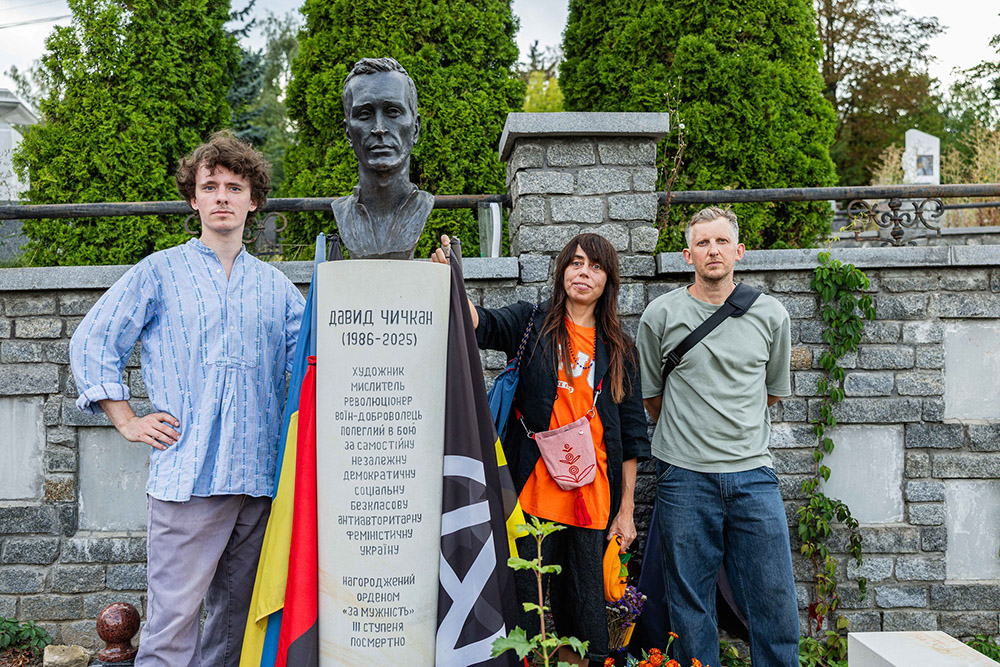
Tsyba, Bozhok, and Karavai saw the finished book for the first time at Chychkan’s grave in late August, on the day his monument was unveiled.
Since then, Tsyba has presented the book in Kyiv and Warsaw and is planning an event in Berlin. Copies are already running out, she said, and the team needs to print more for that presentation.
Carrying on his work and speaking about him, she said, “gives me an impression that he’s still alive.”
The publication is a part of the “Chapter Ukraine” project. The materials have been prepared with the assistance of the Ukrainian Book Institute at the expense of the state budget. The author’s opinion may not coincide with the official position of the Ukrainian Book Institute.
Copyediting: Joy Tataryn
Jared Goyette is an American journalist based in Kyiv who recently began military service in Ukraine. He wrote this piece in a personal capacity.
Читомо» — це медіа про книжки й літературу, що підтримувало українське книговидання задовго до того, як це стало трендом. Ставайте частиною історії — доєднуйтеся до Клубу Читомо!
the more you read, the greater the possibilities