* ESC - close the search window
Greece
Three writers in the war zone: ‘Three and a half years later, we are still here’
22.09.2025
You see an error in the text - select the fragment and press Ctrl + Enter
Literature, music, and art were their natural domain. But the Russian invasion forced them into a different arena – one where the very existence of their country is at stake. Their personal testimonies are not military chronicles; they are the reflection of a society that learned, in the harshest way possible, that independence is never guaranteed.
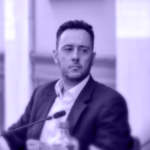
Three Ukrainian writers who grew up during the years of independence found themselves carrying weapons to defend their country. By choice. Yelyzaveta Zharikova, Artem Chapeye, and Valeriy Puzik had never belonged to the military world. Their lives were interwoven with literature, music, and art. But the Russian invasion brought them to the front line, turning their experience into the testimony of a generation that could not remain passive.
All three came of age in a period that felt like an uncertain threshold for Ukraine – on one side, the direction the country would take after the independence of 1991, and on the other, the looming threat of Russian aggression and existential anxiety. Their stories are not just about war, but about a society that was forced to understand that freedom is not given. It must be defended, even at the highest price.
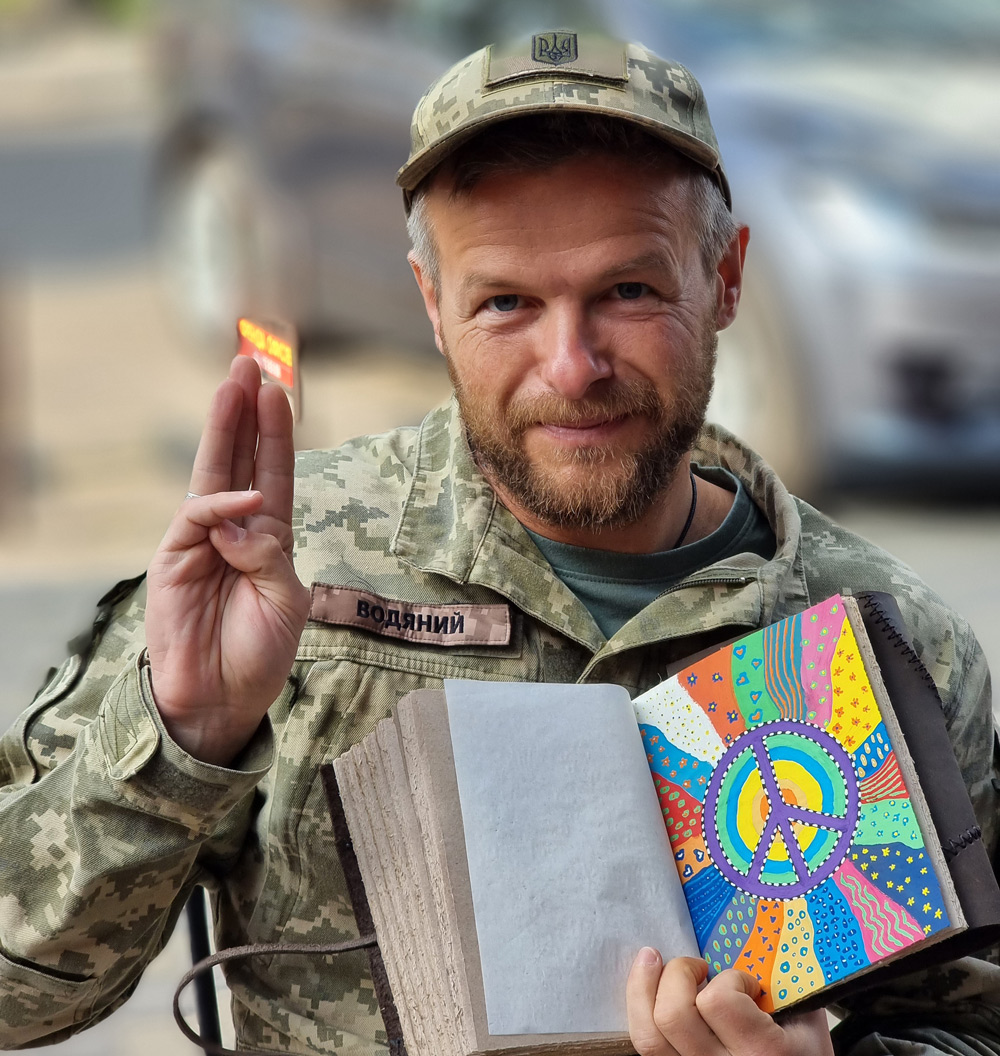
Photo credit: Artem Chapeye’s personal archive
The Pacifist Writer
Artem Chapeye, a writer and translator with strong anarchist leanings, had never hidden his pacifism. He translated Gandhi, wrote about nonviolent struggle, and denounced violence as a means of political change. “Within a few hours, on February 24, 2022, I realized that in cases like this, no petition would help, no hunger strike would help,” he said recently. What he has lived through over the past three and a half years has forced him to question the value of theoretical certainties.
His account begins on that morning of February 24, 2022, in Kyiv. “We woke up to the sound of explosions around us. We had already packed some bags because the government had warned us, but we didn’t believe it was possible. We didn’t believe there would be an invasion of a country with IKEA and McDonald’s.” His family fled the country in haste; he stayed behind.
The first to enlist were ordinary people – workers, drivers, farmers. As an anarchist and a leftist, I didn’t want to use my privilege to avoid what they were doing. To say, ‘I’m a writer, a translator, therefore I’m different.’ No. We are all equal.
He had no previous military experience. “The main reason I joined was to be with the people.” From this experience came his short book “Ordinary People Don’t Carry Machine Guns”, published in Ukrainian, English, and French. “It’s exactly about that: that no one was born for war, that all of us who fight didn’t want it, and still don’t. It was forced upon us by the invasion.”
He recalls his early feelings: he thought the war would be brief. “I was thinking about Finland when Stalin attacked and three months later, there were negotiations. I imagined it would last two or three months. I joined the army with my passport in my pocket. If we lost, I would have to leave. And yet, three and a half years later, we are still here.”
International support is vital, but he sees it differently. “We are grateful to those who support us. But we’re not fighting on anyone’s behalf. We are fighting for our independence. This is an existential threat. We do not want to go back under Russian rule.” He recalls Ukraine’s history, “We were a colony of the Russian Empire. And the Soviet Union was a colonial empire too, with prisons and torture. We are talking about millions of victims, about the famine of 1932–33, which has been recognized as genocide. We don’t want to go back.”
The war experience has changed him. “I give more importance to what people do, not what they say. I can feel closer to soldiers with completely different political views than to like-minded people who make different existential choices.” He admits that, though an atheist, he’s seen the strength others draw from religion. “That faith empowered them.” He also speaks of women: “I became even more of a feminist than I already was. I saw how many women enlisted, some with children. All volunteers.”
He describes the mosaic of his comrades, who became close friends despite coming from entirely different backgrounds: “A carpenter who had worked as a migrant in Finland and came back. Another, uneducated but ‘instinctively’ anarchist, who said he hated all governments but enlisted so he wouldn’t despise himself. A devout Catholic who consulted his priest before joining – he told him that protecting others is a virtue. A vegan paratrooper who still keeps to his diet. And a former convict who learned five languages in prisons across different countries and enlisted because he saw it as a matter of honor.” Not all have survived: “Some died; one had a heart attack at the front.” But to Chapeye, they all represent people who “were not born for war but were forced to fight it.”
He stresses that today’s Ukrainian army is not made up of teenagers. “Most are between 25 and 55. At 40, I’m the average. That changes the mentality: you can’t yell at a 40-year-old like in an American movie. Ukrainian traditions are closer to the Cossacks, fighters who were already mature men with experience.” For him, the point is clear: resistance to the invasion is a struggle for survival, identity, and independence.
If we surrender, we will lose much more. And if we accept it, in one or two generations Russia will even convince some Ukrainians that we are ‘one people.’ That’s what we don’t want to happen. We prefer to fight.
War has changed his outlook. “Now I care more about what people do than what they say. I can feel closer to soldiers with completely different political views than to like-minded people who make different existential choices. Sartre said that man is the sum of his actions. I understand that now.”
His criticism extends to the international anarchist community, to which he himself belongs. He doesn’t hide his disappointment at the passivity of some comrades in Europe. “Theory without action has no value. Here the stake is survival,” he says, stressing that the war has reinforced his conviction that true action lies in the choice to stand beside one’s fellow human beings.
“What most of war feels like is something between boredom and depression. Only on rare occasions does something happen, and usually it’s something bad and you wish to return to boredom and depression,” he says, when asked what war looks like. “Routine, routine, routine – and tragedy. Then back to routine.”
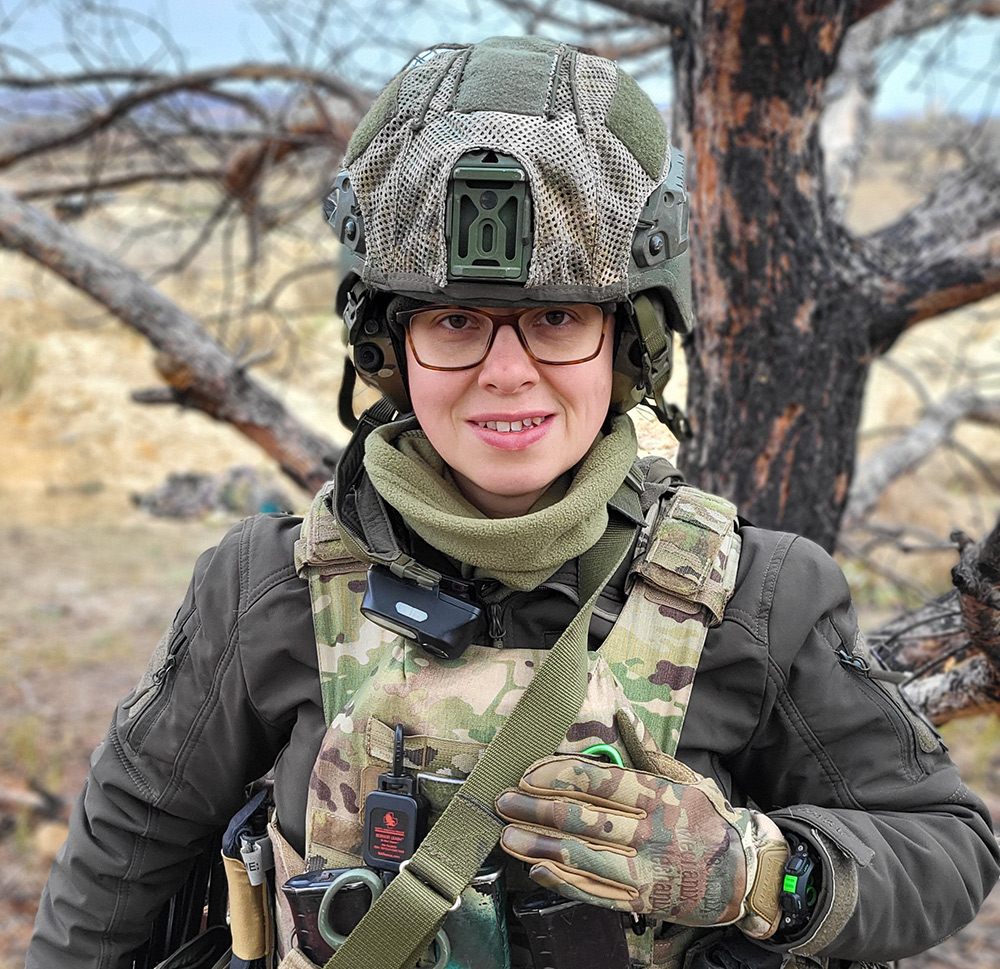
Photo credit: Yelyzaveta Zharikova’s personal archive
A Poet on the Front Line
Yelyzaveta Zharikova, a poet and songwriter from Luhansk, also belongs to the generation that experienced independence as a promise and war as a threat. Before the invasion, she lived in Kyiv teaching Ukrainian language and literature, playing in the band Pororoka, and writing poems and music.
She took part in competitions, and was published in anthologies. “In 2013–2014, I participated in the Revolution of Dignity, and when the war in the east began, I wanted to join the army, but I didn’t meet the health and fitness criteria. I didn’t make enough effort back then – I didn’t train, I devoted myself to my peaceful life. Later I regretted it. But all those years I supported the army through volunteers, mainly in tactical medicine.”
Her decision to enlist came just before the full-scale invasion. “I had attended pre-hospital care seminars and signed a reservist contract with the Territorial Defense, but I hadn’t finished all the exams. I got the last paper on February 23. Thanks to those documents, they accepted me without hesitation, even though I was a young woman with no military experience. For a few days I helped with paperwork, and then the commander asked who had attended medical seminars. I had enough certificates, so I became a combat medic.”
She chose the army after assessing her skills and abilities. “In the event of occupation, I wouldn’t be able to conduct effective guerrilla warfare. But within the regular forces, I could do my share of the work.”
She served mainly on the Bakhmut front. In the summer of 2023, she was wounded during a counteroffensive – first by mortars, then by a drone. After treatment, she returned, but was wounded again and needed surgery. Since then, she has supported her unit in evacuations and now works in administrative duties. “A lot of work, hardly any days off.”
Creation remains part of her life. She learned to play the kalimba, a small instrument she could take to the front line. She writes poetry, music, and now prose.
There are many artists in the Ukrainian army, because we know that if Russia comes here, the first people it will kill are those who can think and resist.
And she adds: “In the 20th century, many waves of Ukrainian intellectuals were persecuted. Their only ‘crime’ was writing in Ukrainian, writing freely without censorship, staging avant-garde plays, composing music that became known abroad. That’s why this war is also an instinct of self-preservation.”
She recalls her childhood in eastern Ukraine. “I heard Russian propaganda saying ‘Russia will come to liberate you.’ I didn’t understand from what – I laughed. Now I know it was part of a long-term plan.” For her, resistance is instinctive survival: “We must resist, no matter how tired, exhausted, or burdened with internal problems we are. We must defend our freedom – even the freedom to create art.”
RELATED: Poet and soldier Liza Zharikova: Ideally, my collection should be presented while I’m still alive
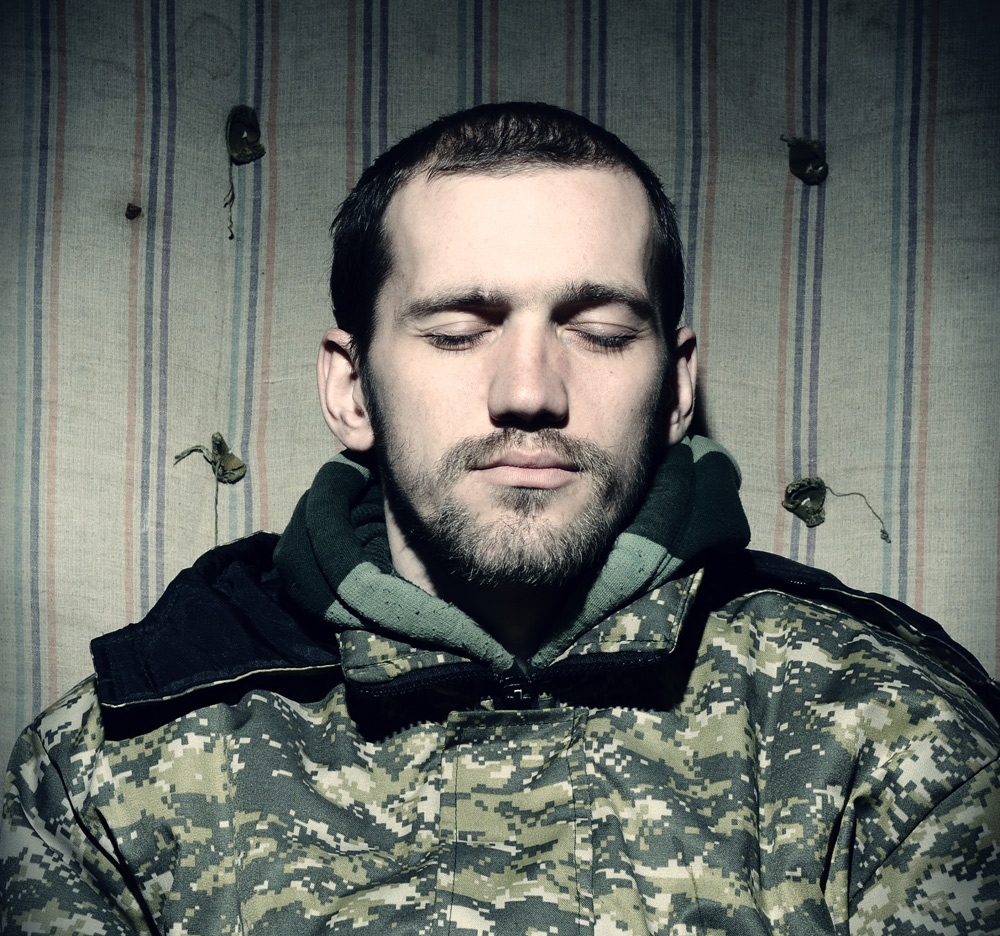
Photo credit: Valeriy Puzik’s personal archive
The Writer of Moments Worth Remembering
Valeriy Puzik is a multimedia artist: a writer, visual artist, and filmmaker. His path to the front began with the Maidan uprising. “On January 21, 2014, I was hit by a rubber bullet in the chin on Hrushevsky Street. For me, that was the day the war began.” He stresses that it was already clear then that Ukraine was entering a conflict “where everything would be decided by determination and violence.”
In 2015, he went to the Donbas war as a volunteer. With his comrades, he filmed the documentary “Peremyria” (“Truce”, 2015), which captures the February 15 ceasefire that year through images of a devastated landscape. The film won an award at the “86” festival. At the same time, he wrote novellas, short stories, and testimonies. His collection of short stories “Monolith” (2018) also won awards, “Stray Dogs” (2018) continued the same trajectory, while his literary voice remained bound to the war experience.
When the full-scale invasion broke out in February 2022, Puzik was in Odesa. “I put my family on a train to Khmelnytskyi, where my parents live. About a week later, I was volunteering with the 122nd Territorial Defense Brigade, and in early March, I joined the 126th Brigade. On March 14 we took the oath.” He remembers the scene outside the recruitment offices: “The lines were huge. People waited three or four days. You couldn’t even get close to the door. I never expected that.” For him, the decision was self-evident:
I had to protect my home, my city, my street, my family. That’s why I stayed.
From November 2022 to April 2023, Puzik kept notes of his experience in Kherson. “Every day I recorded moments that were worth keeping. That’s how ‘Hunters of Happiness’ was born. They were just notes that later became a book.” He disagrees with the idea that it takes ten or fifteen years of distance to write meaningfully about war. “Experiences must be recorded immediately, while the traces are still warm.”
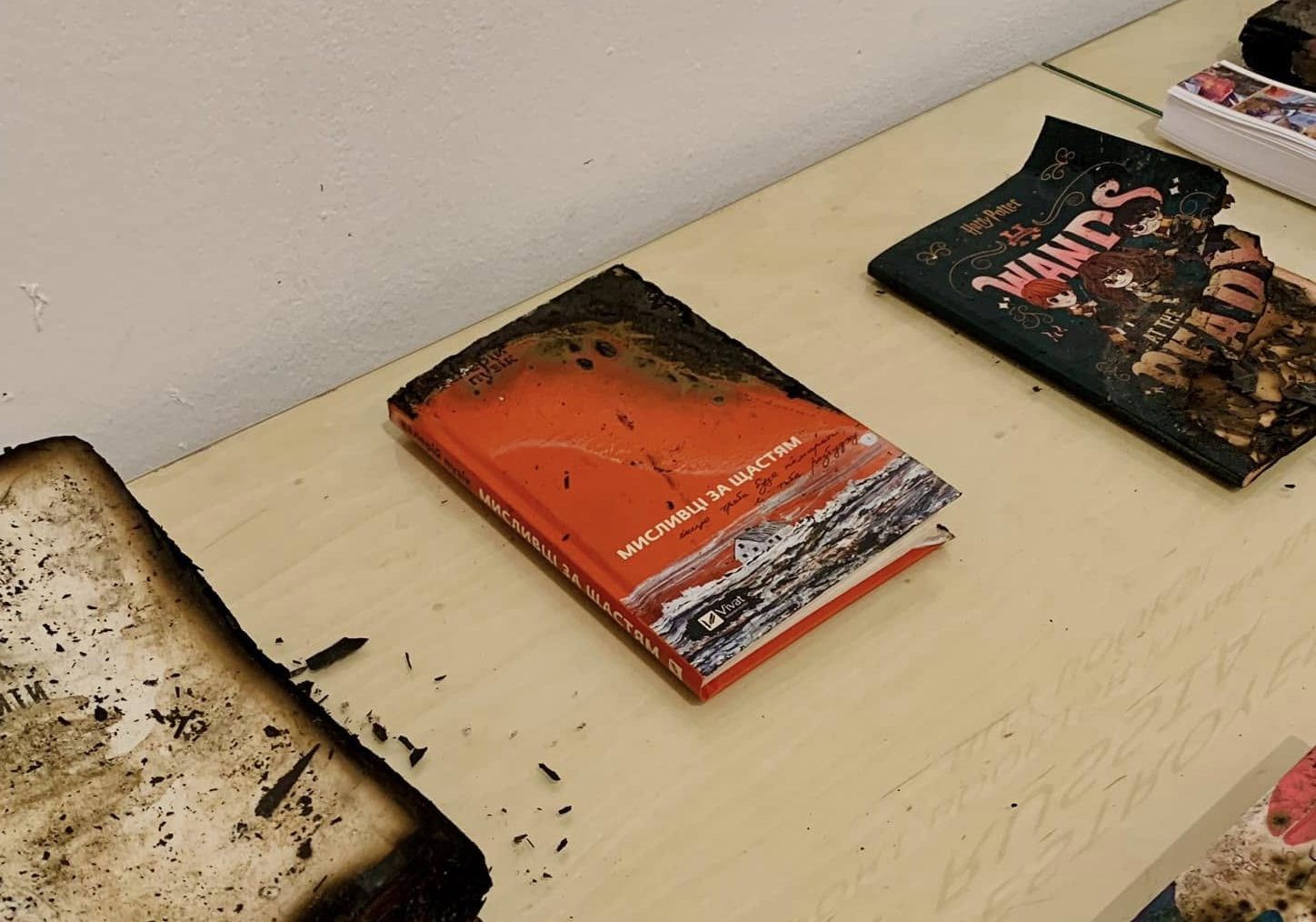
A copy of “Hunters of Happiness” by Valeriy Puzik that survived the Russian strike on the Factor Druk printing house. The book’s first print run was destroyed in May 2024. Photo: Ukrainian Book Institute
His first contact with the front was in 2015. “When I got there, I had to leave the urban part of myself behind. You realize you can be killed, and you start thinking about what you’ll leave behind.” In training, he found colored markers. “I started sketching my comrades. They were like portraits; they took them and were happy.” For about three weeks he was in DUK-Info, the information unit of the Volunteer Corps. “We collected information, made short videos, wrote texts. I had a small notebook, my own observation diary. It helped me organize the world around me.”
That year, he served with Maksym Kryvtsov in the 5th battalion of the Volunteer Corps, in a position near Avdiivka. “We had met in 2015 at a literary school. Maksym had already been with the Volunteer Corps since 2014. We stayed in touch while he was at the front, and I realized I had to go too.” His path to war was not straightforward. “On January 6, 2015, I went for training. I remember the date. I had previously failed to join another battalion and failed my entrance exams at film school in the summer of 2014. In November, I called the Volunteer Corps, and a few months later they called me.”
The loss of comrades has marked how he sees and writes. “When I learned that Maksym Kryvtsov had been killed, I felt that reality was shrinking. You looked at his last posts ‘20 hours ago’ and then nothing. It was a period of disappointment. I had insomnia; at night I gathered his notes and copied them, in the morning I started duty in the unit.” He sums it up simply: “The worst thing is to see the graves of your comrades. It’s better to go there when the war is over or when you no longer have to return to the front line.”
He now serves in Odesa, where his daily life alternates between office duties and artistic creation: writing, painting on ammunition boxes, and making videos to support morale.
Copy editing: Terra Friedman King
The publication was prepared within the framework of the “Cultural Journalism Exchange (Greece Edition)” project, supported by the European Union under the House of Europe program. The article was originally published in the Kathimerini newspaper in Greek.

This publication is sponsored by the Chytomo’s Patreon community