* ESC - close the search window
fixed retail prices
Book sales fall 10% after Hungary implements fixed pricing policy
24.10.2025


You see an error in the text - select the fragment and press Ctrl + Enter
After the introduction of fixed retail prices for books in Hungary, sales in the book market fell by approximately 8-10%, according to the Hungarian Publishers’ and Booksellers’ Association (MKKE).
Prior to the law’s passage in 2023, the Hungarian book market increased by 8% compared to 2022, according to data collected by MKKE. At that time, 15,866 book titles were published with a total circulation of 36.8 million copies. On average, this comes to 2,320 copies per title. Sales amounted to €163.5 million, which is 8% more than in 2022.
The inflation rate in 2023 was 17–18%, while book prices rose only by about 10%.
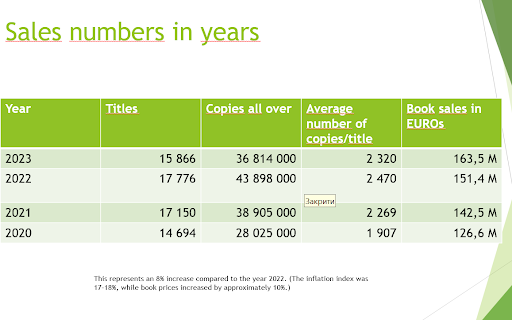
(This data came from voluntary reports by publishers and book distributors that were both members and non-members of MKKE. The collection of similar voluntarily reported sales data for 2024 remains incomplete. Textbooks for public schools were excluded from the survey because the market was fully nationalized, and students began receiving textbooks free of charge in 2012.)
In 2024, after the law on fixed book prices came into force (which limited the ability of retailers to offer discounts), consumer demand fell. Independent bookstores were hit hardest, while larger chains were able to partially offset their losses thanks to their vertically integrated structure.
According to the association, even with an increase in sales, high inflation and administrative restrictions (in particular, fixed prices) reduced the real volume of the market. Preliminary figures showed an approximate 8% increase in revenue, despite an 8% decline in the number of copies sold. Publishing costs increased by 10-15%.
The fixed price law was aimed at supporting small bookstores and ensuring a level playing field for all market participants. However, representatives of large publishing houses and retail chains noted that this step has led to a short-term decline in sales and has made it more difficult to conduct marketing campaigns.
In her comment to Chytomo, Eszter Balazs, deputy publishing director of Central Publishing Group, noted that since Hungary’s fixed book price law was introduced just a year ago, it’s still too early to draw firm conclusions. “As a publisher, we mostly have questions and concerns at this stage. The industry has been advocating for fixed pricing for over a decade, primarily to protect authors and books from unrealistic discounts.
“Unfortunately, the legislation was passed without meaningful professional consultation or clear implementation guidelines, which has led to a lot of confusion in day-to-day operations. Moreover, the law affects not just direct discounts but also things like coupons, loyalty points, pre-orders, and gifts. According to the current rules, only up to a 10% discount is allowed during the first 12 months after a book’s release. This puts smaller publishers at a disadvantage: previously, loyal readers would often buy directly from them because they could offer slightly better deals. Now, with major retailers also allowed to offer 10% off, customers tend to order from the big players online and pick up the book in-store—rather than paying the same price plus shipping from an independent publisher.”
As Balazs pointed out, if they cover the shipping themselves, they lose out on revenue—which again, only impacts smaller players, not the large distributors. Ironically, by eliminating price competition, the law ends up hurting independent publishers and booksellers the most.

“It is ironic that, by removing price competition, the law most negatively impacts independent publishers and booksellers. So far, it seems the regulation has mostly led to a more concentrated market and further discouraged the publication of niche titles—ironically working against its original goal of promoting cultural diversity,” she said.
To make matters worse, because retailers are always looking for the next big thing the shelf life of new titles has shrunk to about three months. “If a book doesn’t take off quickly, we can’t stimulate interest later with promotions or keep it on shelves longer.”
Balazs’s presentation was part of the Special Programme for Publishers from Ukraine & Neighbouring Countries at the Frankfurt Book Fair, organized to promote the exchange of experience between countries in Central and Eastern Europe.
RELATED: László Krasznahorkai’s publisher sold more books in a week than in a year
Main image: László Katona/ Óbudai Anzix
Images: Forbes in Hungary
Copy editing: Ben Angel
Читомо» — це медіа про книжки й літературу, що підтримувало українське книговидання задовго до того, як це стало трендом. Ставайте частиною історії — доєднуйтеся до Клубу Читомо!