* ESC - close the search window
Laboratoria publishing house
Publisher at war: ‘We used to study how to think. Now, we study how to feel and live’
30.01.2026

You see an error in the text - select the fragment and press Ctrl + Enter
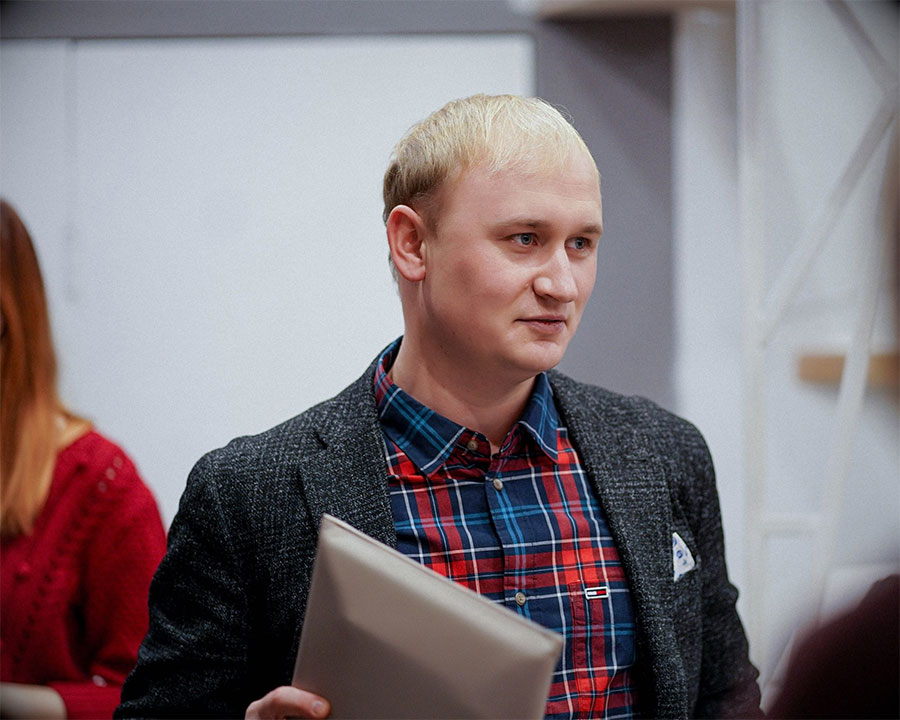
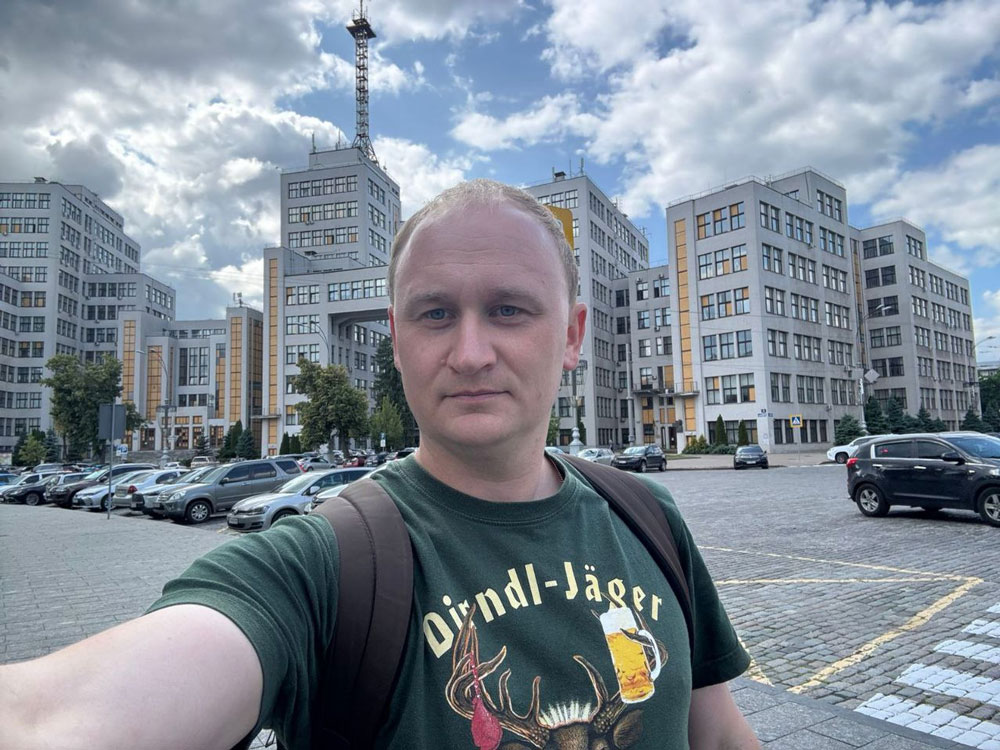
Anton Martynov is the founder of the Laboratoria publishing house and the Librarius digital platform, which has become a hub for creating audiobooks in Ukraine. Martynov serves in the Armed Forces of Ukraine, yet never moves far from the world of books. In 2024, Martynov was one of the winners of the Chytomo Award, and this year he will assess the nominees as a member of the jury. Martynov knows what the market is like, how the audiobook market is developing in Ukraine, a qualitatively new audience is emerging, and how to spot a bestseller and an author destined for the Forbes Ukraine rich list.
We discussed the golden decade of audiobooks, and how opportunities for Ukrainian nonfiction abroad have changed, why informal book clubs are needed, and whether it is worth publishing books in Ukraine by English-language authors in their original language. Most importantly, we talked about where we are heading and the steps needed to survive the crisis.
Iryna Baturevych: First of all, how are you doing? How do you manage to handle both your military service and the book business right now?
Anton Martynov: I can definitely say I live in two parallel worlds: the world of books, ideas, and meaning, and the world of war, where meaning is tested by action. These areas might seem to be incompatible, and yet over time they have begun to reinforce each other. In the Ukrainian modern army, where I have the honor to be serving, you learn clarity in communications, goals, decisions. This affects you and your business when you finally have time to immerse yourself in the book market. Literature gives you energy and reminds you why you are doing things you are doing.
Iryna Baturevych: Which transferable skills helped you endure such drastic changes? I assume that neither the exercises from “A Handbook for New Stoics: How to Thrive in a World Out of Your Control — 52 Week-By-Week Lessons” by Massimo Pigliucci and Gregory Lopez, nor the inspiration from books about Winston Churchill or diplomacy, could withstand such a reality.
Anton Martynov: This involves three things:
Analytical thinking — the ability to structure chaos, even when it is physical, to focus on the main thing, separating the wheat from the chaff. Teamwork — in business and in war, those who know how to trust and delegate survive. Discipline — not as an abstract virtue, but as the ability to get up every morning and do your part of the important work, even when you are not in the mood.
Books about Churchill or stoicism have not lost their meaning. They have simply been tested by reality. If I used to read them to understand how to act, now I act to understand what they are really about.
Iryna Baturevych: War is best not experienced at all. It will end, and you will return to being a publisher; well, maybe not just a publisher, but no longer a soldier. What have you learned in the service, and what have you brought, or would you like to bring, to the world of book publishing?
Anton Martynov: I’ve learned that war accelerates everything, leaving no space for excess in actions, people, or meaning. The most important thing perhaps is to see things more simply and act more precisely. Each day on duty is a lesson in responsibility because every decision you make has direct consequences.
To the book publishing sphere I would like to bring this sense of the real weight of every decision; as well as respect for people who do their job well, without pomp, without seeking heroism, and who do it every day. In the military and in publishing, capable people are the real strength of the system.
In business, as in the military, everything must work smoothly, everyone must know their task, and most importantly, have a common goal that gives them the energy to act.

Iryna Baturevych: You were selected as the market trendsetter by the Chytomo Award jury last year. I completely understand why, because I have always associated you, first of all, with a person who knows how to ask the right questions, and secondly, with innovation. At the same time, I increasingly hear from our foreign partners in the industry that they feel the book business and books as a format are “rudimentary.” Do you believe in the future of this business? Are you one of those people who are devoted to the mission of culture and education?
Anton Martynov: I don’t see books as objects. I believe in their power to shape thought.
The format may change (paper, screen, audio), but the very fact that a person finds the time to transform text into images through thinking and to comprehend it is perhaps one of the last forms of human dignity. Even if the book becomes something else over time, its essential character remains the same.
I am not romanticizing the industry because it has rudimentary features such as slow processes, outdated distribution models, dependence on physical goods. On the other hand, the challenge is to rethink the book as a service, not just as an object. We live in an era when reading is not just the consumption of text, but part of a broader cultural infrastructure: education, self-identification, social dialogue.
I am not one who is devoted to a mission, but rather one who sees the mission as a practical strategy for culture’s survival. Without culture, we are nothing more than reactive biological beings. Books reconnect us with thinking itself. If the market can’t sustain that, society certainly can’t.
Iryna Baturevych: At professional events in many countries, people keep pointing out that the audiobook segment is growing at a fantastic pace. How do you feel about the Ukrainian market? Is it true that Ukrainians are starting to listen to audiobooks more?
Anton Martynov: So true. Ukrainians are listening to more and more audiobooks, and this is not just a trend, but a deeper change in cultural behavior. The outbreak of the full-scale invasion, relocation, and constant mobility have all made audio a more convenient way to stay connected and remain close to culture. People want to feel part of intellectual life, even when physically sitting and holding a book in their hands is not an option.
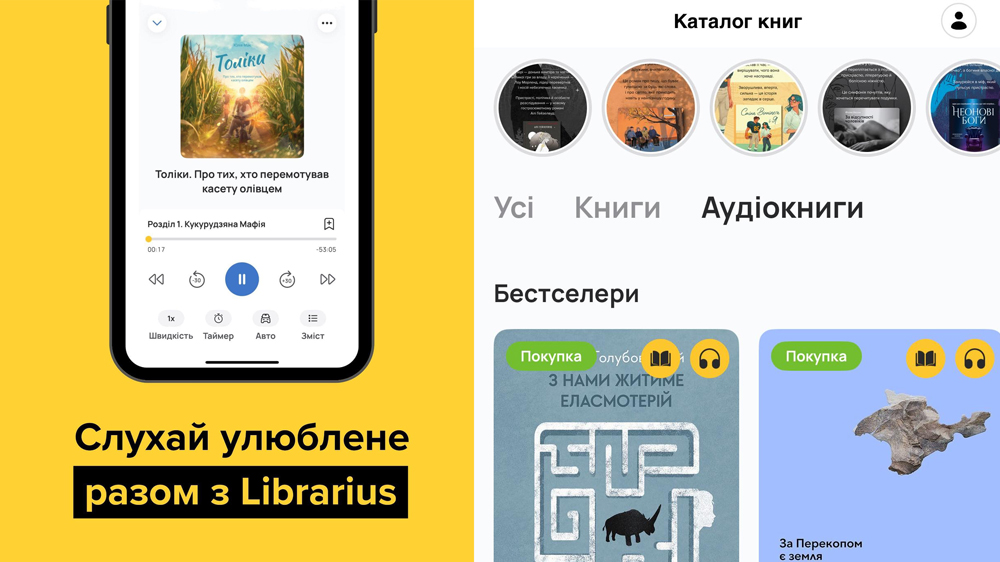
At Librarius, we see that demand for audio is now growing many times faster than for e-books. Not just students who listen, but also military personnel, drivers, mothers with children, and entrepreneurs. Even more so, this format breaks through the barrier of someone saying “I don’t have time to read.” After all, you can listen anywhere, especially since Librarius has an offline mode: download the audio to your phone, and you don’t need an Internet connection.
In addition, audio is a different dimension of the book-reading experience: paper requires silence and concentration, while audio invites movement, presence, and energy. We are now in the golden decade of audio content, and the main thing is not to miss the moment. The habit of listening to Ukrainian content is being formed right now. If we don’t keep the pace, the market will return to its old ways (the dominance of Russian imports in Ukraine before 2014, which led to “cognitive occupation” —the pervasive influence of Russian language and culture on Ukrainian society — Ed.). That is why it is essential for publishers to dedicate resources to creating audiobooks and expanding their Ukrainian-language book catalogs.
Iryna Baturevych: How many audiobooks and electronic titles are there in the Librarius catalog now?
Anton Martynov: As of now, the Librarius catalog contains over 70,000 titles. Of these, there are about 300 audiobooks and 71,000 e-books. We partner with all leading Ukrainian publishers and authors, guided by a simple principle: Librarius isn’t just a service, it’s a shared ecosystem for the whole book industry.
Librarius was born not from the idea of making an app, but from the idea of creating a space where culture and business do not contradict each other. This is probably the most valuable thing we have right now.
Iryna Baturevych: Two years ago, in one of your interviews, you mentioned that the book business, compared to other spheres, is peanuts. Obviously, you can’t compare this market to, say, the real estate market, but if you compare the market to itself in retrospect and to other creative industries, do you see an opportunity for growth through the e-book and audiobook segment, at least to the level of a peanut patch? Especially given that, according to various estimates, we have lost between six and eight million potential readers.
Anton Martynov: Yes, peanuts, but these are our peanuts. In our context, it’s essential to look beyond size and also consider movement and growth. In absolute terms, the book market remains small, estimated at between €100 million and €200 million. If we look at its evolution, we still have a chance to create not just a market, but an industry with a technological core.
After all, we have a potential market of 30-40 million Ukrainian speakers around the world. This gives us an opportunity that we could miss. Yet the war forces the question to be asked directly. Millions of people understand the importance of cultivating culture across all its dimensions, and I believe that together we will build a strong industry in the next few decades, reaching market volumes comparable to those of our neighbors.
E- and audiobooks go beyond mere formats as they mark a move toward a cultural service model. A book’s journey doesn’t stop at the cash register; it starts as soon as a person engages with it. This opens up new income opportunities: subscriptions, tailored recommendations, library offerings, and corporate licenses — each forming a unique track for Librarius’ development and marketing efforts.
We have lost millions of potential readers, it is true. Some due to emigration, some — due to the war. But in return, a new quality of audience has emerged. These people read not because they have to, but to maintain their sanity. That is more valuable than mere quantity.
We will surely have our own peanut patch if we can combine cultural motivation with technological thinking. The book business will not grow to reach the scale of the IT sphere, but it can become its cultural partner, creating narratives that technology then spreads.
Iryna Baturevych: People continually discuss how AI could remove all barriers to time-consuming and costly production. I personally find it hard to believe that books read aloud by AI will fly off the shelves. Does artificial intelligence justify itself in this case?
Anton Martynov: Artificial intelligence has already altered the game, but not by replacing humans. It makes routine tasks easier, yet it cannot generate emotion. We tested several voice synthesis systems on recordings of some texts: they sound clear, literate, and sometimes even with the correct intonation. But a book is not just sound, it is presence. People listen not to text, but to a living story.
Practically speaking, AI voiceovers demand continual reworking of accents and tones, which is neither time-efficient nor financially viable. Often, if we are talking not about a robotic voice, but a more lively one, the tone changes in many AI systems. Therefore, it is often necessary to rewrite the recording. While short stories remain suitable for experimentation, we currently see little value in doing so with novellas or novels.
Iryna Baturevych: Okay. Where does expansion occur, and where do obstacles lie?
Anton Martynov: Expansion occurs in hybrid formats. AI helps directors and sound engineers work with large amounts of material, automatically removing noise, etc. This opens the way to more projects without losing quality.

The obstacles lie in the desire to have it done cheaply. When the market begins to replace content with seemingly convenient imitations, it degrades. Culture needs a human touch, even if it is supported by technology.
We need to learn how to use AI so that it is an aid to culture, not a substitute for it.
Iryna Baturevych: An interesting trend has been recently revealed by TikTok: people in Ukraine follow English-speaking authors (for some reason, these are mostly women) and want to be the first to read their books in English. They want to quote the books so that the authors can see them too. They don’t want to wait for the book to come out in Ukrainian and they order the book from the UK directly, for example. Do you see any potential in buying the rights to English-language books for Ukraine?
Anton Martynov: We see this trend, and it shows that Ukrainian readers are becoming part of the global conversation. People want to engage with content instantly, without waiting for translations, and feel part of the global scene here and now. That’s great. And that is a sign of audience maturity. As a publisher, I view this as two directions developing simultaneously.
The first is the growing demand for English-language content in Ukraine, a trend that is real and will continue. This is not a threat to Ukrainian books, but a challenge for us: how can we ensure that translations are published simultaneously or almost simultaneously, with the release of the original books? If our market keeps pace with the rest of the world, Ukrainians will not need to turn to Amazon or Waterstones.
When we created the Laboratoria, we started working on publishing books simultaneously with the original, but the full-scale invasion had a major impact on our publishing timeline due to team relocations, power outages, and similar challenges, but we anticipate resuming this pace at the end of 2026.
The second is the potential for importing rights to English-language publications. Librarius is already looking in this direction: the opportunity to sell e- and audiobooks in English legally in Ukraine is a clearly defined and viable segment. There are Ukrainians who think in two languages, and they want to consume content without intermediaries which means we could create a “meeting point”: a Ukrainian service where English-language books are legally available, with Ukrainian service and a Ukrainian user experience. This task is challenging to carry out. It requires negotiations at the highest level with international players, but there are certain nuances inherent to a country defending itself during a full-scale invasion.
It is cultural autonomy, not competition between languages. Strategically, we should not fight against English-language books, but rather ensure that Ukrainian readers can read the world through their own ecosystem.
If we succeed, Librarius will become not just a Ukrainian app, but a bridge between cultures, a space where Ukrainians don’t wait for translations, but read and live within the global context while staying true to themselves.
Iryna Baturevych: Let’s talk about selling rights abroad. What books have already been sold abroad, and how did you manage to achieve this?
Anton Martynov: We started actively working with export rights relatively recently, but we are already seeing results.
To date, the Laboratoria has secured several successful rights deals.
Rights have already been sold in nine languages: English, German, Czech, Korean, Latvian, Lithuanian, Polish, Slovak, and Armenian. We hope to soon add Spanish and French. Anastasia Levkova’s “Za Perekopom ye zemlya” (There Is Land Beyond Perekop) will be published in five languages: English, German, Polish, Armenian, and Slovak. Three or four of these contracts, I believe, are part of the Ukrainian Book Institute’s program to support translations from Ukrainian into other languages.
In the second cycle of the Book Arsenal project, together with Connecting Emerging Literary Artists (CELA), our author Olena Pshenychna was selected as one of three Ukrainian writers whose works will be translated into 10 European languages by participants from other national teams: Spain, Italy, the Czech Republic, Poland, the Netherlands, Serbia, Slovenia, Romania, Bulgaria, and Belgium.
Interest in Ukrainian books peaked during the spring and summer of 2022, right after the outbreak of the full-scale invasion. We, as an industry, were not ready to respond to the demand. Currently, interest in Ukrainian content around the world is growing gradually and rather slowly. It seems that the military and diplomats are currently promoting Ukrainian literature around the world more strongly than the entire book publishing industry.
Iryna Baturevych: I remember that at one of the international professional exhibitions, we talked about the lack of interest in Ukrainian nonfiction because it is an experience that cannot be exported. It appears now that contemporary Ukrainian nonfiction offers a chance to look into Europe’s future, and these are books that deserve to be sold internationally. Have you changed your opinion on the topic?
Anton Martynov: Both my opinion and the reality have changed. A few years ago, I believed that Ukrainian nonfiction was primarily a domestic experience that was difficult to translate into other languages. At that time, we were still forming our narrative, we did not have a stable tradition of essay writing, and most of the texts were reactive (war, crisis, and trauma). These topics were important, but not always exportable.
Now it seems that Ukrainian nonfiction is becoming not just a reaction, but a reflection. We have started writing not about what happened, but about what it means. And that is a universal thing. A part of Europe looks at us with indifference, while others view us as a laboratory of the future, a society experiencing changes that others will face later: a crisis of trust, shifting elites, and a search for meaning in an age of information overload.
Ukrainian texts today are truly the European tomorrow reflected in the Ukrainian present. So yes, I admit I was wrong. Ukrainian nonfiction can and should go global. But to do so, we need to break the habit of explaining ourselves to the world and start talking about the world from a Ukrainian perspective. Then people will read Ukrainian books and about Ukraine, not because they feel sorry for us, but because they are genuinely interested.
Iryna Baturevych: At Laboratoria, you have shifted from focusing primarily on nonfiction to becoming a more general publisher, with increased attention to Ukrainian fiction writers. Why?
Anton Martynov: It came naturally. When we started, I wanted to give Ukrainian readers the tools to understand the world and nonfiction was the perfect option: books on leadership, thinking, organizational development, philosophy, and history. Over time, I saw that there were already enough tools, but there was a lack of meaning, something to help people live, understand themselves, and feel. So we added fiction.
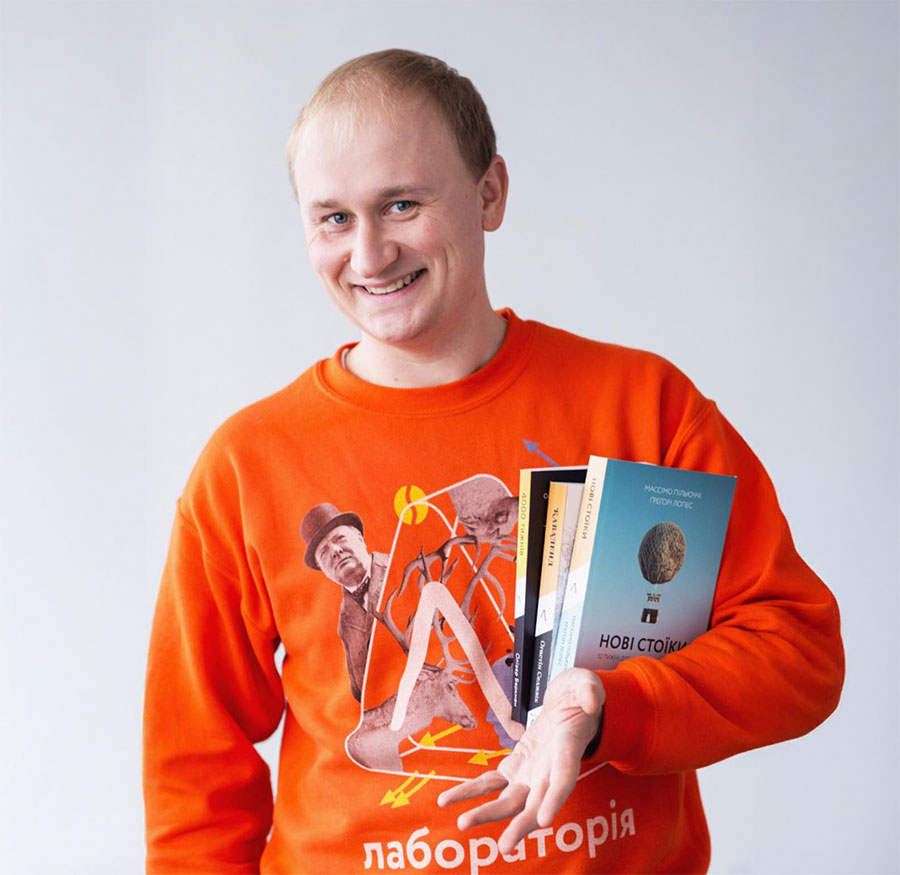
In 2022, we began supporting local authors and, over time, have created a collection of nearly one hundred books by Ukrainian writers. We also plan to continue growing this collection.
Today, we all live in a situation where reality is too complex for straightforward language. Sometimes a work of fiction can tell the truth more accurately than a historical document. Ukrainian authors now possess a unique experience that encompasses not only pain but also transformation and depth. This is important not just for us; it has universal resonance.
Therefore, we are not abandoning nonfiction, but expanding the field of perception. We have simply continued our logic. We used to study how to think. Now, we study how to feel and live.
We have also launched a manga series and have big plans for the development of this category of literature, although we are moving rather slowly so far.
RELATED: Conclusions without optimism: The Ukrainian book market in 2025
Iryna Baturevych: Publishers have recently been talking about a significant sales decline. Can you confirm? If true, why is this happening now, four years after the great shock of 2022?
Anton Martynov: The decline began at the end of 2024, and even though state support through the E-book program helped the industry withstand the onset of the crisis, the prolonged nature of the war has its consequences:
1. Reader fatigue and behavioral change. At the beginning of the full-scale invasion, there was an emotional surge: people sought books as a source of support, identity, and a way to connect with themselves and their country. Now that phase has passed, and readers have become more discerning and consume differently.
2. Decreased purchasing power. War, economic instability, inflation. All of this affects how much people can spend on books. Even if the desire is there, the opportunities may be fewer.
3. Shift in format and channel. Part of reading is shifting to digital formats (audio, e-books), while purchases at physical bookstores are declining. This changes the revenue model: print runs are decreasing, production costs are rising, and, accordingly, so is the price of books on bookstore shelves.
4. Market cycle and competition. While the war continues and everyone is working in stress mode, the book business also has to deal with logistics, printing, warehousing, and retail issues.
5. The industry is not isolated. Russian books have left a portion of the market. Ukrainian publishers have stepped into this vacated space and established their presence, but future growth will be more modest.
The market is entering a new phase. Where large publishers have resources and a good model, revenues may grow, but for many small publishers, this is a challenge: print runs are decreasing, margins are shrinking, and they need to change and adapt their business model. This is not just a challenge for publishers. It is also an opportunity to become one of the key players shaping the new normal: digital content, audio, special-format publications, and online reader communities.
Iryna Baturevych: Returning to your recognition as a Market Trendsetter, the jury’s statement was as follows: “For implementing best practices of creative business in publishing, changing the rules of the game in the book market through high-quality service and innovative approaches, as well as fostering significant partnerships.”
Do you know which rules of the game will need to change soon in order to establish and safeguard the national cultural market?
Anton Martynov: I think we will have to change not just one rule, but the very logic of the game. The Ukrainian cultural market grew on enthusiasm and volunteerism, and survived thanks to dedication. In order to establish itself, it needs to move from the emotional phase to the systemic one. And this will be the main transformation in the years ahead.
First, the shift from heroism to infrastructure. We need to establish normal economic conditions for culture: transparent sales data, standardized reporting, a system for protecting rights, and a broad network of libraries and bookstores in cities where books and culture are lacking. As long as culture relies solely on inspiration, it remains vulnerable to destruction.
Second, state policy must become partnership-based, not symbolic. Culture is not a social project but a strategic industry. If we want to have a strong cultural product, the state must think of it as an export category, not a subsidy.
Third, the market must become ethical internally. Without this, we will not survive. Respect for rights, fair competition, cooperation between publishers, translators, and platforms is essential. If we do not develop internal discipline ourselves, it will be imposed from the outside, and we will once again find ourselves subject to someone else’s rules.
Finally, we must learn to think in terms of ecosystems. Books, music, cinema, education, technology are not separate worlds, but a single cultural space. If we connect them within a system, the Ukrainian cultural market will become self-sufficient, not only protected.
Therefore, when people talk about changing the rules of the game, I am not thinking about revolution, but about evolving or becoming mature.
RELATED: In 2026, Ukrainian Publishers Association forecasts 30% rise in book prices
Translation: Iryna Savyuk
Copy editing: Sheri Liguori
Читомо» — це медіа про книжки й літературу, що підтримувало українське книговидання задовго до того, як це стало трендом. Ставайте частиною історії — доєднуйтеся до Клубу Читомо!
the more you read, the greater the possibilities