* ESC - close the search window
Holodomor
How the Ukrainian Press Bureau in London informed the West about the Holodomor
11.06.2026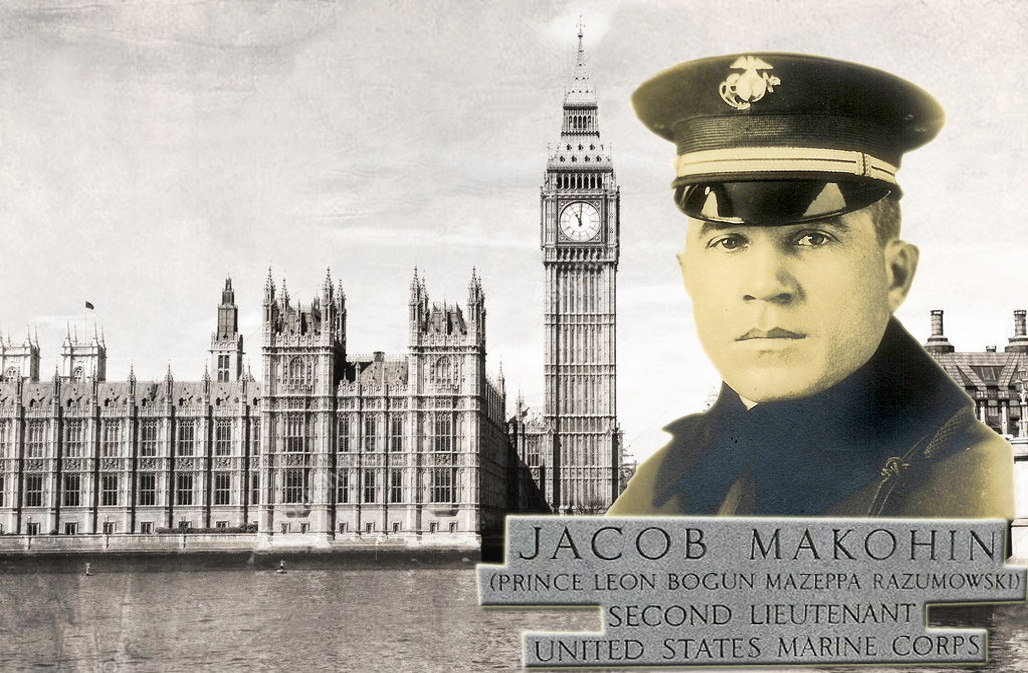
You see an error in the text - select the fragment and press Ctrl + Enter
How did the world learn about events in Ukraine, including the Holodomor, during the first half of the 20th century? Ukraine fully depended on Soviet authorities, and gaining international attention was difficult. However, many Ukrainians living abroad remained connected to their homeland, establishing cultural initiatives, movements, and institutions in countries around the world.
Established in Great Britain in March 1931, the Ukrainian Press Bureau operated until May 1940. Its founder, Yakiv (Jacob) Makohin, a patron, promoter, emigrant from Galicia, and U.S. citizen, created the organization to advance Ukrainian interests abroad. With offices in Geneva and Prague, the bureau served as a de facto Ukrainian embassy, helping bring the unresolved Ukrainian issue to the attention of Western audiences. In addition, it published books, collaborated with foreign journalists and British parliamentarians, and launched initiatives aimed at safeguarding Ukrainian communities around the world.
In his conversation with Chytomo, Mykola Tymoshyk, a Doctor of Philology, professor, and researcher of the history of Ukrainian book publishing, who has studied the archives of the Ukrainian Press Bureau, explains what we owe to this organization.
An unexpected discovery of a previously unknown archive in London
The Ukrainian Press Bureau in London during the 1930s, a hub of Ukrainian culture in Great Britain, remained unrecognized by its contemporaries. For a long time, it seemed that this important chapter in the press and media efforts of Ukrainians abroad, dedicated to advancing the Ukrainian issue in Europe and beyond, would remain unwritten.
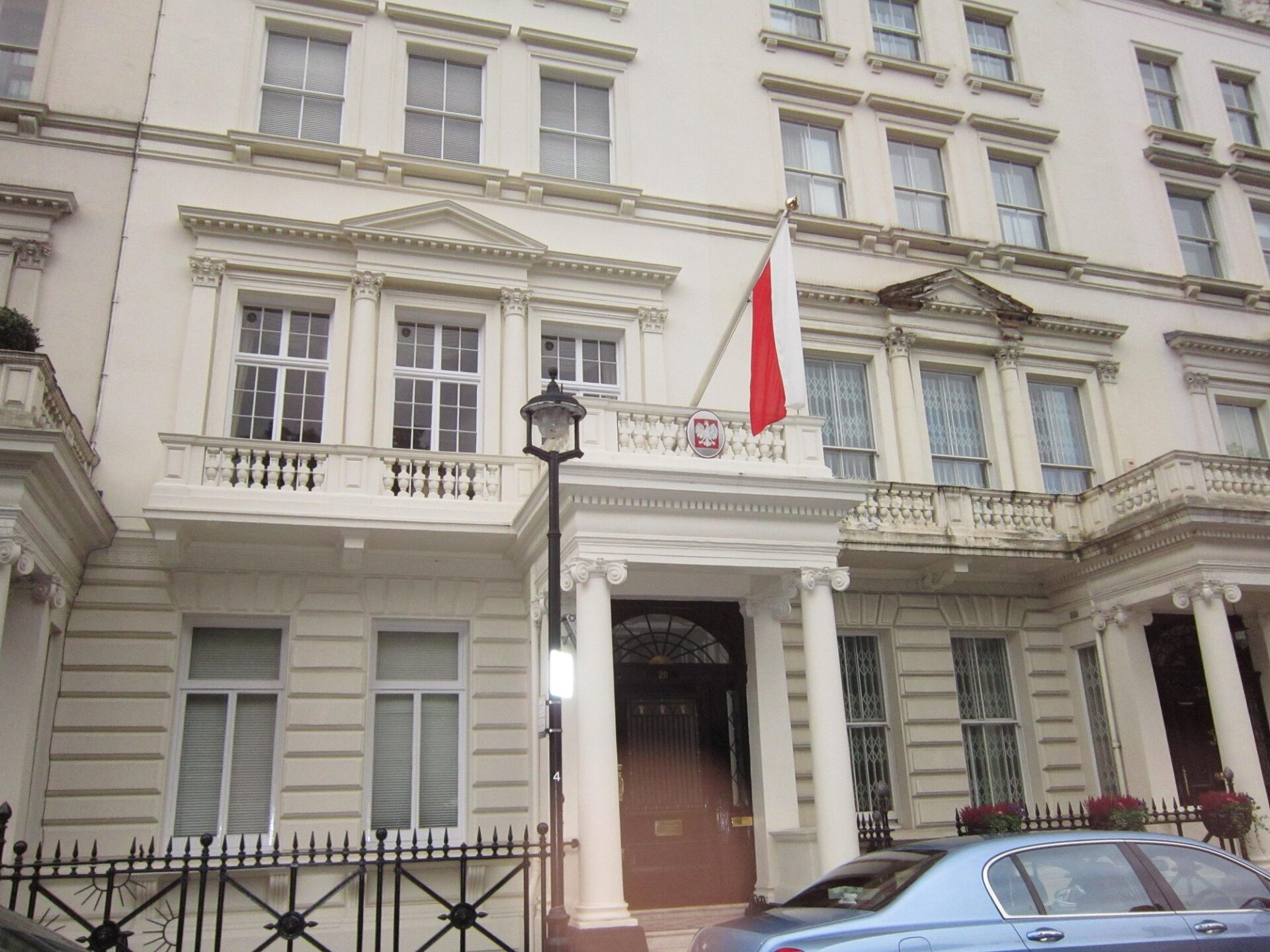
And now there’s an unexpected, almost sensational, discovery by scholars: during a recent research internship in the United Kingdom, the author of this article not only managed to uncover traces of the Ukrainian Press Bureau archive in London, but also became the first among Ukrainian and foreign researchers to study it. The unexpected discovery was that, for nearly 80 years, several boxes of archival documents of different sizes remained untouched — not in a well-known British library or archive, but in a private institution: the Polish Institute and Sikorski Museum in London.
The size and subject structure of the archive
The collection of Ukrainian documents at the Sikorski Museum in London is catalogued under number 433 and housed in more than 150 files, with each file containing between 20 and 200 pages.
Handwritten and typed materials related to the Bureau’s founding and activities — including references, reports, reviews, proclamations, appeals, official correspondence, and photographs — total 127 pages. The file is titled “Biura Ukraińskie: Założenia i Sprawozdania z Działalności. 1931–1939” (Kolekcja 433/2. Strony 1–107 + str. 108–127 (Ukrainian Bureaus: Founding Documents and Activity Reports, 1931–1939, Collection 433/2, pages 1–107 and 108–127)).
Over the last year and a half alone, the Bureau’s bank account received $7,000 from Makohin. These funds were used to cover all operational and administrative expenses. This did not include expenses for salaries, the administrator’s travel and trips, or financial assistance to public institutions in the diaspora and other charitable projects, as well as entertainment expenses related to the Bureau’s activities. Makohin paid all necessary amounts for these expense categories separately.
Separate folders contain the Bureau’s official correspondence with prominent Ukrainian figures. The significance of this section of the archive is that it includes copies of the Bureau’s dated responses attached to original letters. The most extensive correspondence in the files is with Yevhen Onatsky, totaling 60 pages, and with Sofiia Rusova, totaling 56 pages. Among other prominent figures in Ukrainian history whose letters to the Ukrainian Press Bureau in London and the responses to them have been preserved, I would highlight the following: Mykhailo Hrushevsky, Yevhen Konovalets, Volodymyr Kubiyovych, Isaac Mazepa, Roman Smal-Stotsky, Olena Kysilevska, Vasyl Koroliv-Staryi, Yurii Pelenskyi, Ihor Kedrovsky, Oleksandr Kolessa, and Mlada Lypovetska. A separate folder of documents is labeled “Hetman Skoropadsky.”
The background to the establishment of the Bureau, and its founder
March 25, 1931, marks the official opening of the Ukrainian Press Bureau in London. Thanks to personal connections with official circles in London, Makohin was able to quickly resolve the issue of acquiring premises in the central part of the British capital. The office address was 40 Grosvenor Place, London, S.W. 1, England.
In November 1931, Makohin established a branch of the Ukrainian Bureau in Geneva, and on January 1, 1932, he established a similar branch in Prague.
Given Makohin’s central role in establishing and organizing the activities of a Ukrainian émigré institution that remains little known in Ukrainian media history, as well as his leadership of other prominent Ukrainian initiatives abroad, it is useful to briefly examine key aspects of his life. Such a review is also warranted because the limited references to him published abroad by both foreign authors and members of the Ukrainian diaspora often contain incomplete and, at times, conflicting information.
Yakiv Makohin
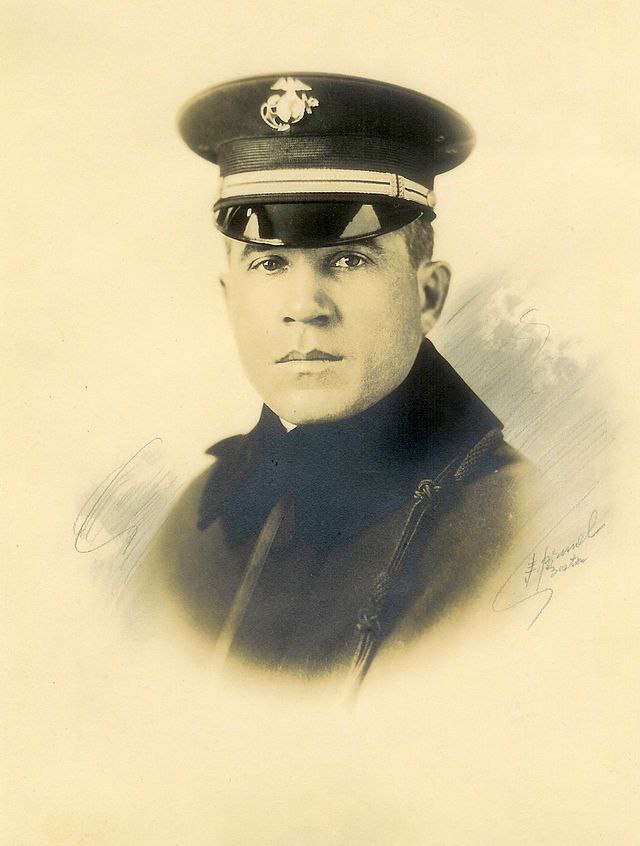
Makohin was born on September 27, 1880, in the village of Vyazova near Zhovkva. At age 23, he emigrated to the United States. After obtaining U.S. citizenship, he joined the Marine Corps, where he served for 15 years.
After his military service, he married Susanna Fallon, a wealthy American woman and the daughter of an American admiral. He managed not only to interest, but also to inspire his wife in Ukrainian affairs, which subsequently played a positive role in the former Marine’s implementation of a number of charitable projects aimed at supporting civic institutions of the Ukrainian diaspora.
Later, during their visits to Romania, Czechoslovakia, Austria, and Poland, the couple met with prominent Ukrainian public and political figures, as well as supporters of the Ukrainian People’s Republic (UNR) and the West Ukrainian People’s Republic (ZUNR). In 1930, at the height of the conflict between Poles and Ukrainians, as well as during the Holodomor in Ukraine, they undertook a several-week trip to the Ukrainian regions under Polish rule, specifically to Galicia and the city of Lviv.
Why? Their goal was to collect detailed information while events were still unfolding, document conditions through photographs, and later publish two booklets in the United States containing compiled materials on developments in the Polish-occupied and Soviet-occupied regions of Ukraine.
Makohin appointed Volodymyr Kysilevsky, a native of Kolomyia who was 16 years younger than Makohin himself, as the Bureau’s chief staff member. Kysilevsky emigrated to Canada in 1925 at a mature age. During the period of the Ukrainian People’s Republic (UNR) and the West Ukrainian People’s Republic (ZUNR), he served on the Odesa front with the Ukrainian Galician Army. Before emigrating, Kysilevsky completed and defended a doctoral dissertation at the Vienna University of Technology. Upon arriving in Canada, he was widely recognized among Ukrainian immigrants as the son of Olena Kysilevska, the prominent Galician social activist, writer, and editor of the Kolomyia biweekly “Zhinocha Dolya,” who also served for many years as a Ukrainian representative in the Polish Senate.
The Ukrainian Bureau Bulletin
The English-language Ukrainian Bureau Bulletin was the primary publication through which this unique news agency sought to convey to the Western world up-to-date information on the “Ukrainian issue.” While its first issue was published on April 11, 1931, the last appeared on September 1, 1939. The publication produced a total of 116 issues.
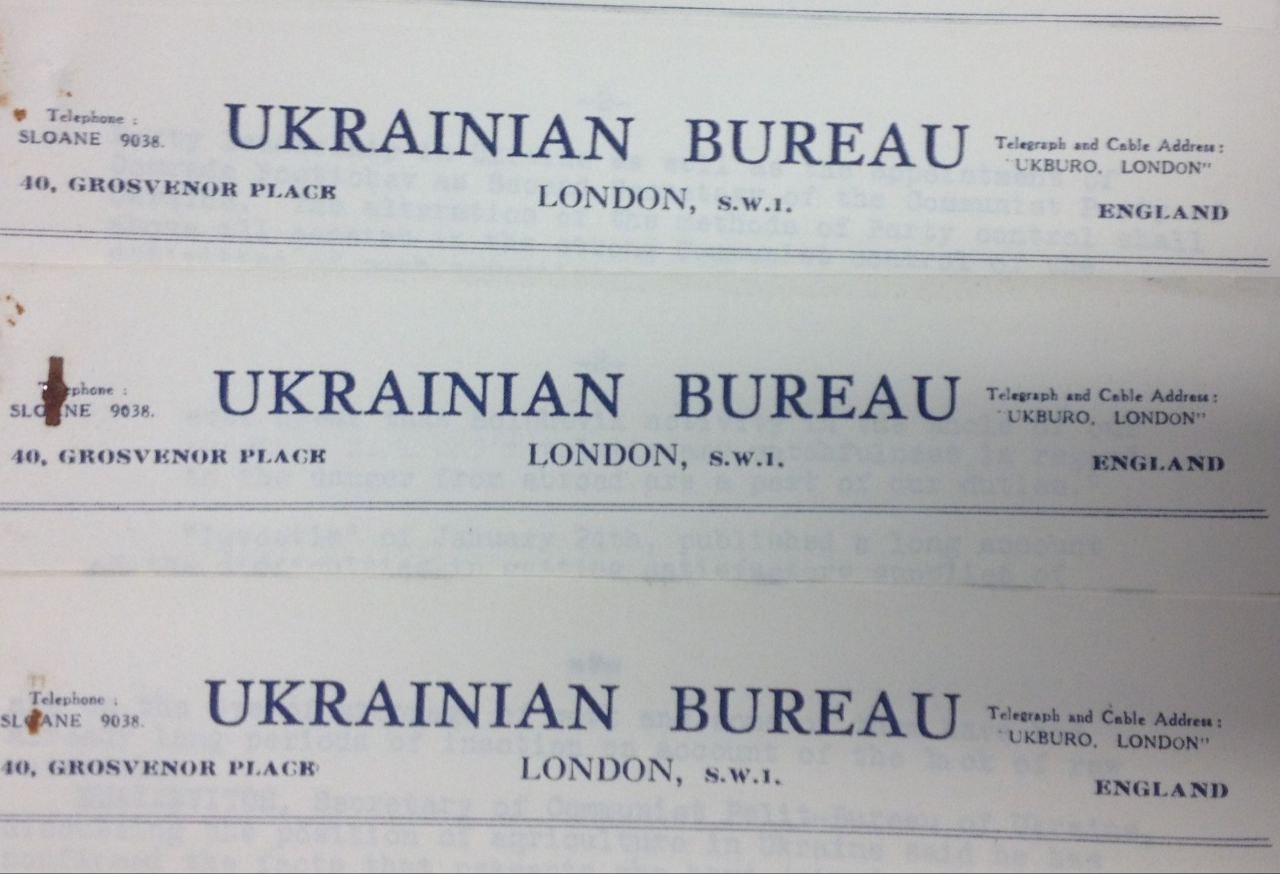
The UKRAINIAN BUREAU letterhead served as the logo; the text was typewritten and reproduced using lithography. The length of each issue varied, ranging from two pages (April 11 and October 10, 1931) to nine pages (January 19, 1932).
Who was the newsletter’s target audience?
The newsletter was intended primarily for people with a particular interest in the Ukrainian issue. Its audience consisted largely of editorial offices of English-language newspapers and magazines, along with British public figures, politicians, government officials, scholars, writers, and artists who were sympathetic to Ukrainian issues.
Circulation was not stable and fluctuated as the mailing list of potentially interested readers expanded. The editorial staff worked hard to compile this mailing list, both independently and with the help of trusted friends in other countries. Among them was professor Onatsky from Rome. In a letter dated June 6, 1931, to the Bureau’s director, Kysilevsky, he provided a detailed list of Italian addresses where he believed the Bureau’s printed materials should be sent.
This explains why, in its first year of publication, the circulation ranged from 100 to 500 copies. By the following year, the latest issues were already being mailed to 1,200 addresses.
The Holodomor as the main theme of the newsletter
The coverage of the Ukrainian issue is clearly evident across all Ukrainian ethnic territories, particularly in Poland, Romania, Hungary, and Czechoslovakia. The materials on the contemporary life of Ukrainians are divided into two sections: “Ukraine under Soviet rule” and “Ukraine under Polish rule.”
Recurring themes:
- The Holodomor in Soviet Ukraine in 1932-1933;
- The Ukrainian issue at meetings of the League of Nations;
- The status of Ukrainians in Subcarpathian Rus as part of Czechoslovakia.
The Holodomor, a famine that was artificially created by Moscow, became the primary focus starting in 1932.
The Bureau documented every aspect of this nationwide tragedy affecting the Ukrainian people, including eyewitness accounts that reached the outside world despite the barriers of the Soviet border. Through the bulletin’s pages, multilingual Western European readers first learned of the harsh realities of Soviet life: the forced confiscation of the last grain reserves from Ukrainian people in villages, the deportation of so-called kulaks or kurkuls (rich citizens who owned private property and could hire workers) to Siberia, the prohibition on peasants leaving their villages, and the deaths of hundreds and thousands of peasants and their children.
The Soviet authorities kept the Holodomor hidden and provided no assistance to the Ukrainian population. Information about this man-made famine, its true scale, and its tragic consequences reached the West with a delay. That is why the editorial staff of the Ukrainian Bulletin in London was perhaps the first to sound the alarm, calling on the international community to give close attention to this Ukrainian issue.
This raises the question: through what channels did the editorial staff of the Ukrainian Bureau Bulletin, located perhaps the farthest from the Soviet borders, obtain information about the situation in Ukraine, and where did they gather eyewitness accounts of the Holodomor?
An analysis of publications on this topic reveals several channels:
- a) Reports from international news agencies;
- b) Press reviews from leading Western publications;
- c) Information from the government of the Ukrainian People’s Republic in exile;
- d) Accounts by Western tourists who visited Soviet Ukraine on sightseeing trips; and
- e) Editorial sources of information.
The value of these materials also lay in the fact that they were published soon after the widely publicized trip through the Soviet Union by the French Radical politician of the Third Republic Édouard Herriot. The Soviet leadership, having rejected offers from Western countries to aid the starving Ukrainian population, consistently claimed that information about the Holodomor was being deliberately spread by enemies of the Soviet Union. That is why Moscow invited Herriot, who was sympathetic to the Soviet authorities and later wrote a series of articles claiming there was no basis for the so-called rumors of famine in the USSR.
The controversy surrounding Herriot’s publications was further intensified by numerous interviews with foreign tourists who had visited the USSR and witnessed the true scale of the tragedy. Their accounts to foreign correspondents had a profound impact on Western readers.
In 1933, based on data provided by the Ukrainian Press Bureau in London, a “Facts about Ukraine” brochure was published in English. It was compiled from the most relevant clippings from the foreign press concerning the Ukrainian issue in general and the Holodomor in particular.
After going into exile (following her work in the government of the Ukrainian People’s Republic under Ivan Ohienko in Kamianets-Podilskyi), Sofiia Rusova became even more concerned about what was going on in Ukraine, which she considered her homeland (due to her deep love for her husband, Oleksandr Rusov). Bolshevik officials, acting on orders from Moscow, had already so severely oppressed the Ukrainian peasantry that, since 1932, hundreds of thousands of children had been dying from starvation and malnutrition. After reading in the press about the effective work of the Ukrainian Press Bureau in London, Rusova sent an Appeal for Help for Ukrainian Children, written with deep emotion, and asked that it be published in the English press, urging honest people around the world to take action to help stop the scale of this tragedy.
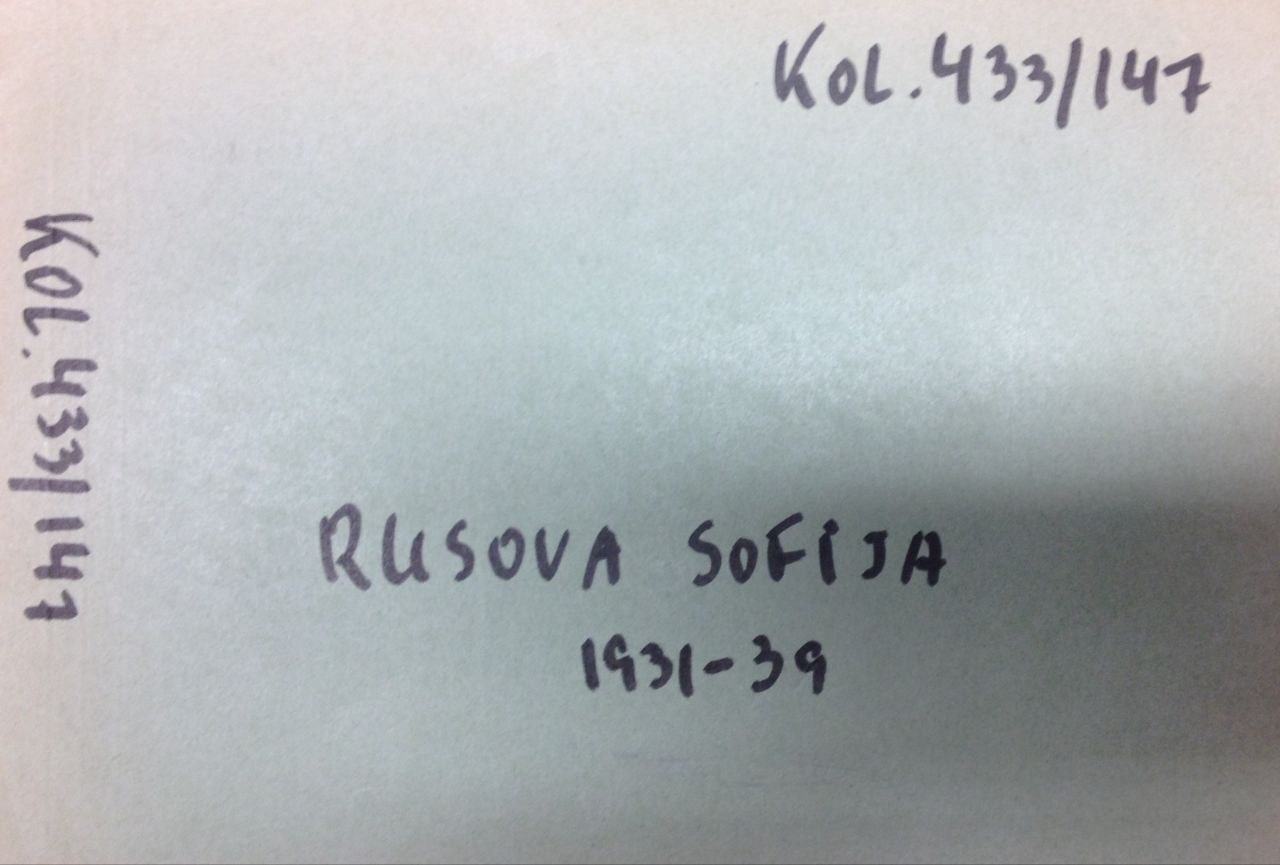
The letter includes a strong appeal to the international community to act to save Ukrainian children — the future of the Ukrainian nation.
“I am sending you — whether it is a cry or a plea for help for the children, I do not know — perhaps you will find a way to have it published in the English press. I have sent the same text elsewhere, but for some reason I always feel compelled to turn to you, because I hold you in such high esteem and am delighted by how much you have achieved in the English press. None of this will feed a single child or save them from extermination. I am in such despair over Litvinov’s ‘success’ [the then-Foreign Minister of the USSR] that I no longer know where to turn. With sincere respect, Rusova.”
Kysilevsky, head of the Ukrainian Press Bureau in London, took this appeal seriously. He spread it among his British friends and officially submitted it to the Presidium of the International Society for the Protection of Children for consideration. In turn, the Bureau, as a member of the recently formed Committee for the Rescue of Ukraine in Prague, submitted a request to the British Parliament asking whether some kind of rescue operation could be launched in this matter. They received a reply stating that the Parliament would do everything in its power and would report on the results.
“Our motherland, Ukraine, is going through dark times. It seems we have not known such oppression and such misery since the days of the Tatar yoke. There have been difficult times, but no one has ever known cannibalism,” Kysilevsky wrote in his reply to Rusova.
One more letter from Rusova, sent from Prague to London, mentions the thousands of refugees from Ukraine who, thanks to the longstanding support of the then-President of Czechoslovakia, Tomáš Masaryk, for the Ukrainian independence movement, found temporary refuge there. The fate of the Ukrainian intelligentsia, the educated, patriotic, true elite of the nation who, in the prime of their physical and spiritual strength, were forced to languish in a foreign land, unable to fully realize their God-given talents, worried Rusova.
In a letter to the Bureau dated September 18, 1933, she proposed a new idea: finding wealthy patrons or organizing a fundraising campaign among émigrés to buy or build a building in Prague for Ukrainian scholars and cultural workers.
“Help the two young Ukrainian women!”
In this letter, Rusova asks the staff at the Bureau in London to look among the distinguished London ladies for those who would be willing to take in two young Ukrainian girls, aged 15 or 16, the daughter of the late Vakula and the daughter of Moralevich, for the summer. She wrote that the girls were sick, exhausted, and in need of at least proper nutrition.
“Please respond to all of this.”
Kysilevsky’s last letter to Rusova is dated March 7, 1939. In it, he reported that the Makohin family had expressed interest in her projects and wished to meet with her at the earliest opportunity during their trip to Prague. Although Kysilevsky had begun winding down the Bureau’s activities at Makohin’s instruction, this letter of his still breathed hope.
“The world has started taking an interest in us Ukrainians. If only that interest were of some practical benefit to us, things would be better.”
English-language books about the Holodomor
A vast body of little-known information about the Holodomor in Ukraine, which had been compiled in the issues of the Ukrainian Bureau Bulletin, came to light with renewed force in the early 1950s, when the organized Ukrainian community decided to make a strong case to Europeans regarding the unresolved “Ukrainian issue” on the occasion of the 20th anniversary of the 1933 Holodomor in Ukraine, about which Moscow had kept silent.
In the fall of 1953, hundreds of activists from the Ukrainian Youth Association, an organization suppressed in the Ukrainian SSR in the 1920s and later revived abroad, demonstrated in cities, towns, and villages across Great Britain, carrying posters and banners. They distributed English-language leaflets to passersby, describing what they called Moscow’s unpunished crime against the Ukrainian people. In Bolton, more than 1,000 people joined the demonstration. According to “Ukrainska Dumka,” more than 50,000 leaflets were distributed during the event.
In this way, young Ukrainian emigrants alerted the Western world to Moscow’s perceived plans to expand its influence deeper into Europe and beyond.
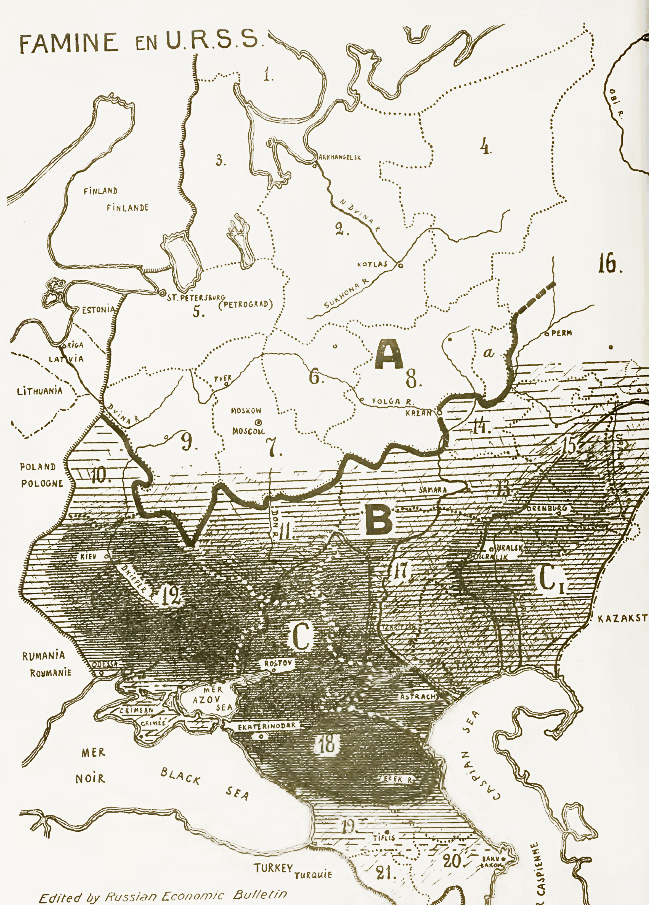
Map of the Holodomor in Ukraine
“Ukrainska Dumka” provided an interesting account of the campaign’s progress across Britain. The October 29, 1953, issue of this newspaper was headlined with the bold title “Moscow — Ukraine’s Executioner: Ukrainian Youth Association Commemorates the Victims of the 1933 Famine Abroad”. The entire front page and the following spread of the magazine were devoted to this topic.
The campaign to commemorate the Holodomor anniversary did not end there. That same year, the Regional Committee of the Ukrainian Youth Association launched a nationwide fundraising campaign in the United Kingdom to publish a series of accessible brochures on the genocide of the Ukrainian people organized by Stalin and people who worked for him. By that time, activists already had the prepared manuscripts of future publications by local authors: “The Ninth Circle” by Olexa Woropay, “The Stalin Famine: Ukraine in the Year 1933” by Fedir Pigido-Pravoberezhnyi, and “Communism the Enemy of Mankind” by Ukrainian writer and activist Oleksa Kalynyk. It was decided to publish the books in separate print runs in two languages: English and Ukrainian.
The fundraising campaign was a success. As early as 1953, the first two publications of the project were released through the efforts of the Regional Committee of Ukrainian Youth Association.
The first to be published in English was “The Ninth Circle.”
From the pen of the distinguished journalist and publicist Olexa Woropay (pen name Oleksa Stepovyi) — an ethnographer, writer, and naturalist who for a time served as editor of the “Ukrainska Dumka” newspaper — came a compelling and harrowing account of what he witnessed with his own eyes in 1932-1933 in his native Vinnytsia region while serving as a district agronomist at the Ulaniv Machine-Tractor Station. That is why the subtitle of his memoir is “What I Saw with My Own Eyes.”
Here is a brief excerpt from what the author witnessed firsthand and recorded in this book:
“May brought rainfall: it rained nearly every day, and all green things grew buoyantly. In uncultivated gardens, orchards, by the roadside, wherever there was an inch of soil, enormous weeds grew. Starving people rushed at the verdure and started to eat cooked orrach, sorrel, nettle — anything which could possibly seem edible to a starving human body.
“But after consuming such wild plants — and often eating them raw — people suffered from dropsy and died from starvation in great numbers. In the second half of May, the death rate from starvation was so great that a kolhosp wagon was specially set aside for the purpose of carrying the dead each day to the cemetery.
“These bodies were thrown down, several into one grave, and covered with earth without any customary or religious rites. The debasement of human dignity was carried to the limit.”
The print run for the English-language edition of the book was 3,000 copies.
What became of them after they reached the publishers?
We can determine this from a newspaper article.
Half of the print run was set aside for distribution in Great Britain. The remaining 1,500 copies were designated for overseas distribution: 750 were donated to libraries in countries around the world, primarily English-speaking ones, while the rest were offered for sale through street vendors at two shillings per copy.
Donations collected in the following cities in the United Kingdom were used to publish and distribute copies of this book: Bolton, Bradford, Halifax, Bury, Rochdale, London, Coventry, Stoke-on-Trent, Middleton, and Huddersfield, as indicated on the back of the title page.
The information contained in Pigido-Pravoberezhnyi’s book is also firsthand. The author survived the Holodomor in the Kharkiv Oblast and managed to escape to the West, carrying with him the irrefutable truth of his memories of those terrible times. The book differs from the previous one in several ways: it is twice as long (72 pages), the memoirs are supplemented by 11 evocative documentary photographs; and the foreword was written by Moira Roberts, an Englishwoman.
The third book in the planned series (Kalynyk’s work) was published later: the Ukrainian edition in 1954 and the English edition in 1955. It differs from the previous two in that it is based on documents collected by the author from various sources regarding Russian-Communist terror in Ukraine. These include, first and foremost, government directives, minutes, judicial and investigative files, and secret documents of the GPU regarding collectivization, grain requisitioning, and the dispossession of the kulaks. Structurally, it consists of 14 chapters.
The lasting importance of what was likely the first publication of such documents in the West is underscored in the preface. “Years and decades will pass. Memories about the horrors of the communist regime may eventually fade, but this book and its authentic documents will remain a powerful testament to that era, a record written either by the occupier himself or by his victim.”
This three-volume work on the Holodomor in Ukraine from 1921 to 1933, a publication of inestimable historical and educational value, is not the only example of involvement of Ukrainian Youth Association in the field of Ukrainian studies publishing.
In lieu of a conclusion
It is fair to say that the intensive (despite its limited staff), wide-ranging (across its main areas of activity), and long-standing (nearly 10 years) activities of the Ukrainian Press Bureau in London brought the urgency of the protacted and unresolved Ukrainian question to the attention of the wider European community, preventing Ukraine’s opponents from portraying it as an internal matter of Russia or Poland.
The bureau’s proclamations, appeals, and statements became the subject of consideration and discussion among government and political circles in Great Britain. Brochures, bulletins, and other informational materials were distributed through the media, in political, academic, and cultural circles, and among both foreigners and locals, and a number of publications were reprinted or cited.
This demonstrated to audiences across Europe the Ukrainian people’s determination to continue pursuing their enduring goal of establishing a united and independent Ukrainian state and freeing it from Soviet, Polish, and Romanian rule.
The positive assessments of the Ukrainian Press Bureau’s activities under the leadership of the true patriot Makohin, as well as all the factual material described above, speak for themselves and put an end to the baseless insinuations, slander, conjectures, and assumptions regarding the activities of the Ukrainian Press Bureau in London.
It is regrettable, however, that this was often done not only by the open enemies of the Ukrainian cause, but also by Ukrainians. In their intense competition for positions of influence and the advancement of their own ambitions, they often fueled public disputes and weakened the unity of the Ukrainian movement at a time when it was most needed. And this instead of trying to do for the common cause and at their own expense, no less, even a fraction of what Makohin and the small group of like-minded people he assembled at the London Press Bureau and its official representative offices in Geneva and Prague actually achieved.
For nearly a decade, the Ukrainian Bureau in London served as a de facto Ukrainian embassy, steadfastly promoting the Ukrainian cause and raising its profile to unprecedented heights.
This is a rare example of how wealthy businesspeople in modern Ukraine could contribute to the national cause.
RELATED: Six essential books on Holodomor worth translation
Translation: Iryna Savyuk
Copyediting: Joy Tataryn
Читомо» — це медіа про книжки й літературу, що підтримувало українське книговидання задовго до того, як це стало трендом. Ставайте частиною історії — доєднуйтеся до Клубу Читомо!
the more you read, the greater the possibilities
5854
Chytomo Picks
Vasyl Barka: Conservative modernist and Holodomor survivor
15.10.2024 - Mykhailo Sokulsky
1227
Holodomor
Ukraine’s Holodomor Museum is urging for the revocation of Walter Duranty’s Pulitzer Prize
28.03.2024 -