* ESC - close the search window
Earth
Enchanting the ephemeral: A review of Oleksandr Dovzhenko’s ‘The Enchanted Desna’
22.08.2026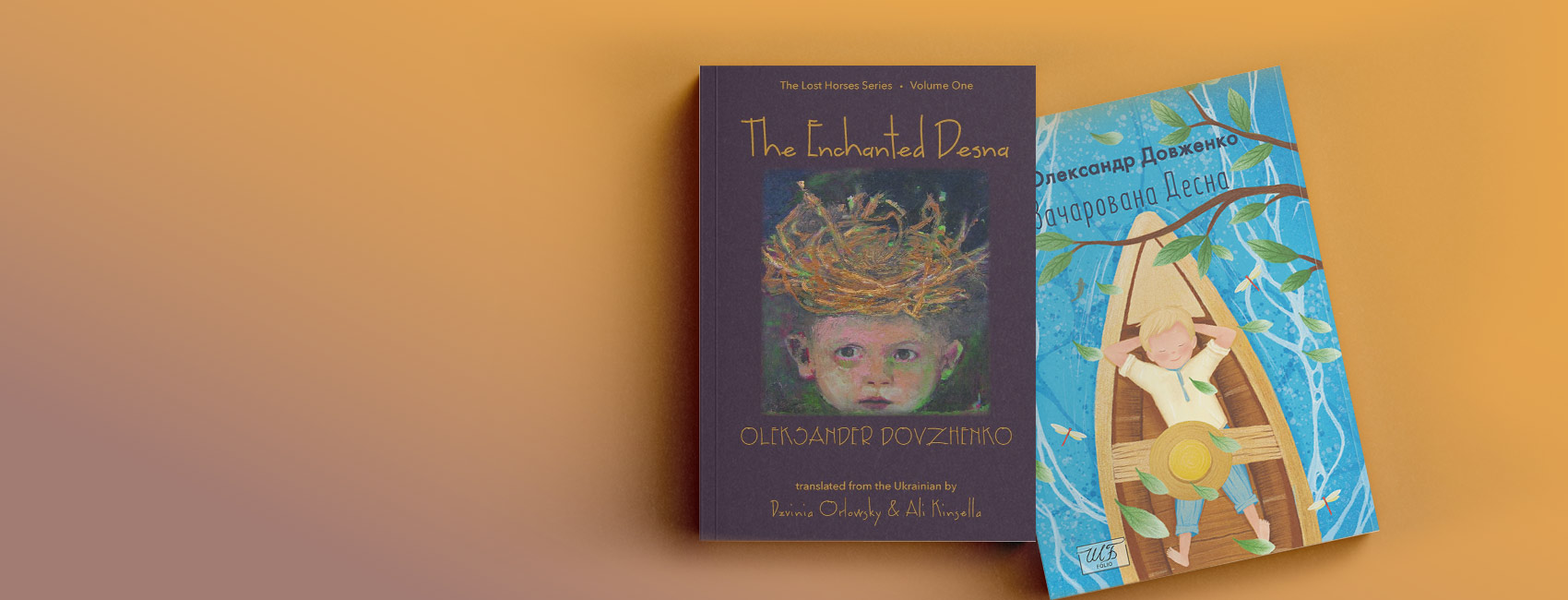

You see an error in the text - select the fragment and press Ctrl + Enter
Oleksandr Dovzhenko is regarded as one of the most distinguished directors of the 20th century. His film “Earth” (a poetic film narrative portraying the implementation of the policy of collectivization in Ukraine in the late 1920s, the establishment of the first collective farms, and the tensions between social classes) is considered a classic of world cinema. Long perceived internationally as a Soviet (read: Russian) director, Dovzhenko’s identity was unequivocally Ukrainian, and his literary work serves as proof. Dovzhenko was a brilliant writer whose works were not supplements to his films, but fascinating, stand-alone works in their own right.
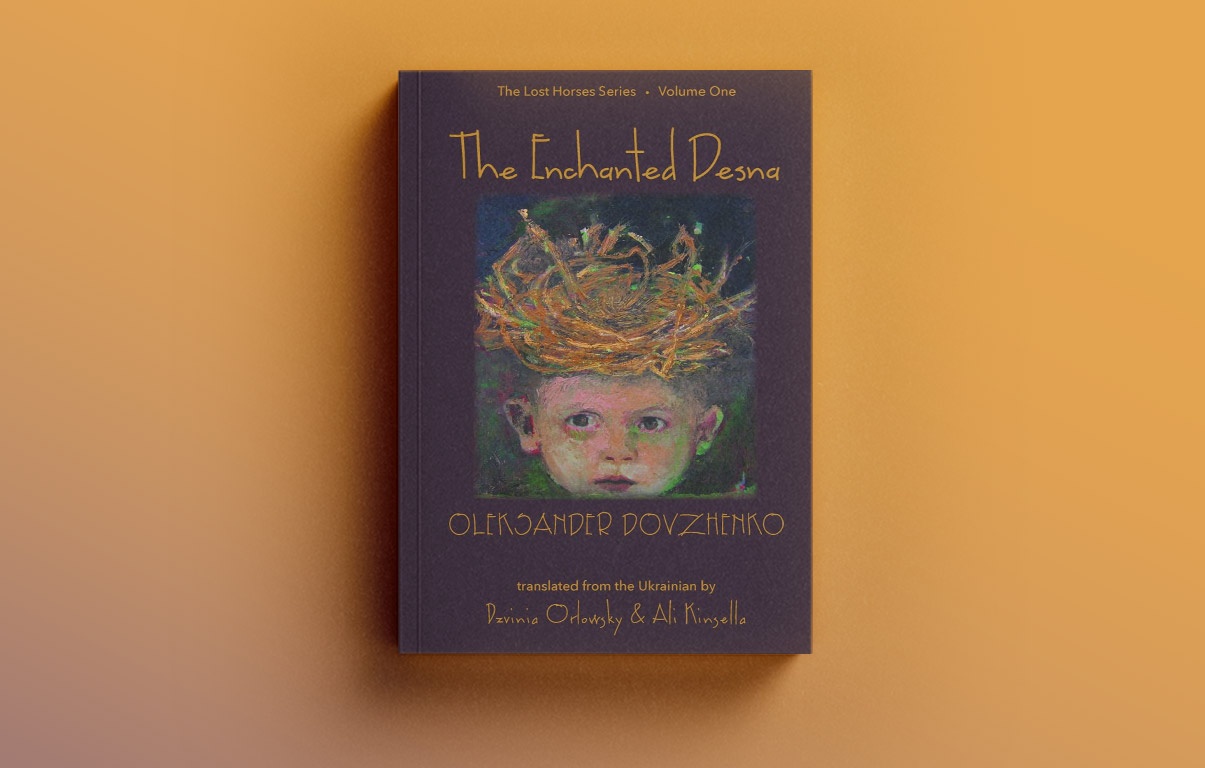
“The Enchanted Desna” occupies a central place among Dovzhenko’s works. Being Dovzhenko’s autobiographical novella, it tells a mythologized story about the world of his childhood. In 2026, Lost Horse Press published a translation of this novella by Ali Kinsella and Dzvinia Orlowsky.
Who enchanted Desna?
The term “enchanted” is often used in Ukrainian fairy tales to describe a place, person, or object that has been bewitched — or cursed. A location is “enchanted” if the usual order of things does not apply there and time does not flow normally. By portraying his childhood memories as “enchanted,” Dovzhenko leads us into a world governed by the logic of myth and fairy tale.
What we encounter is a village near the Desna River, where fish and mosquitoes can be abnormally large, and people are portrayed not so much through their personalities or psychological profiles as through their fairy-tale roles and exaggerated traits. In this book, everything expands into the realm of myth. God appears in the form of an Old Man, the ancestors of the local horses had wings and carried prophets on their backs, and a lion, quite an exotic creature in these places, strolls along the banks of the Desna River.
Through defamiliarization, Dovzhenko transforms the depths of childhood memories into an enchanted realm governed by the logic of a fairy tale where, by uttering a certain combination of words, one can catch a glimpse and see this magical world. But the truth is that the Desna River described in the novella exists only in its own enchanted dimension. In reality, it is ruins and desolation. Instead of the people mentioned in the novella, there are the smoke and ashes of memories. Mosquitoes are small, and fish are of a usual size. No one sits on the rooftops with calves, waiting to be saved from the flood, because salvation will not come. After all, the real world of “The Enchanted Desna” has been swallowed up by war.
A dream amid the end of the world
In his diary entry for April 1942, Dovzhenko wrote: “Yesterday, writing down memories of childhood, of home, of my grandfather, and of mowing hay, I found myself laughing and weeping all alone in that tiny little room. Dear God, there was so much beauty and dear things to me in my life, and those things will never, ever return.” At that time, Dovzhenko was under evacuation rules. World War II was tearing reality apart, and Europe was on fire.
The initial version of “The Enchanted Desna” was completed in 1948. One can say that it is not just a reminiscence of the carefree, radiant world of childhood, but a painful evocation of images from a world that has been lost forever. It is an attempt to enchant that world and hold on to it before it slips away from Dovzhenko completely.
To create this novella, Dovzhenko constantly employs the device of dreams, and throughout the text he scatters reminders that the world he describes has already been destroyed, moving back and forth between the idyllic dream of childhood and the bleakness of reality. Dovzhenko constantly hypnotizes us, lulls us to sleep, and then jolts us awake.
The strongest parallel to the actual end of the world appears in the episode about Easter during the flood, when villagers were forced up onto the roofs of their houses with all their livestock and waited to be rescued. This is an unmistakable allusion to the Old Testament flood, and it is significant. On a symbolic level, it represents the water that destroys the old world for its sins. In describing this episode, Dovzhenko employs a technique reminiscent of a transition from dream to reality. He says that his native village is being swept away by another flood — the flood of fire from World War II. The biblical catastrophe, which seemed only a temporary ordeal within the enchanted world of childhood, will actually take place in reality, and this time, there will be no return to the life of the past.
The shadows of the Gods of the Golden Age
In many Ukrainian novels, the rural world is portrayed as a space where Christian and pre-Christian worldviews coexist. The Christian calendar and churchgoing are organically interwoven with pre-Christian beliefs in nature, spirits, and the veneration of ancestors. Dovzhenko, depicting the village of his childhood, offers almost no ethnographic panorama. Instead, he recasts the figures of his childhood as members of a pantheon of family deities and realizes that he is describing an archetypal Ukrainian world, not yet touched by industrialization or progressive knowledge about the world.
RELATED: ‘Enchanted Desna,’ ‘Radio Night,’ ‘The Gaze of Medusa’: New English translations in 2026
If you take a closer look, the book’s characters are deliberately exaggerated, which is only natural, since we’re seeing them through the eyes of Dovzhenko as a child. To him, the world must have seemed larger and more expansive than it would have to an adult. At the same time, this reinforces the work’s mythological dimension and, in particular, the concept of the myth of the Golden Age. Dovzhenko’s characters can be interpreted as an assembly of deities. They are not portrayed primarily as psychologically complex individuals but as embodiments of particular qualities exaggerated to an extreme.
There is a supreme god in the book: Dovzhenko’s grandfather. When little Sashko looked at the sacred images — icon, — he found that the saints painted in them reminded him of his grandfather: The iconic figures held something resembling a salt shaker in one hand, while the other hand’s gesture reminded him of the way his grandfather moved when he was about to pick up a clove of garlic.
While the grandfather is associated with Christian imagery, the great-grandmother belongs wholly to the pagan realm. After reading “The Enchanted Desna,” it’s hard to forget the great-grandmother who is constantly cursing everyone. Embodying the distinctive character of the local world, she is portrayed not as evil, but as a unique phenomenon of nature. This woman, with her incessant stream of curses, appears as a force of nature, as a downpour or a storm — formidable and unavoidable.
Dovzhenko portrays a character named Samiilo as a mower. Not just a mower, but a legendary mower who towers above the rest and is nicknamed Kosar (mower). The Kosar, with a capital K. By the way, the Ukrainian folk name for the constellation Orion is “Kosari” (mowers), and we have no doubt that Samiilo is among those who mow in the heavens. Samiilo is not the only celestial character in the book. In the novella, Dovzhenko mentions his great-grandfather, who was a chumak (a historical Ukrainian salt merchant, carter, or trader from the late medieval period to the 19th century who hauled goods like salt, fish, and grain across the steppes using ox-drawn carts), and whose image refers to the great tradition and culture of traveling merchants.
The chumaks, in turn, are associated with the image of two roads: the earthly one, across all of Ukraine, and the heavenly one — the Milky Way (in Ukrainian, it is Chumatsky shliah — literally, “the way of the chumak”). The fact is that the visible band of our galaxy, which shines brightly in the sky, is known in Ukraine by the folk name “Chumak’s Way.” The band of the galaxy in the sky becomes a metaphorical road connecting not only distant geographical points but also heaven and earth, the world of the living and the dead.
Another semi-pagan image in the book is that of the narrator’s four deceased brothers. When they were still alive, these children would perch on the fence like sparrows and begin to sing. After the four brothers died as children, everyone said that God had welcomed them into his choir. The image of the brothers transforming into birds and being present nearby every day has deep mythological roots. The children do not simply die; they seem to remain near their family home, flying back from time to time to their native farmstead in the form of birds, symbols of pure souls.
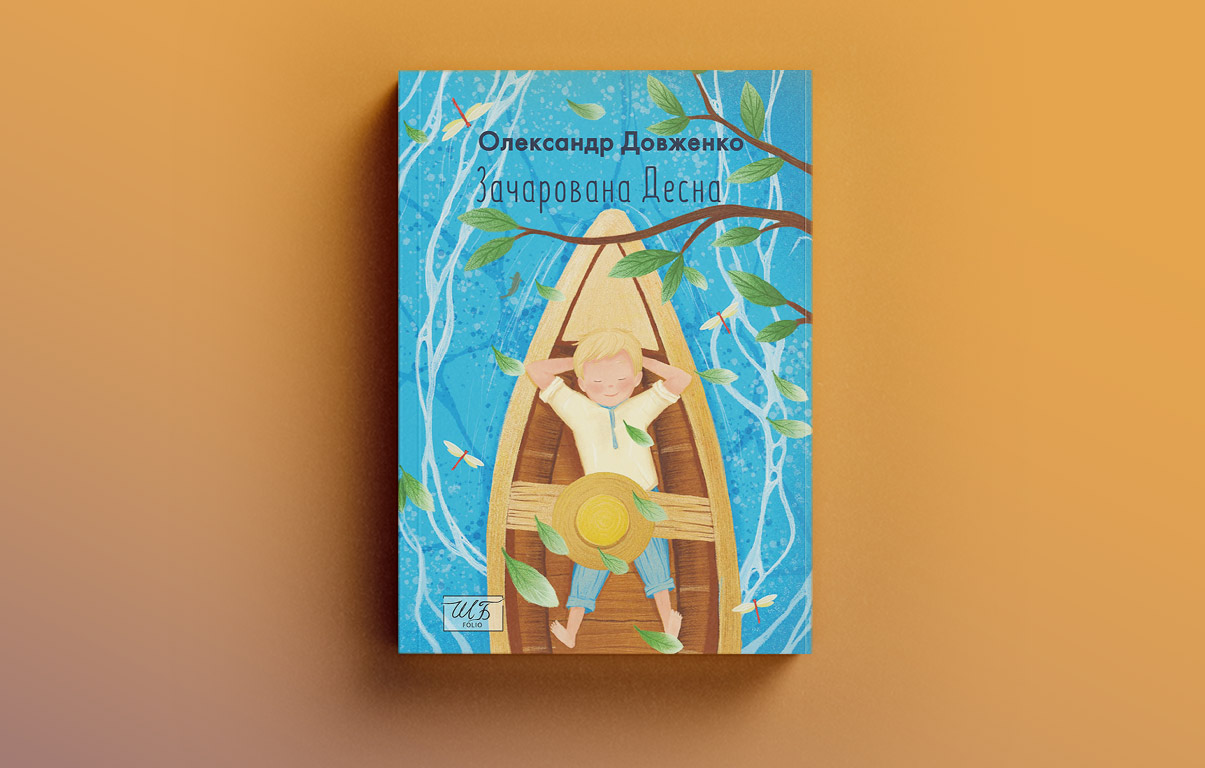
“The Enchanted Desna” by Oleksandr Dovzhenko (Ukrainian edition bookcover)
Despite the dynamism of certain scenes, Dovzhenko’s novella is composed of such images and fragments of situations. It does not develop complete storylines for each of the characters it introduces. Instead, what unfolds is a stream of memories and a state of half-sleep in which the narrator drifts. Dovzhenko’s enchanted Desna transforms into a great mythical river of life, from which he manages to snatch only fragments of memories, swept away by war and time.
Although the book evokes a distinctly mythological realm and the motif of the destruction of the old world, it is difficult to classify “The Enchanted Desna” alongside other works of world literature from the mid- and second half of the 20th century that depict an authentic pre-colonial world, such as “Things Fall Apart” by Chinua Achebe or “Men of Maize” by Miguel Ángel Asturias. Dovzhenko makes little use of ethnographic detail in his novella and does not seek to reconstruct such a world. Yet his book can be placed alongside the aforementioned novels, for Dovzhenko’s writing reflects an attempt to preserve the vanishing cultural cosmos of the authentic Ukrainian village, which is being rapidly swept away by the tides of urbanization, industrialization, and, ultimately, war.
The reality we see every day is fragile and fleeting. In “The Enchanted Desna,” Dovzhenko attempted to rescue the world of his childhood from the flames of World War II. Just as museum workers today preserve collections from war-torn regions and digitize them, or as people living in active combat zones try to put their experiences into words during brief moments of calm. Dovzhenko enchanted memories of his native village through words, giving everyone who turns the pages of “The Enchanted Desna” today the chance to touch the beautiful world of those times, when the fish in the Desna River and the mosquitoes by the river were huge, horses had wings and carried prophets on their backs, and God sat on a bench by the house, holding a salt shaker in one hand and a clove of garlic in the other.
RELATED: The War & The Self in All Their Iterations: A Review of Halyna Kruk’s Lost in Living
The publication is a part of the “Chapter Ukraine” project. The materials have been prepared with the assistance of the Ukrainian Book Institute at the expense of the state budget. The author’s opinion may not coincide with the official position of the Ukrainian Book Institute.
Translation: Iryna Savyuk
Copy editing: Joy Tataryn
Читомо» — це медіа про книжки й літературу, що підтримувало українське книговидання задовго до того, як це стало трендом. Ставайте частиною історії — доєднуйтеся до Клубу Читомо!
the more you read, the greater the possibilities