* ESC - close the search window
poetry collection
Foxes, birds, and the contradictions of the era: A new translation of Ukrainian poetry
22.07.2025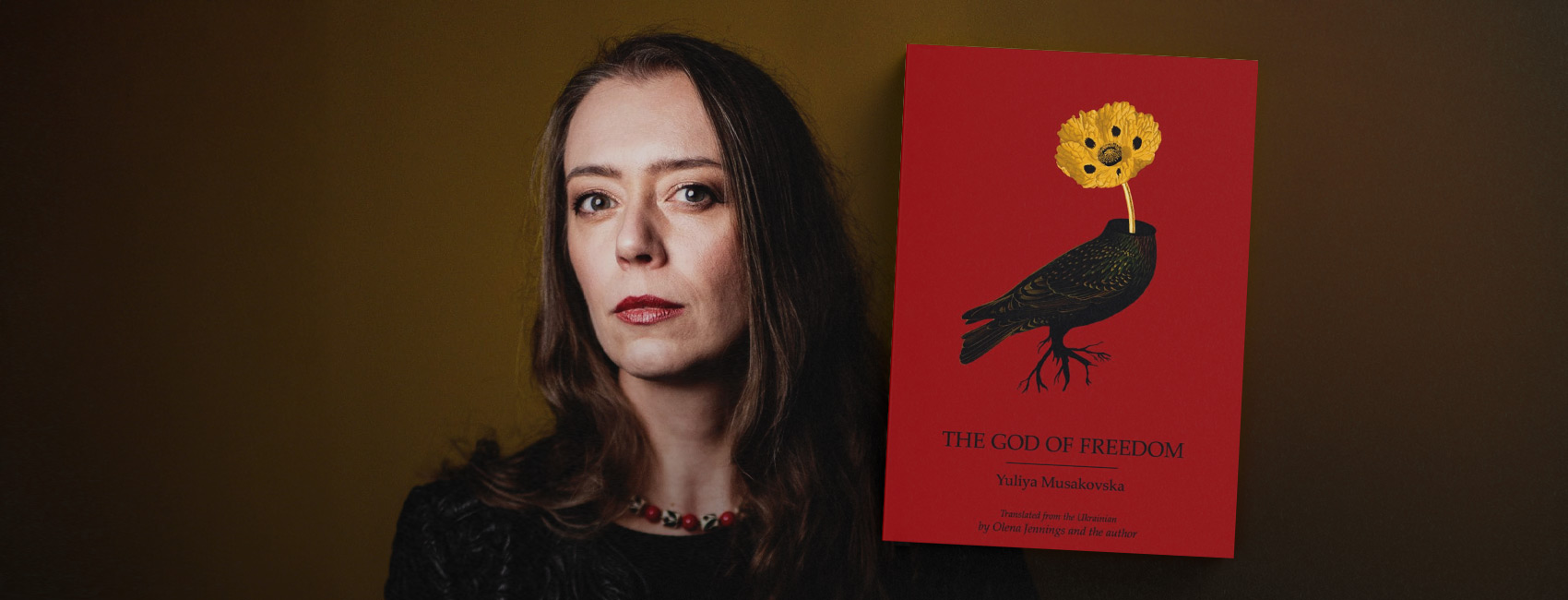

You see an error in the text - select the fragment and press Ctrl + Enter
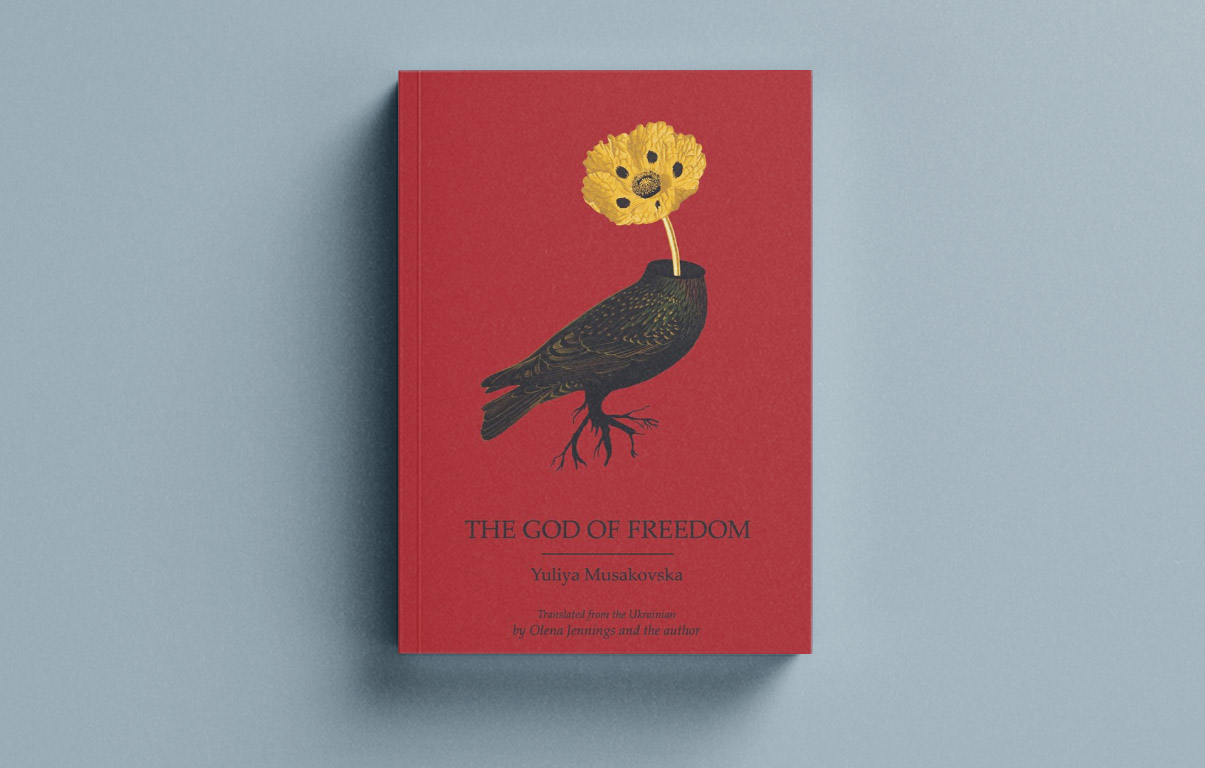
“The God of Freedom” is a collection of contemporary Ukrainian poetry by Yuliya Musakovska published in English, and translated by Olena Jennings and the author herself. Among recent poetry releases, its intellectual discipline sets it apart — not directness but nuance — amidst a rich, cohesive world of imagery.
Musakovska is one of today’s renowned Ukrainian poets. She was born and resides in Lviv, a city with a strong literary tradition. Musakovska is the author of several books, including “Exhaling, Inhaling” (2010), “Masks” (2011), “Hunting for Silence” (2014), “Men, Women and Children” (2015), “Iron” (2022), and “Stones and Nails” (2024). Musakovska has received numerous literary awards. As a translator, Musakovska works with English and Swedish languages. Her current focus is on Ukrainian soldier poets. In 2023, Musakovska paused her 20-year career in IT business to dedicate herself to literary work and cultural advocacy for Ukraine.
“The God of Freedom” was originally published in Ukrainian in 2021. The fact that the English translation appears now is not a coincidence — it is symbolic. These poems, written shortly before the outbreak of the full-scale Russian invasion, are filled with a sense of impending doom: a massive conflict, human suffering, and the unsettling, repetitive patterns of history.
Today, it isn’t possible to discuss Ukrainian poetry (and perhaps even poetry in general) without mentioning the war. However, Musakovska’s work, at times of prediction, is neither blunt nor speculative, nor does it drown in propaganda (even though some works undoubtedly reflect the spirit of their period). The author skillfully employs a universal poetic language that — quite paradoxically — projects itself onto specific historical reality and context.
What happens next? Some will leave, some lose their lives.
The rest will stumble at the doorstep and somehow linger.
They will unlearn the difference between friends and enemies.
Because when everyone is made the same—why bother?
(…) How else would they survive in this devilish game,
where today you’re a hero and tomorrow, a loser?
You don’t necessarily delve deep into the details of the tragedy in Eastern Europe to grasp the particular resonance of these lines today.
RELATED: Julia Musakovska. People like these
Musakovska’s work carries strong historical depth. A series of poems in which historical processes (perhaps wholly lacking in anything contemporary) are viewed from a distance, with a clear sense of their cause-and-effect logic, their “karmic” nature are scattered throughout the collection. One of such poems is “Three Wishes for Cinderella” (or “Three Hazelnuts for Cinderella”), its title alluding to the well-known fairy tale by the Grimms Brothers, as interpreted through a popular 1970s Czechoslovak-German movie adaptation.
Three magic hazelnuts for Cinderella.
Breadcrumbs from a humble family table.
Three vulnerable places—eyes, heart and throat—
that’s all the inheritance, apart from a bundle of family stories.
(…)
Grandma Vira, a rusyn woman from Poland,
deported, deracinated, took new root outside Ternopil.
That rich soil cost her father his life.
Beware of Soviets bearing gifts,
but a man is only a man thanks to the land he works.
Vira orphaned early, her father died of TB.
A smart girl, got herself through studies
to become a nursery school teacher.
Picture-perfect.
And then suddenly, a khanum, a matriarch.
Grandma Vira,
the maker of our gorgeous sweaters and life truths.
“A gentle calf sucks two mothers,” she was saying,
kneading the dough for pampukhy.
“A man and a dog walk the same road.”
So much ungiven love, there was no room for it in her body.
Finally, her heart failed.
Grandfather Petro, a merry maker, a brawler,
He was from Kuban’. The war kept bending him
but he did not break.
A poet, an artist, a singer—made into a gymnastics teacher,
thrown into a god-forsaken place so as not to make trouble.
Unruly mane, explosive temper.
He left one family, just to get himself another.
But he wouldn’t live to see his grandchildren.
A young nurse at a hospital,
The copper wire of her hair, in the pink of health.
Far from her Siberia home.
All of their roads somehow led to Lviv (…)
In this text, Musakovska captures the formation of a multifaceted identity, both within the context of family and in the context of Lviv, a city that holds symbolic significance for several cultures. What will happen to such multiplicity in literature during and after the full-scale invasion? How about the life of Ukraine and other countries, those affected and unaffected by the war? We will see that later, but “The God of Freedom” is asking questions now.
When you read the verse, it becomes clear that one of the main features of Musakovska’s collection is the attention to psychology and sensuality. In a way, it serves as a diagnosis of human fragility. Another crucial characteristic arises from the title of the collection: the dialectic of freedom. It is, in fact, the search for freedom, particularly from the pressures of conventions and stereotypes.
This choice is derived from “challenge,”
Otherwise, it’s deprived of meaning and heart.
One only keeps grumbling
why isn’t everything turning into a perfect picture,
for each their own,
by swinging, let’s say, a magic mace.
At the level of social groups, gender, family, or an individual…
This will never happen to me,
she says, ironing her dress, white like a blank page.
All these women—each has her own truth.
Perhaps they prayed carelessly, couldn’t keep the hearth,
didn’t put a mandragora root under their bed,
perhaps they just couldn’t manage it.
(…)
You were busy making yourself beautiful,
neglecting housework.
Perhaps you weren’t considerate enough,
grew yourself a crown; perhaps you have gone too far,
Swayed the foundation of this cozy world.
A neighbor’s baby is crying behind the wall,
reminding you of what is crucial.
Annoyingly, only minutes of tardiness are being born.
Don’t air your dirty linen in public,
don’t talk of nasty things at the table,
on Sunday morning, on a hard day’s night, on holiday or at lent.
When she comes to me with her swollen lip,
with a carefully masked blue bird on her temple,
I don’t tell her: perhaps you didn’t. Instead, for the both of us
I tell her: turn the page, darling, just turn the page.
There is a significant and seemingly quite typical topic of female solidarity, sisterhood against the backdrop of traditions of oppression, the “glass ceiling.” It is interesting that Musakovska presents these and related stories not as a one-dimensional narrative of limitations or the struggle against them. It is not sorrow over struggle, not a shout for war, nor an exultation of conquest. Instead, it is a multi-layered and dialectical intertwining, a contrasting combination of realities, plots, and practices. It is an exploration of their diversity and a refusal to simplify. It is no coincidence that the final poem of the collection can easily be read as a dramatic – especially today – antithesis to its title (even if the author didn’t plan this dramatic effect).
The god of submission loves gentle calves.
They can be spread like honey and put on a wound.
They will be watching and chewing diligently,
in the grass where a soldier is dying.
The god of submission loves gentle calves.
Significantly, the works addressing themes of freedom and oppression, especially in the context of patriarchal dominance, closely align with those centered on home and family life. There is a paradox too: home and family are important “archetypes” in “The God of Freedom.” But again, we do not have a hymn to the coziness of the family nor a battle song about the destruction of the family-as-prison, but rather an attentive watching and listening to the family as a fragile, delicate system of human coexistence, where very different tendencies coexist. There are also evocative poems devoted to childhood and motherhood:
My golden child,
the moon holds out its palm.
Sit there, while it is generous,
plunge into the blue darkness. (…)
–
The boy: an image stuffed into a lantern.
Gold candles, coffee beans in tall cups.
The story unfolds, behind the frame is a frame;
a camera tries in vain to stop time.
A dimple on his cheek, inside him an ever-turning mill;
how many stones did we grind, how many crises.
A mobile perpetuum. A thread that leads from the mist.
Maturity is creeping up on its soft paws like a lynx. (…)
–
The knight of eggshells, my unmistakable copy
in a modern remix, processed by time and space—
where did you get so much courage, moving non-stop
along this stunning journey towards adulthood?
The green pea curls, biting into the fence,
getting angry, bending old and creaky weeds.
Who would dare trim you with the “you-cannot” scissors,
or straighten you up with the “you-must” planks? (…)
The hallmarks of the intellectual foundation in Musakovska’s writing are attention to detail and contradictions — the intention to understand and explore. Which, again, do not appear in a straightforward way. Critique, denial, destruction often coexist in the poetry alongside “correctness,” a formal or intellectual canon. Who represents the lyrical self in these poems? A restrained high achiever? An active rebel? An ironic observer? A passionate participant, contemporary, and heir? The historical truth of our time: all of this we have to combine. No single element can hold complete dominance.
The critical language in “God of freedom” successfully interacts with images and metaphors. In her book, Musakovska constructs a coherent space of symbols — not random or separated by poem, but connected and, to some extent, even systematized.
Let’s take the recurring image of the fox as an example. Why are there so many foxes in contemporary Ukrainian poetry? In Musakovska’s poems live entire packs of foxes — this is both the familiar European “fairy-tale foxiness,” adaptability, cleverness, wisdom, worldly savvy, and also, perhaps, the martial spirit found in Eastern tradition.
The war that you’ve been carrying
in your shirt pocket
gnawed a hole in you as if it were a fox cub.
Your heart keeps falling out.
I sew the hole shut,
firmly holding the edges together
with my numb, unbending fingers.
I hope it stays closed a little longer.
–
The sun, a rustling fox,
sniffs the ticklish spot on your neck,
the spot from where my journey began.
It is a kind of grand and dangerous trickster or trigger symbol. Somewhere nearby are also the colors. Heart, pajamas, fox — all of these are red, foxy. Like arterial blood. And on the opposite pole — birds, including paradise birds, not without their totemic significance:
We have a coastline,
painted with oils—it comes to life twice a year.
We keep heavenly birds on our shoulders.
The fox watches them ravenously.
Son, let’s go, feed the fox.
In this home, no one will be excluded
or lonely. And especially if it is the sun.
Speaking of the coast and colors, the vivid landscape lyricism deserves special attention in “The God of Freedom.” Convincing landscapes are memorable characters. Even though Musakovska is not often perceived in this context in Ukraine (readers of the translation, on the other hand, are free from such conventions).
The sun kisses stigmas on the palms of trees,
a path hides its dragon scales under cobblestones.
A fire explodes, a lion comes out of the thicket
but this is just wind, wearing a wig of leaves.
All precious gifts, those really are priceless,
acorns and chestnuts, hiding in your jacket pockets.
Children are dragging dry logs like boats
splashing laughter and rustling out of the yellow sea.
The annual October performance, tickets sold out.
Get expired leftovers of summer for a dime!
Walnuts are beating like drums and a squirrel approaches
sniffing your hand, a shy little red-haired beast.
People, the lost flock. Watch the lord, the fall park,
carefully herding us into his golden fort
while a thin voile of wonder hangs in the air,
while someone is still in need of high art.
“The God of Freedom” unquestionably has become a part of the growing and multifaceted landscape of the increasingly broad and diverse puzzle of contemporary Ukrainian poetry.
RELATED: Ukrainian poets’ anthology to be published in Croatia
The publication is a part of the “Chytomo Picks” project. The materials have been prepared with the assistance of the Ukrainian Book Institute at the expense of the state budget. The author’s opinion may not coincide with the official position of the Ukrainian Book Institute.
Authors: Nataliia Kushnirchuk, Oleh Kotsarev
Translation: Iryna Savyuk
Copy editing: Ben Angel, Terra Friedman King
Читомо» — це медіа про книжки й літературу, що підтримувало українське книговидання задовго до того, як це стало трендом. Ставайте частиною історії — доєднуйтеся до Клубу Читомо!
the more you read, the greater the possibilities
326
Translate Ukraine
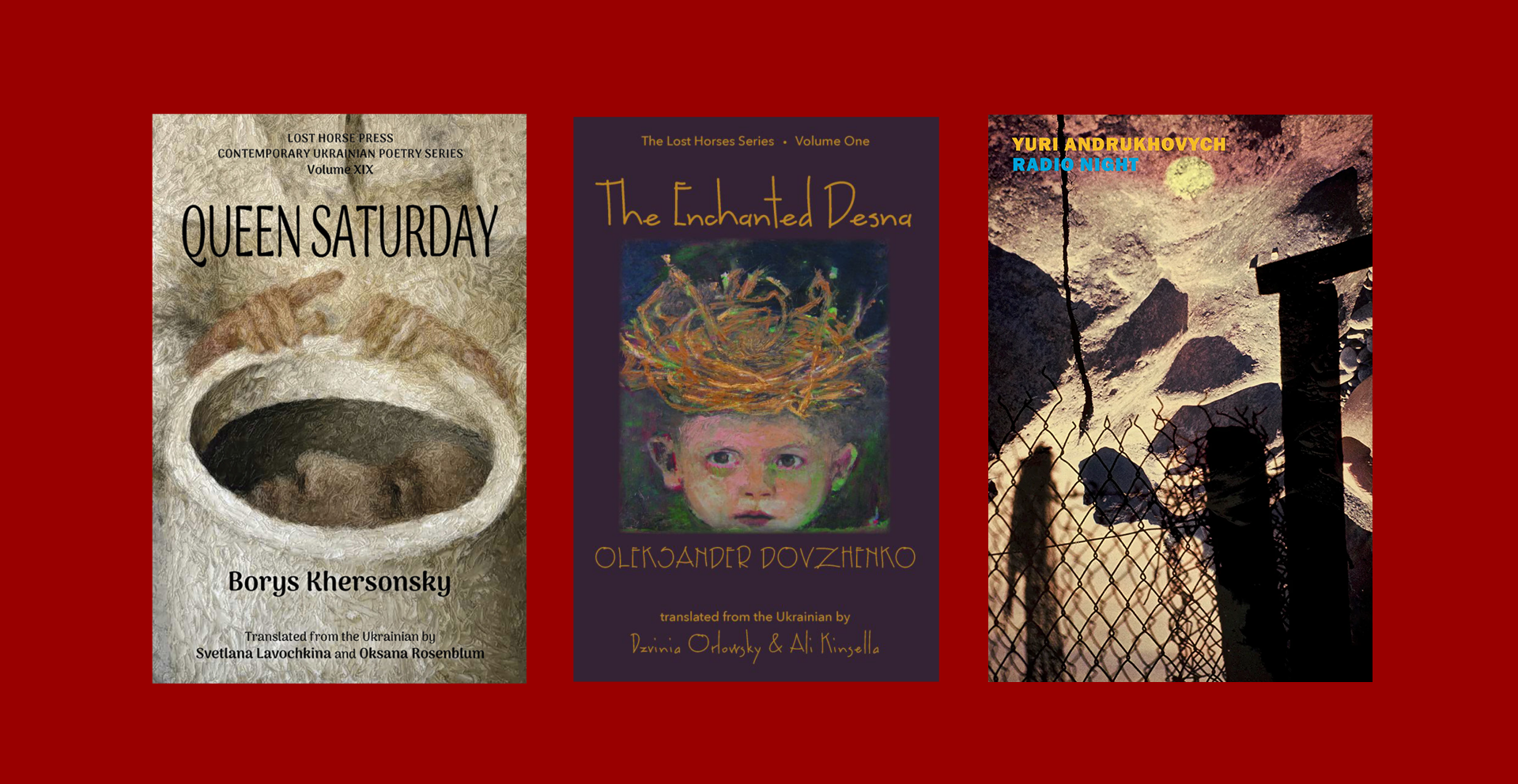
‘Enchanted Desna,’ ‘Radio Night,’ ‘The Gaze of Medusa’: New English translations in 2026
11.04.2026 -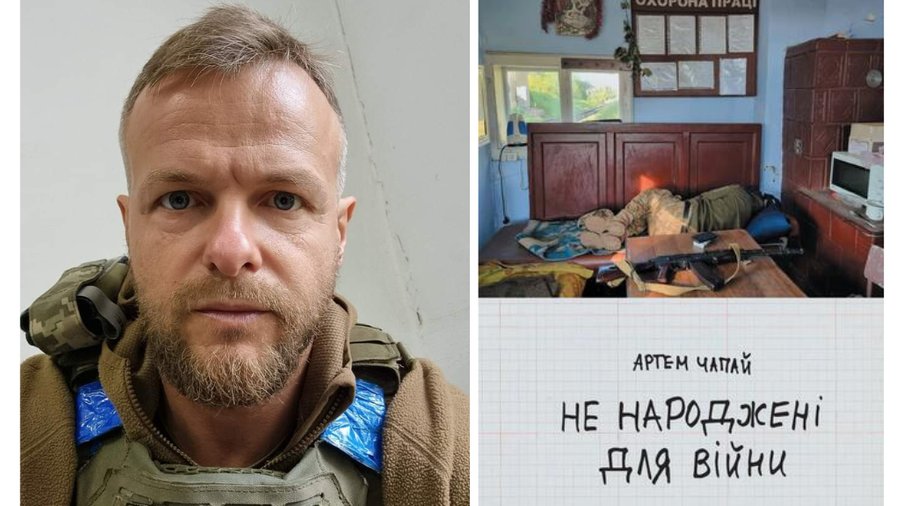
963
Artem Chapeye
‘Ordinary People Don’t Carry Machine Guns: Thoughts on War’ by Artem Chapeye to be translated into Chinese and Korean
11.04.2026 -