* ESC - close the search window
Åsne Seierstad
Reading a Wagner Soldier through Ukrainian eyes: The villain who still commands the world’s attention in Åsne Seierstad’s book
25.06.2026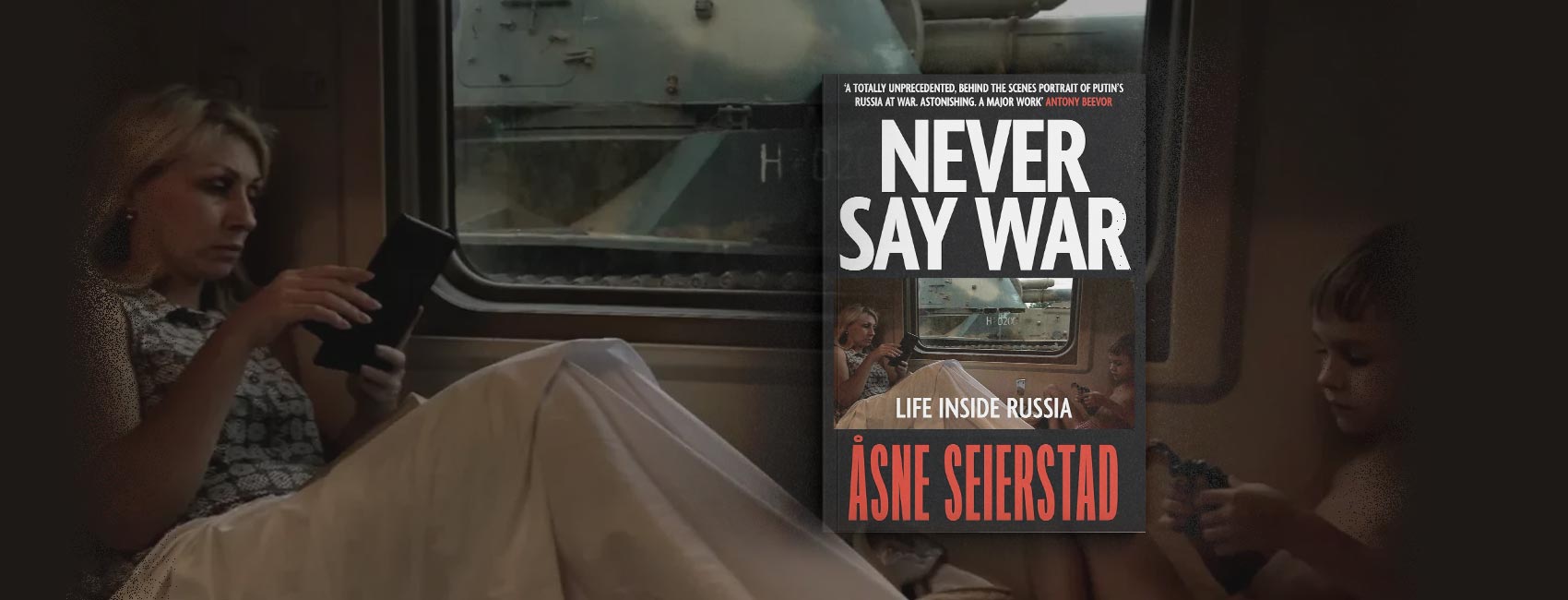

You see an error in the text - select the fragment and press Ctrl + Enter
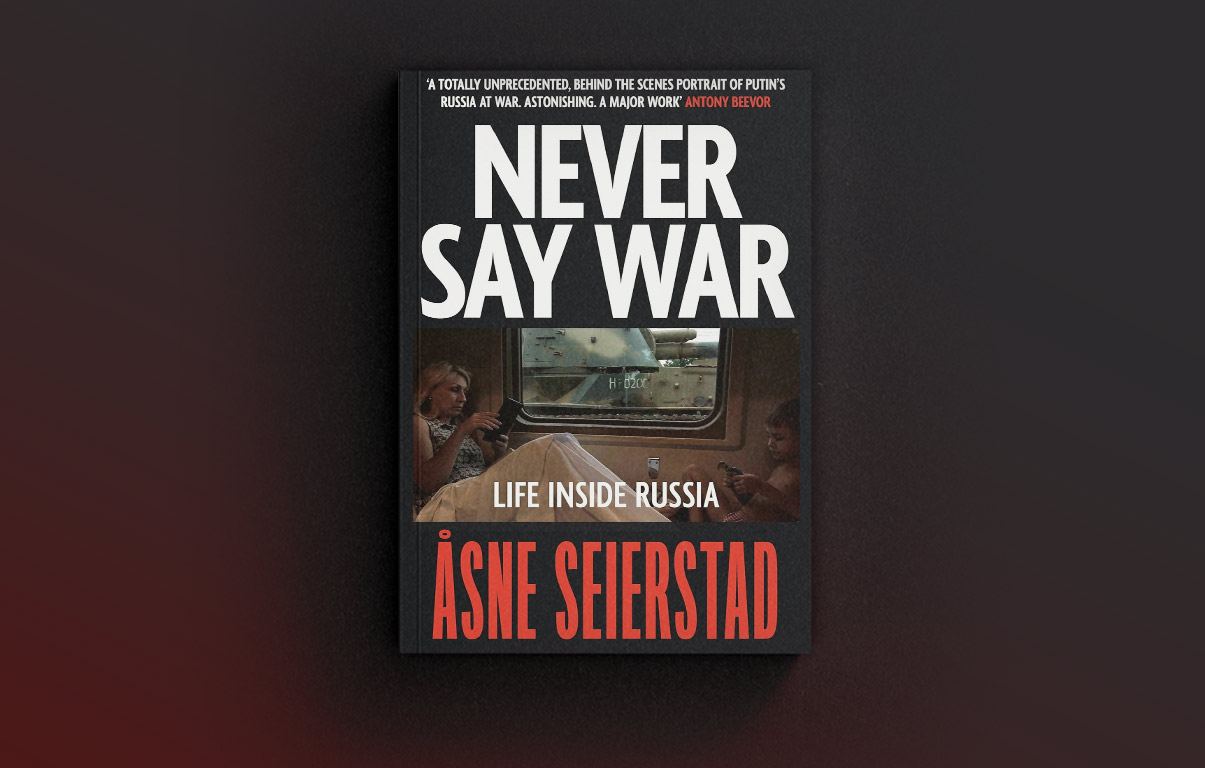
On June 15, 2026, the city library in Malmö, southern Sweden, hosted its final event of the season, marking the last author talk before summer break. This time, the season ended with renowned Norwegian author Åsne Seierstad and her latest book, a work of literary journalism about a Wagner Group soldier, “Ufred: Russland fra innsiden” (published internationally as “Never Say War: Life in Russia Today”).
I’ve read this book and couldn’t help but notice how Seierstad absolves the Wagner mercenary of responsibility, who voluntarily joined a private army and went to fight near Bakhmut. At that point, I had a few questions for the author.
When I walked into the library 15 minutes before the event, the large, modern hall shaped like a glass cube was already packed. Unable to find a free seat, I headed to the second floor. From there, surrounded by shelves of Polish, Turkish and Ukrainian literature, I watched the presentation and imagined sharing my impressions of the event with Ukrainians. “Yes,” I began sharing with my imagined listeners, “Europeans are still interested in the Russian soul.” I wrote the same thing that very evening in a long Facebook post, which serves as the basis for this article.
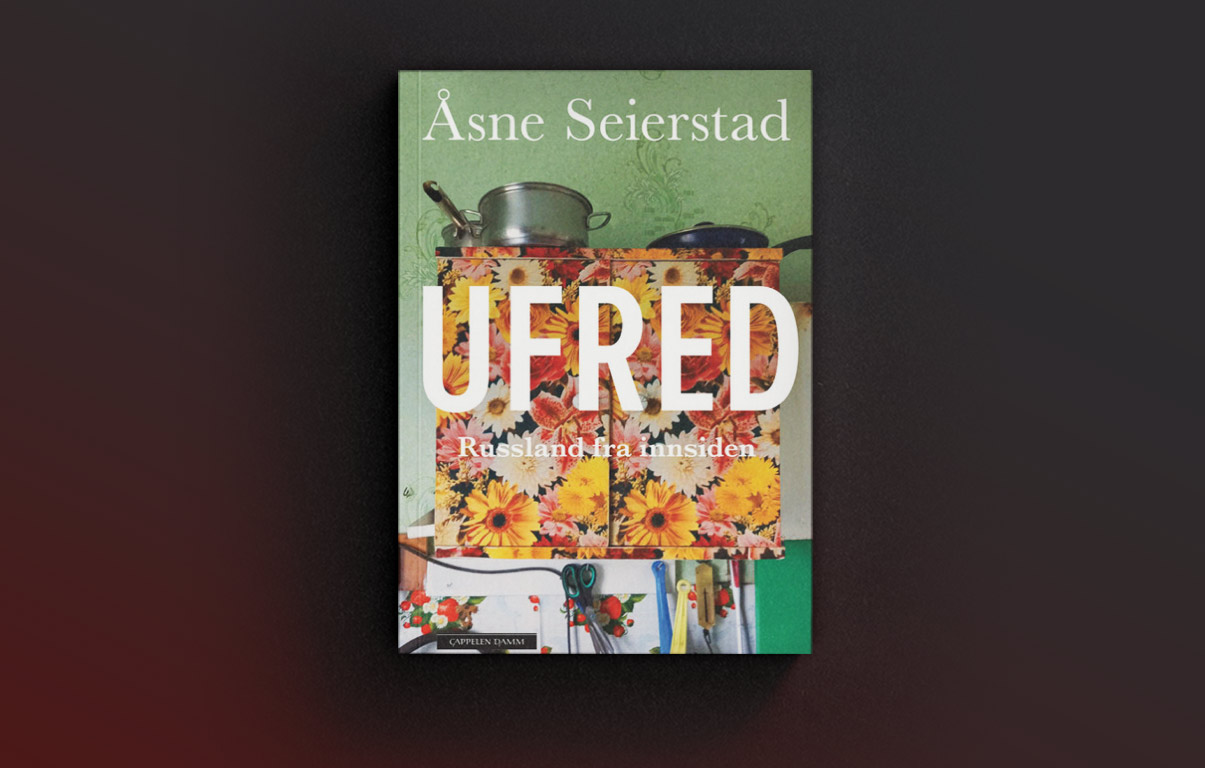
Ukrainian readers may remember Seierstad for her book “The Bookseller of Kabul,” the Ukrainian translation of which was published over 10 years ago (Nash Format, 2014). The Norwegian author’s latest work is titled “Ufred: Russland fra innsiden.” From Norwegian, I translate this as “Restlessness: Russia from the Inside.” It is a major work of reportage exploring the troubled life of a Wagner Group fighter and the rural Russian environment that shaped him. Seierstad suggests that, in a sense, he is not entirely responsible for who he became. More on that later.
I was interested in this book not only because it was about a Wagner Group fighter. I’d seen similar books on the shelves in European cities, but never felt compelled to read them. There was something else at play. In early spring, we discussed writer and Russo-Ukrainian war veteran Arthur Dron’s decision to turn down an offer from the major Norwegian publishing house Cappelen Damm because it had released Seierstad’s book in 2025.
I believe Dron’s argument was that he didn’t want the voices of Ukrainian soldiers to sit on the same shelf as the voice of a Wagner mercenary. Dron is the author of poetry collections such as “Dormitory №6” (2020), “We Were Here” (2023), and a short prose collection “Hemingway Knows Nothing” (2025). His poetry has been translated into 10 languages and “We Were Here” has been published in Sweden, Norway, Poland, and the UK.
RELATED: Hugh Roberts: Often I wonder who is supporting whom
That is understandable. At the same time, a major publishing house is unlikely to turn down a renowned author whose books it has consistently published, especially when the new book has generated such widespread interest.
I realized just how popular the book was when I visited the website of a local library in a small Swedish town and saw that I was number 259 in line for it. Fortunately, the waitlist at the University of Malmö was shorter. I waited my turn and started reading.
The book consists of five parts. The first tells the story of Andrei Medvedev, a young Russian from the Tomsk region, and how he ended up in the Wagner Group. It is based on interviews Seierstad conducted with him in Norway after he sought asylum there following his illegal crossing of the border from Russia. The later chapters draw on the author’s trips to Russia after 2022 and offer a view of “Russia from the inside,” as the title promises.
The book concludes with a brief account of another Russian who is fighting on Ukraine’s side. If it was intended to provide balance, it didn’t work from my Ukrainian perspective. And that is not what initially prompted me to write a post about this book. My immediate response was outrage, and it persisted throughout as I continued reading.
Ukrainians in Europe are accused of being overly emotional when it comes to Russian culture. But only a Ukrainian perspective can fully grasp the nuances of this text, nuances that may not be apparent even to an interested, well-informed reader from Western or Northern Europe.
This story can be viewed from two perspectives. The first is a neutral one in which the book is a thorough work of journalism that, overall, offers a broad context for how a person ends up in the Wagner Group and presents voices both supportive of and opposed to the regime, painting a broad picture of Russian reality. The author also took a personal risk by traveling to Russia at a time when the country was engaged in a war that authorities refused to call a war.
From a Ukrainian perspective, however, reading the book is likely to provoke irritation at the continued Western European fascination with Russians — their souls, culture, banya (bathhouse), and their braga (home brew). Both also appear in the text when Seierstad travels to the soldier’s hometown and speaks with his aunt there. Seierstad arrives with gifts, including a bottle of champagne, but the aunt puts it away in a cupboard and brings out something stronger instead. It was easy for me to imagine that this was the kind of character who might have encouraged soldiers to rape Ukrainian women, as we heard in the intercepted conversations of Russian soldiers in Oksana Karpovych’s film “Peaceful People.”
As a Ukrainian, I reacted skeptically at the clichés that probably would not strike a Norwegian reader as particularly tasteless: the chapter title “Moscow Doesn’t Believe in Tears” or the author’s conclusion at one point that “you can’t understand Russia with your mind.”

A screenshot from “Peaceful People” film
This Ukrainian perspective may be dismissed as overly emotional, yet it is also the only perspective that reveals what a European reader might otherwise overlook. What, exactly, is being overlooked?
As a Ukrainian woman and writer, I acknowledge that this is indeed thorough journalism undertaken at considerable personal risk. However, this piece contains substantial distortions and manipulations. As a result, the reader is inclined not only to sympathize with the aggressor, but also to justify his actions. Let me give you examples.
First, Seierstad goes to great lengths to portray the soldier as an ordinary person, someone who was simply trying to survive. At one point, while recounting how Medvedev voluntarily went to Ukraine to kill, Seierstad concludes the chapter with an observation that it’s all because one day Putin decided that Russians and Ukrainians are “brotherly nations.” But wait — we have just been told that after leaving prison, he did not know how to earn a living. So he voluntarily signed a contract with a private military company and went to Ukraine to fight, destroy, and kill for money.
I understand that portraying Medvedev this way makes it easier to appeal to a Western European reader. An ordinary person, a victim of the system. These are understandable, familiar roles. However, the book itself makes it clear that he could have chosen otherwise. Putin’s regime created conditions that made the decision to kill and destroy easier, but this man’s story shows that he still had a choice. So this isn’t a story about ordinary people who simply want to live rather than fight.
This emphasis in Seierstad’s work can be interpreted as suggesting that there are no war criminals, Putin is to blame for everything, and all soldiers, whether conscripts or mercenaries, are victims. Here, the author references acclaimed Croatian writer and journalist Slavenka Drakulić’s portrayal of grieving mothers in Russia and Ukraine in “War Is the Same Everywhere.”
At a certain point, Seierstad does indeed adopt her protagonist’s perspective. This may strengthen the book’s literary qualities, but reportage is first and foremost a documentary genre. Here, the protagonist’s point of view is left unchallenged and becomes the definitive “truth.” This is particularly evident in the scene with the house in Klynove near Bakhmut.
“ … have found a nice house with a basement. The room underground not only provided shelter, but also had shelves stocked with canned tomatoes and cucumbers, as well as two large containers of homemade wine … ”
That is all we learn about the place. It is treated as though it belongs to no one, an abandoned-looking house where wine conveniently appears, despite the fact that Medvedev prefers stronger alcohol. The author never seems to consider that this was someone’s HOME. Perhaps that is because her perspective was already shaped by Russia before she met the protagonist. After all, she studied in St. Petersburg. Our empathy often gravitates toward what feels familiar.
Further on, the text tells us that the soldiers in the house lay down to sleep: some on the couch, some on the floor, and two others in an actual bed.
I understand that the story was supposed to present the protagonist’s perspective and the way he experienced that situation. Yet the book never portrays the house near Bakhmut as the home of actual people. Instead, Ukrainians there are simply depicted as a dehumanized threat. They have no faces, they are simply “enemies” or, at best, “Ukrainians.”
“Here, near the front line, there was always a risk that Ukrainians might slip behind the line and attack while they [the Wagner Group members] were asleep,” we read, and it becomes easy to forget that the action is actually taking place in Ukraine, not in some no-man’s-land being fought over, and that Ukrainians could very well have been the owners of that house, harvested those grapes, and grown those tomatoes.
Imagine that the house stood on a Norwegian fjord and had been occupied by Nazis during World War II. Could the author have portrayed this “ownerless” house in the same way from the perspective of a German soldier?
Throughout the entire text, just as in the basement scene, there are no Ukrainians whose lives have fallen apart specifically because the “Andreis” made their choice. There is no room here, for example, for Ivan, who went to war not for money, not because he had just been released from prison and could not cope with life, and not because he needed a firm hand.
RELATED: An anthology with Iryna Tsilyk’s text has been published in Norway
There’s no place for Ukrainian Ivan, and I’m capitalizing his name because this is a specific Ivan, though he’s not the only one. He had a business, a job, a family, plans, and didn’t want to lose any of it. Ivan chose to defend Ukrainians from the “Andreis,” and he died, killed by one of them, and we can see his portrait on the Alley of Heroes. Another Ivan went missing near Bakhmut, and his portrait is not displayed on any memorial avenue. This happened not only because Putin decided that we were “brotherly nations,” but also because the “Andreis” made their choice. Let us not strip him of his agency and capacity for choice, even in difficult circumstances — whether he chooses good or evil.
But we have 600 pages about Andrei. Are villains more interesting to read about? Are the life stories of criminals more compelling to explore? The answer is yes, but only in literature. The detective genre is very popular in Scandinavia. But no text written during a war, a war that continues and destroys someone’s life, someone’s world, every single day, can merely be literature.
The book event in Malmö lasted an hour, and there was no opportunity for audience questions. “What do Ukrainians think of the book?” was the moderator’s only question at the end. I missed part of her answer, but the audience did not seem especially interested in it either. People lined up to buy copies, while I headed off to catch my train. I do not even know whether there were any other Ukrainian women in the audience. But here is my answer to the question of what Ukrainians think of this book.
Translation: Iryna Savyuk
Copyediting: Sheri Liguori
Читомо» — це медіа про книжки й літературу, що підтримувало українське книговидання задовго до того, як це стало трендом. Ставайте частиною історії — доєднуйтеся до Клубу Читомо!
the more you read, the greater the possibilities