* ESC - close the search window
books for libraries
Nearly half of Estonian-speaking readers skip buying books because of high prices
22.07.2026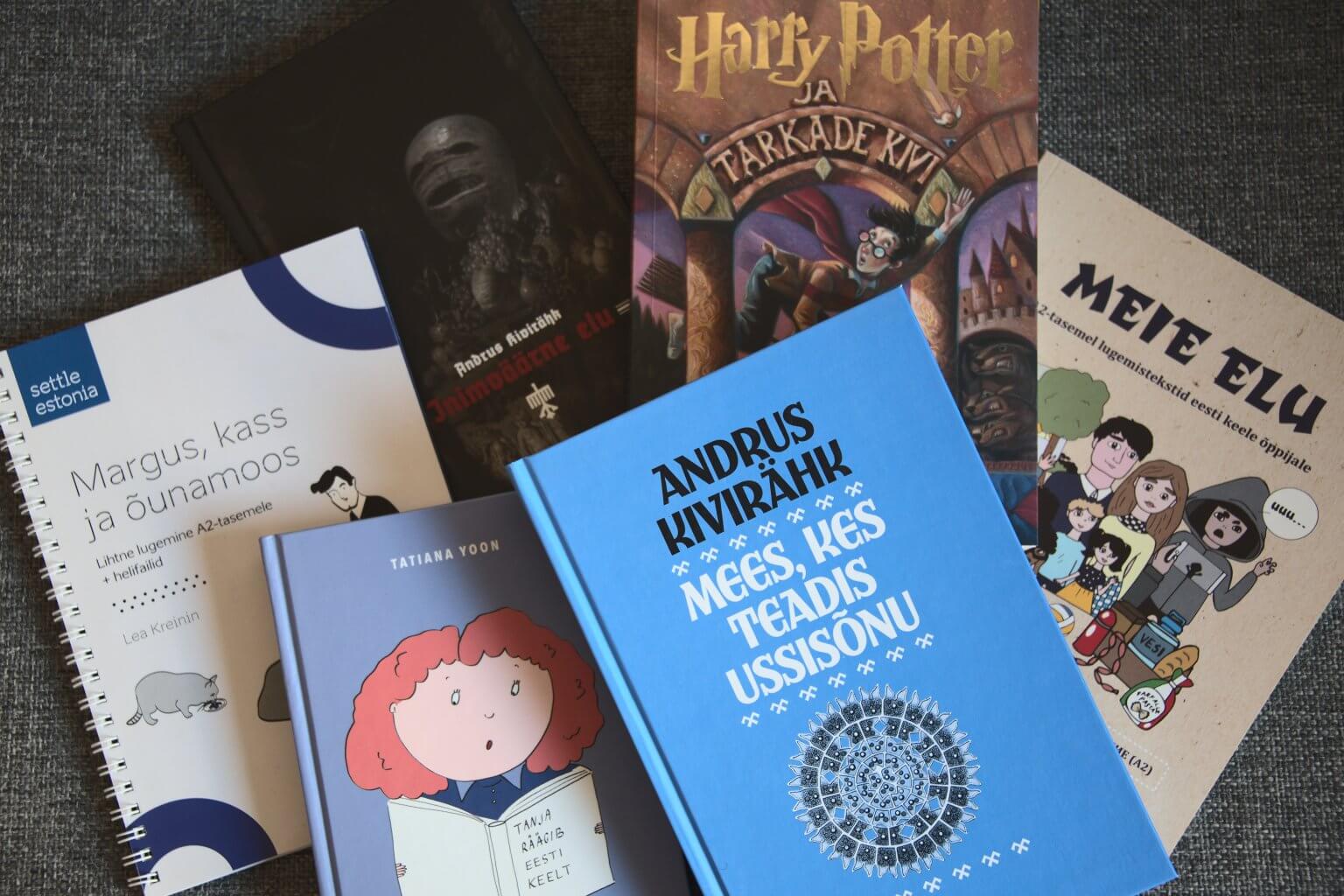
Nearly half of Estonian-speaking readers have frequently decided against buying a book because it was too expensive, according to a national study of reading habits. The researchers warn that rising prices are making Estonian-language literature less accessible, particularly to younger and lower-income readers, and increasing the importance of libraries.
The study, “Eestlane loeb 2025” (“Estonians Read 2025”), found that 46% of respondents classified as readers had often abandoned plans to buy a book they wanted because of its price. Only 16% said book prices had not prevented them from making purchases.
Price was the second most important consideration when selecting a book, after its subject and content. Forty-two percent of readers considered 20 euros the highest reasonable price for a printed book, while 24% were prepared to pay up to 30 euros. Among respondents aged 15–24, 63% said they would pay no more than 20 euros.
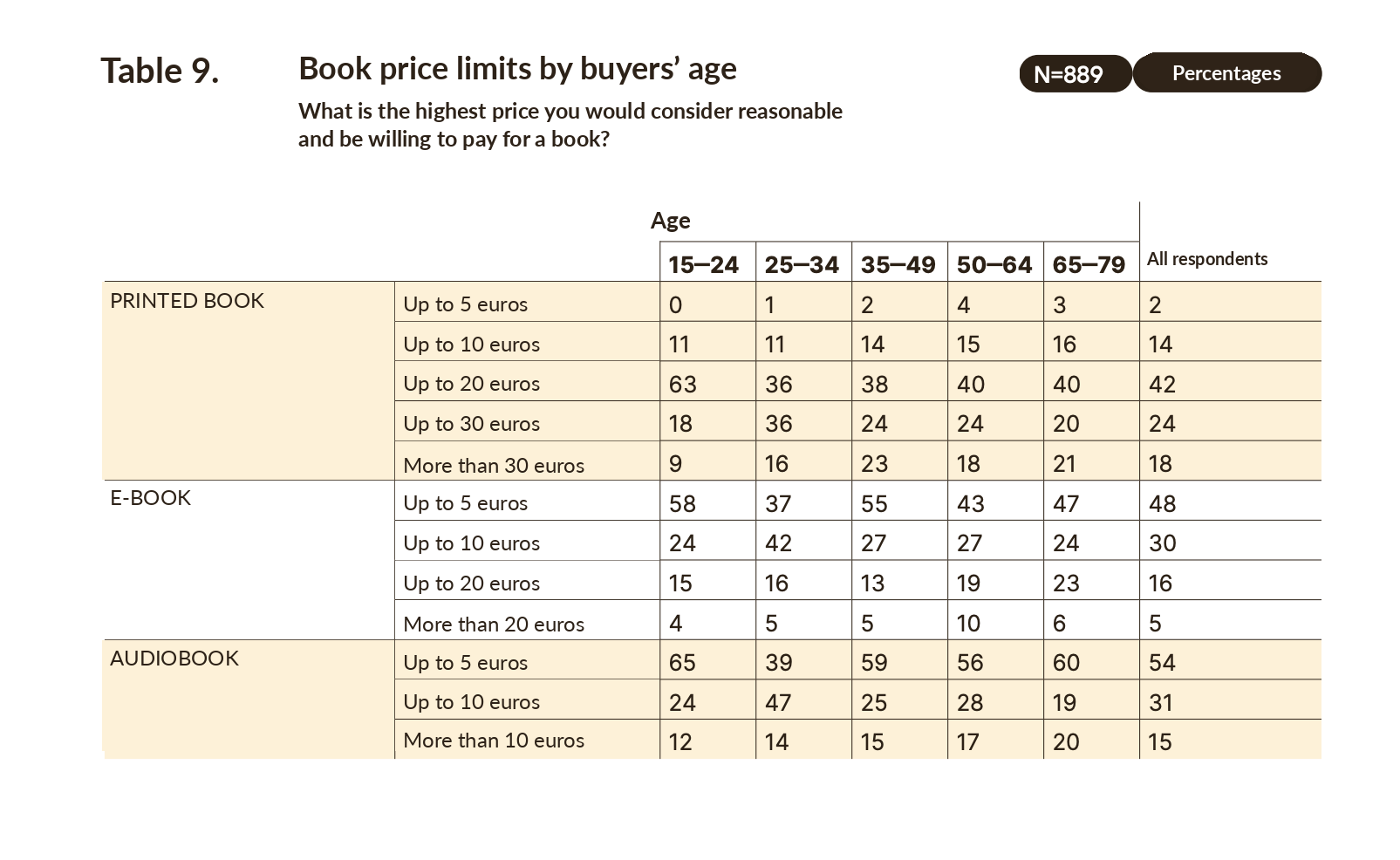 Image: “Eestlane loeb 2025” (“Estonians Read 2025”), National Library of Estonia, 2026.
The report identifies younger and financially less secure active readers as particularly affected by book prices. It is indicated that the cost of recently published Estonian-language literature may encourage some younger readers to choose English-language books that are cheaper and more readily available through international online platforms.
The report does not suggest that young Estonians have stopped reading. It found that 32% of younger respondents frequently read fiction, compared with 27% of the total sample. According to the researchers, the more critical question is what young people read and in which language.
Representatives of seven Estonian publishing houses — Eesti Raamat, Varrak, Tänapäev, Hea Lugu, EKSA, Päike ja Pilv, and Pilgrim — participated in the November 2025 focus group. They described a generational shift toward reading in English, although the report did not attribute individual comments to particular publishers. One participant said Estonian publishers had largely stopped translating young adult literature because some titles sold only 150–200 copies, while another estimated that English-language books could be up to three times cheaper than Estonian-language publications.
Publishers linked rising retail prices to smaller print runs and higher production costs. The researchers warn that if younger readers continue moving into an international, predominantly English-language digital environment, the market for Estonian-language books could contract substantially over the next decade.
Libraries become increasingly important
The study presents libraries as a crucial way to reduce economic and regional inequalities in access to books.
Of the 889 respondents classified as readers, 56% had visited a library during the previous year. Twenty-seven percent had visited frequently, while 29% had gone several times. Another 38% said their last library visit had been several years earlier, and 6% had never used a library.
Printed books remained the main reason for using libraries. Among respondents who used library services, 67% frequently borrowed printed books to read at home, while another 24% did so occasionally.
Libraries also helped readers discover and select books. Twenty-nine percent of users frequently encountered new titles in libraries, and 43% did so occasionally. Twenty-two percent frequently asked librarians for help finding or choosing books, while another 39% did so occasionally.
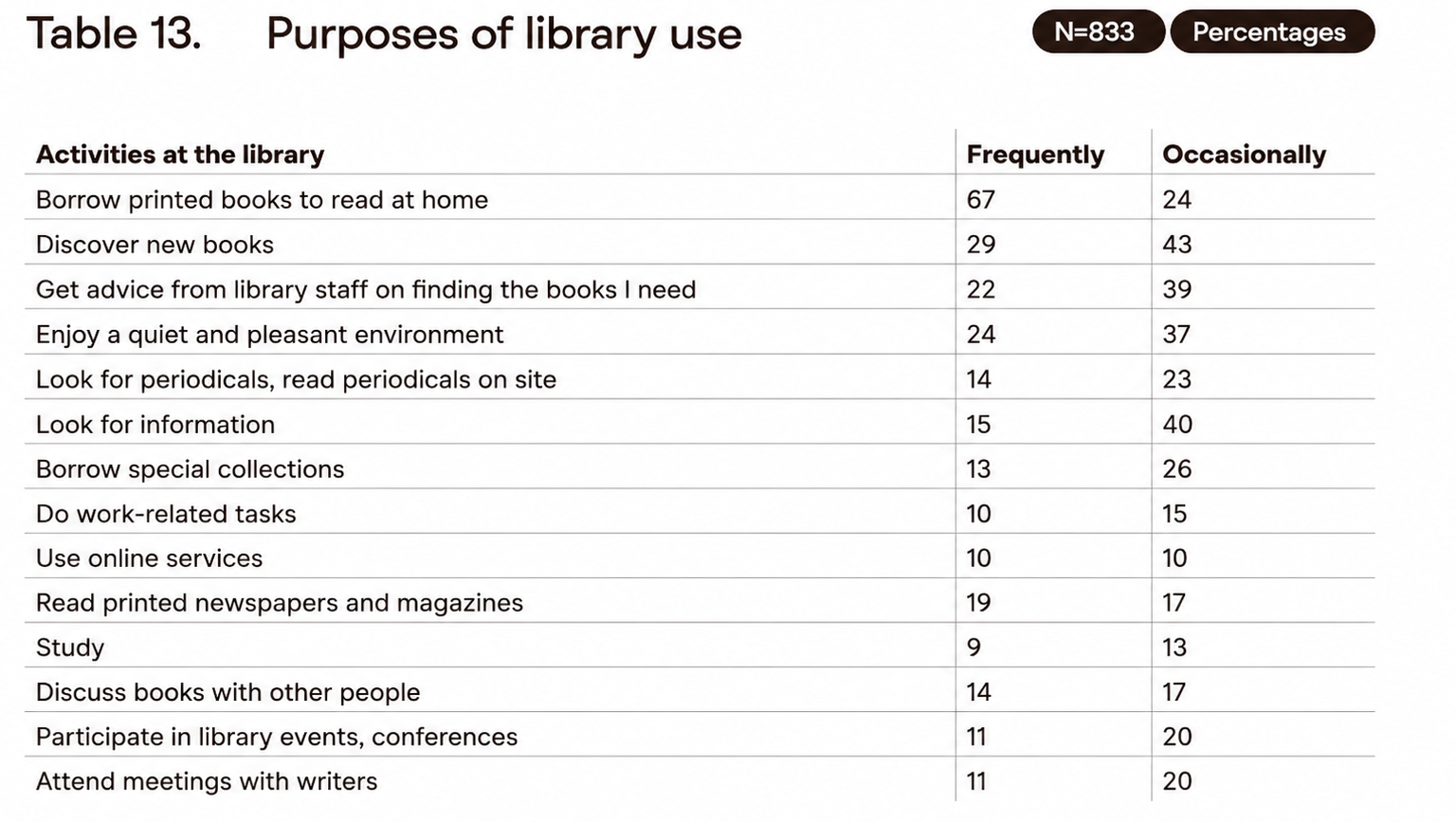
Image: “Eestlane loeb 2025” (“Estonians Read 2025”), National Library of Estonia, 2026.
Library use was comparatively more common among women, school-age readers, people with higher education, lower-income respondents, and residents outside Tallinn. This showed that libraries helped address differences in access linked to income and place of residence.
However, librarians interviewed for the study said libraries did not always have enough copies of popular Estonian-language books. Waiting lists for some titles could exceed 100 readers. The report argues that as purchasing books becomes less affordable, libraries bear greater responsibility for maintaining access to literature in Estonian.
Estonia publishes fewer books
The reading study was published as Estonia recorded a decline in book production. The number of printed book titles fell from 3,098 in 2024 to 2,883 in 2025, while the number of e-book titles declined from 2,349 to 1,901. The total print run fell by 6.5% to 1.976 million copies.
In 2025, publishers released 1,273 original Estonian-language titles, 6.8% fewer than a year earlier. The number of Estonian-language e-books declined by 12.8% to 1,507.
The report’s authors called for a national program providing stable support for the creation, publication, and distribution of Estonian-language books through libraries. They also recommended increasing resources for libraries and other cultural institutions and considering a reduction or removal of value-added tax on Estonian-language books and other printed publications.
The Estonian research company Kantar Emor conducted the nationally representative survey in May and June 2025 among 1,196 Estonian-speaking residents aged 15–79. Of those surveyed, 889 were classified as readers and answered detailed questions about book purchases, preferences, and library use.
The research also included focus groups and expert interviews with publishers, booksellers, librarians, literature teachers, and parents. The National Library of Estonia published the report in 2026, with the participation of the University of Tartu, the Estonian Literary Museum, and Kantar Emor. Estonia’s Ministry of Culture funded the research. The research formed part of the Year of the Estonian Book, held from Jan. 30, 2025, to March 14, 2026, to mark 500 years since the earliest known publication of a book in Estonian.
As reported earlier, the Estonian Librarians’ Association warned that state support for purchasing public library materials had remained unchanged for five years at 1.9 million euros, despite rising book prices. At the Oskar Luts Tartu City Library, 127 people were waiting for Tõnu Õnnepalu’s “Tööpäevale.” The association estimated that libraries needed at least 1 million euros in additional support to ease the funding shortage.
As reported earlier, Estonia allocated more than 1.4 million euros in public lending remuneration based on 4,051,004 electronically registered library loans in 2025. The payments were distributed among 2,115 authors and rights holders, with 27 authors receiving the maximum annual amount.
Main image: Joseph Haske / University of Tartu International Student Ambassadors Blog
Читомо» — це медіа про книжки й літературу, що підтримувало українське книговидання задовго до того, як це стало трендом. Ставайте частиною історії — доєднуйтеся до Клубу Читомо!
the more you read, the greater the possibilities