* ESC - close the search window
printed books
Share of Ukrainians who say they read at least one book a year rises to 80% over four years
08.06.2026
In the survey “Culture in Ukraine”, 80% of respondents said they had read at least one book over the past year, compared with 65% in 2022. The results of the nationwide study by Research.ua were publicly presented by Ukraine’s Ministry of Culture.
According to the survey, four out of five respondents read at least one book during the year. The largest group — 35% — said they had read one or two books. Another 20% read three or four books, while 25% read five books or more. At the same time, 15% of respondents said they had not read any books over the year, and another 5% could not answer or remember.
By age group, respondents aged 18–25 most often reported reading one or two books — 42%. In the same group, 25% read five books or more, 17% read three or four books, 14% did not read any books, and 2% could not answer.
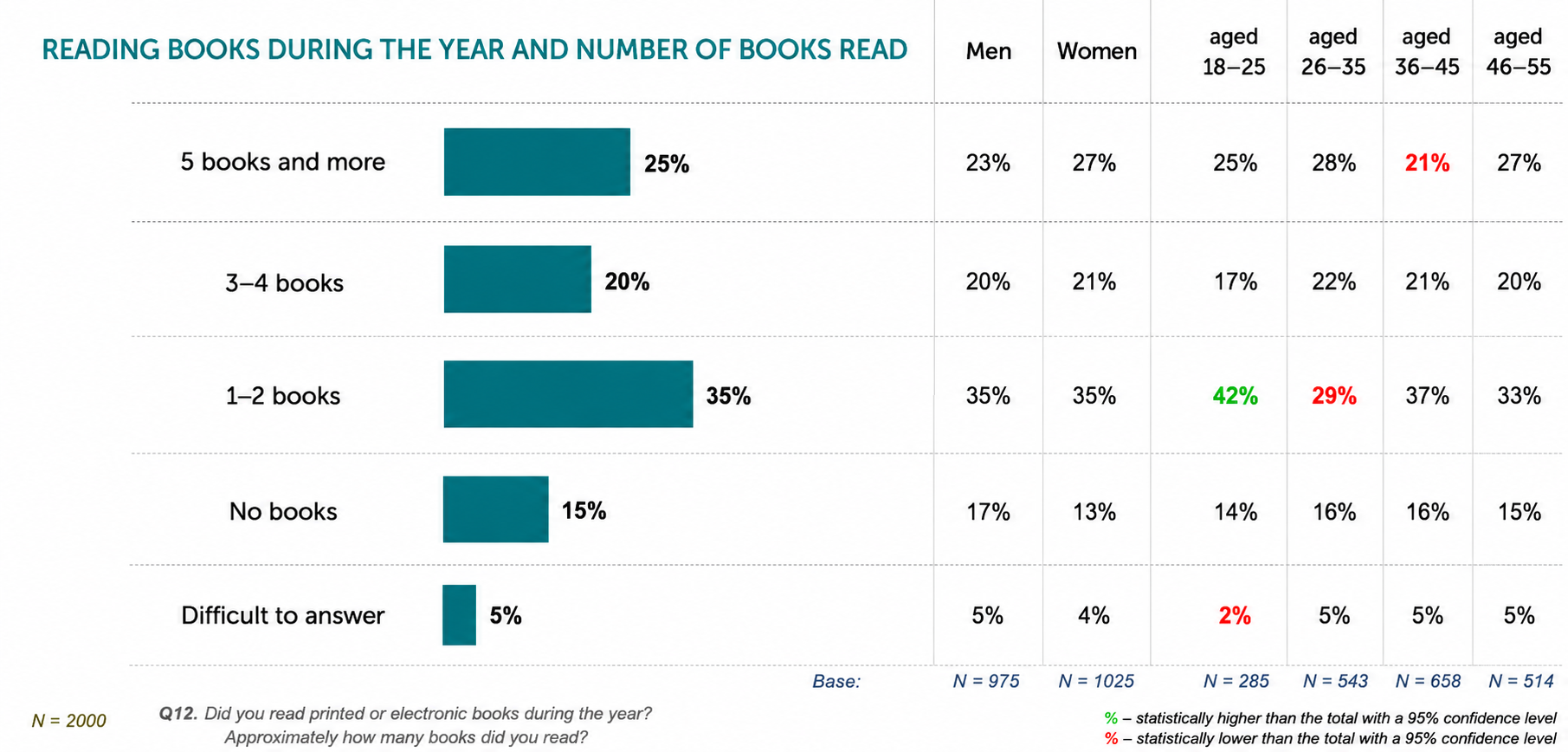
Among respondents aged 26–35, 29% read one or two books, 22% read three or four, and 28% read five books or more. In this age group, 16% did not read any books, while 5% could not answer. In the 36–45 age group, 37% read one or two books, 21% read three or four, and another 21% read five books or more. 16% said they had not read any books during the year. Among respondents aged 46–55, 33% read one or two books, 20% read three or four, and 27% read five books or more. In this group, 15% did not read any books.
Among men and women, the share of those who read one or two books was the same among men and women — 35%. However, women were slightly more likely to read five books or more: 27%, compared with 23% among men. 17% of men and 13% of women did not read books over the year.
Printed books were the most common format. Among those who read at least one book over the year, 75% read printed books, 55% — e-books, and 24% listened to audiobooks. Women chose printed books more often — 80%, compared with 70% among men. E-books were slightly more common among men — 57%, compared with 53% among women. Audiobooks were used by 26% of men and 22% of women.
By age, printed books were most common among respondents aged 18–25 and 26–35 — 81% in each group. Among respondents aged 36–45, 70% read printed books, while the figure was 73% in the 46–55 age group. Respondents aged 26–35 preferred e-books — 57%. In the 36–45 age group, the figure stood at 55%; among those aged 46–55, it was 54%; and among the youngest respondents, aged 18–25, it was 52%. Audiobooks were most popular among respondents aged 26–35 — 29%. They were used by 24% of respondents aged 46–55, 22% of those aged 36–45, and 17% of respondents aged 18–25.
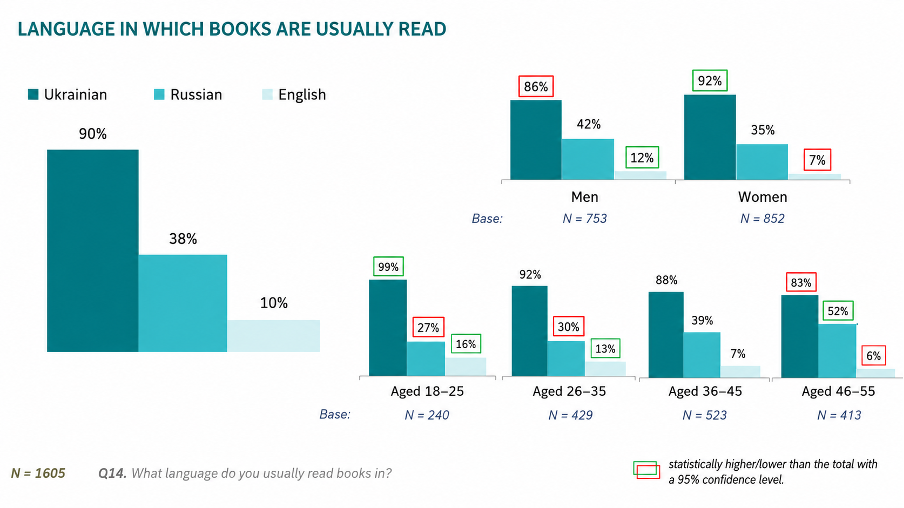
Ukrainian was the most common reading language. Among respondents who read at least one book over the year, 90% read books in Ukrainian, 38% in Russian, and 10% in English.
Women were more likely to read in Ukrainian — 92%, compared with 86% among men. Men were slightly more likely to read in Russian — 42%, compared with 35% among women. Books in English were read by 12% of men and 7% of women.
The highest share of Ukrainian-language reading was recorded among respondents aged 18–25 — 99%. In the 26–35 age group, 92% read in Ukrainian; among those aged 36–45, the figure was 88%; and among respondents aged 46–55, it was 83%. Russian-language reading was most common among respondents aged 46–55 — 52%. In the 36–45 age group, the figure was 39%; among those aged 26–35, 30%; and among respondents aged 18–25, 27%.
English-language reading was most common among the youngest respondents: 16% of those aged 18–25 confirmed reading books in English. The figure stood at 13% among respondents aged 26–35, 7% among those aged 36–45, and 6% among respondents aged 46–55.
The survey was conducted from Dec. 22, 2025, to Jan. 7, 2026, using online interviews. It included 2,000 respondents — men and women aged 18–55 from all regions of Ukraine, excluding the temporarily occupied territories of Crimea and parts of Donetsk, Luhansk, Zaporizhzhia, and Kherson oblasts. The sample corresponds to the characteristics of Ukraine’s urban population by gender, age, and region of residence before the start of Russia’s full-scale invasion on Feb. 24, 2022.
The study aimed to examine public opinion on culture in Ukraine, Ukrainians’ participation in cultural life, and everyday and cultural language practices.
As reported earlier, in 2020, 72% of surveyed Ukrainians said they read regularly, compared with 51% in 2014. Read also Chytomo’s analysis of how Ukraine’s book market responded to restrictions on Russian book imports. The article cites survey data showing that the share of readers who preferred books in Russian fell from 53% in 2013 to 28% in 2018, while the share choosing books in the original language became the largest category in 2018.
Infographics: Research.ua, Ministry of Culture of Ukraine
Cover photo: Book Arsenal, illustrative image
Читомо» — це медіа про книжки й літературу, що підтримувало українське книговидання задовго до того, як це стало трендом. Ставайте частиною історії — доєднуйтеся до Клубу Читомо!