* ESC - close the search window
English translations
One of the greatest voices of Ukrainian poetry and dissidence: What Vasyl Stus tells us about today’s Ukraine
12.11.2026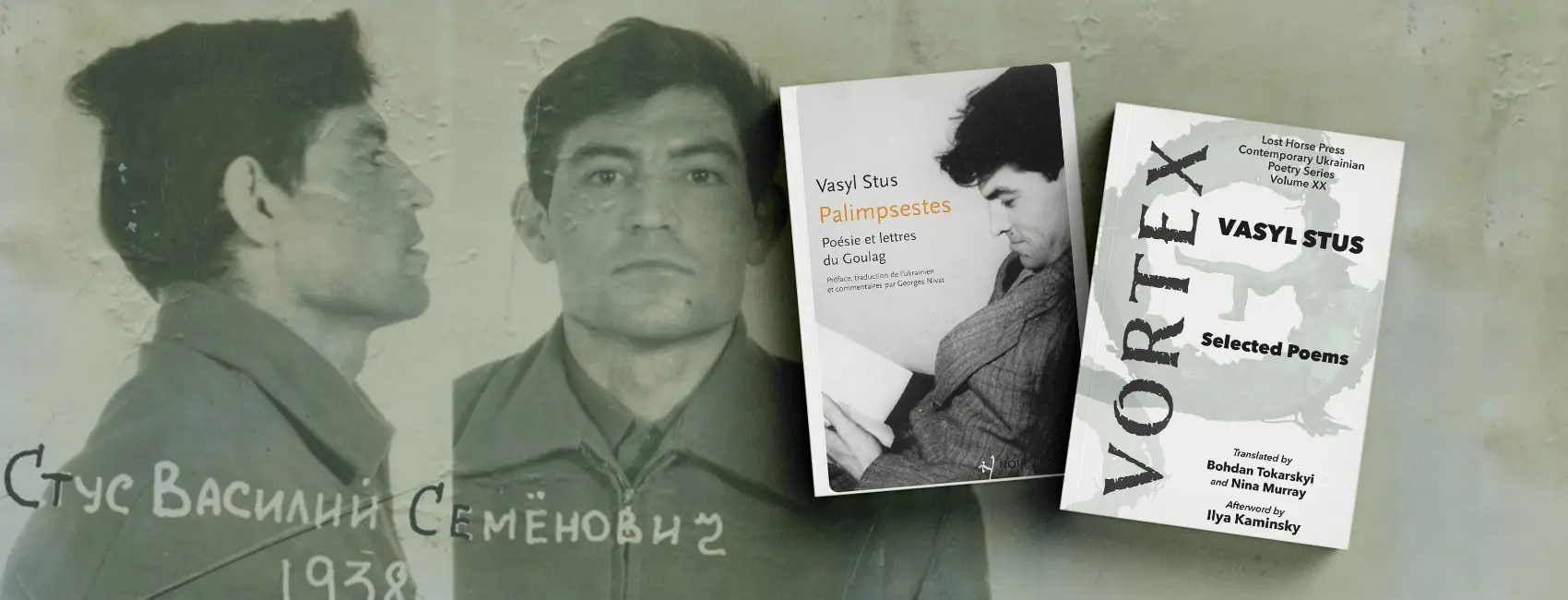

You see an error in the text - select the fragment and press Ctrl + Enter
This year, another great voice of Ukrainian poetry has finally been brought to English- and French-speaking audiences, for the first time in a full-scale edition, a voice that might explain Ukrainian resistance and resilience better than any other. A voice which, on top of that, gave the world some of the most profound poetry. Here is why Vasyl Stus matters so much, and what his voice reveals about today’s Ukraine.
In extreme moments, we, Ukrainians, keep turning to classics for support, and to authors who fought for the same cause we continue to defend. In the imperial 19th century, in the bloodbaths of the 20th century, in the turbulent 21st century with its Revolution of Dignity and the subsequent Russian war against Ukraine, we seem to have always been united in one aspiration, a brick-wielding Maidan activist shaking hands with Taras Shevchenko whose lines about resisting Muscovites remain as urgent as ever. Vasyl Stus is one of those key elements in the living chain of generations.
Born in 1938, Stus grew up in Donetsk (Stalino at the time), a predominantly Russified city his family moved to from Podillya, a region in western Ukraine, and formed his first impressions of Ukrainian language and poetry through the folk songs he heard from his mother. In the 1960s, after completing his studies and serving in the army, he moved to Kyiv to pursue literary studies. The late 1960s, however, were marked by another wave of repressions — not as massive as in the Stalin era, but no less brutal and Ukrainophobic. Stus, who had never conformed to the official aesthetic standards of socialist realism, joined his colleagues and friends in their fight for human rights and against political and ethnic discrimination.
In 1965, he joined a spontaneous protest during the premiere of Parajanov’s “Shadows of Forgotten Ancestors,” and was immediately expelled from the institute. He continued his literary work, even though his poetry could not be published and he was forced to earn his living in factories and heating plants, like so many of his generation. The KGB kept him under close surveillance, and finally, in 1972, he was arrested for the first time and sent to the camps. There he would spend the rest of his life, except for a brief pause for several months in 1979–1980 when he returned home and joined the Ukrainian Helsinki Group, a human rights organization, which was followed by his second arrest and 10-year sentence. In 1985, six years before the collapse of the USSR, Stus died in the camp; while the exact cause of death remains unclear, it comes as no surprise that Gulag prisoners were denied proper care or medical help.
Through all these hardships, Stus, uncompromising, wrote poetry outstanding in its depth and intensity. Bitterly — and perhaps rather ironically — insisting he did not consider himself a poet, he nevertheless steadily followed the path of Dante Alighieri, Johann Wolfgang von Goethe, and Rainer Maria Rilke, who were among his favorites, and Russian poet, novelist, and literary translator Boris Pasternak, from whom he eventually “set free,” in his own words; he kept reading, writing and translating, no matter what it took. Prisoners were allowed no more than five books in their cells, and it was nearly impossible to smuggle any writings from behind the barbed wire. Around 300 of his poems were destroyed by the camp administration, and yet, in 1983, Stus managed to pass a notebook with his original poems and translations of Rilke’s elegies to the outside world — an act for which he was confined to solitary for an entire year. But what exactly were those poems?
Stus, stubborn, fierce, stern, addressing countless open letters to Soviet and international institutions even knowing they would come to nothing: a man of steel. This is the stereotype formed upon only a superficial reading, for his poetry reveals a very different truth. It takes only a slightly closer look to discover Stus the lyricist, Stus in love, Stus in awe of the eternal beauty of flowers growing amid the barbed wire. His poems reveal his truer self, an unexpected fragility and sensitivity when he admits how deeply he misses home, his son, his country, declaring he is not “made of steel” and explaining to his beloved wife, as if begging forgiveness for the path he chose:
“What is my sin? That I still have a soul that aches with all the universe’s aches.”
Yes, it seemed to be an itch he couldn’t get rid of, the pain he felt for those who suffered from injustice, because he found intolerable “the conditions where a simple human wish to live a life with elementary decency requires superhuman boldness and heroism” in a country that “crucified us… simply for wishing to have a sense of self-respect, that of human and national dignity.” And even for demanding a more basic right “to have a world within oneself, that is a right to think, to have opinions, habits, a point of view, a character” — an individual freedom of thought denied by the totalitarian USSR. With almost Kafkaesque absurdity, Stus pointed out that one of his “crimes” consisted in not being a communist and having an alternative worldview (“abstract humanism” and “existential attitude,” in Soviet legal terms). In the belly of this soulless machine called Soviet justice, he could only “value the capacity to die honestly.”
RELATED: Ukrainian dissident poet Vasyl Stus’s bilingual “Vortex: Selected Poems” to be published in the U.S.
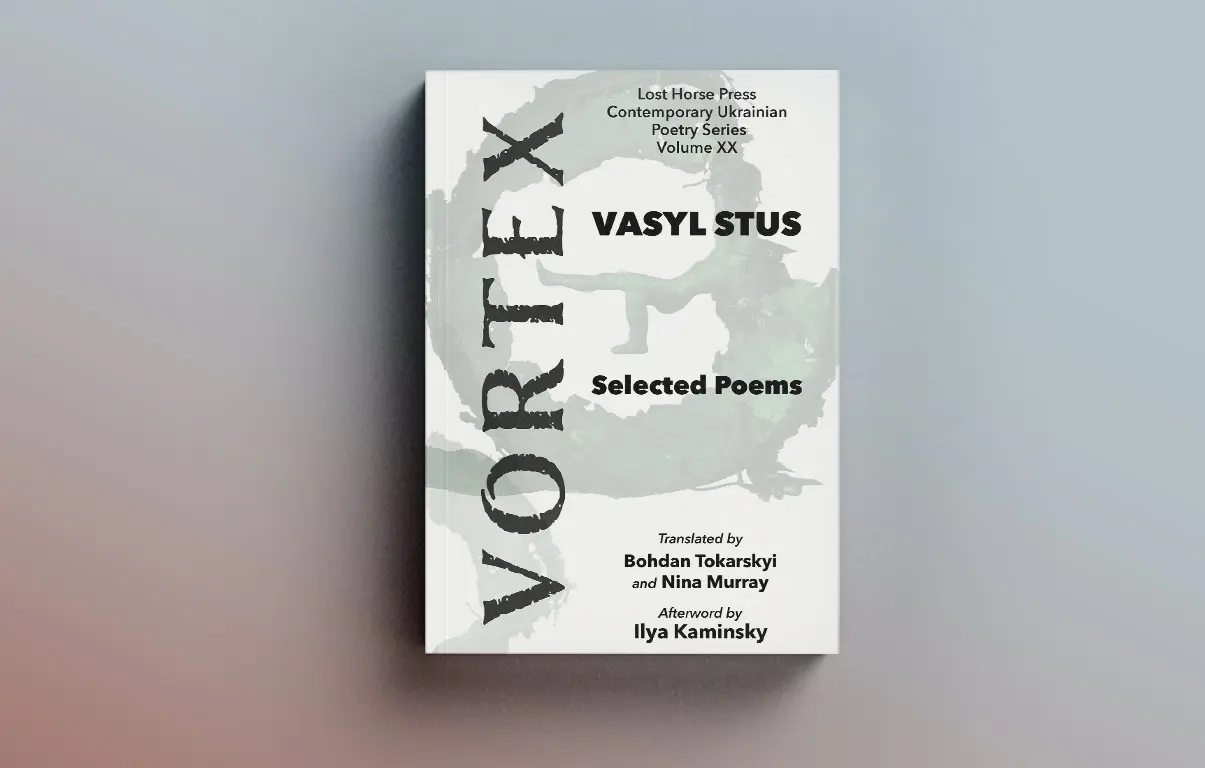
Unsurprisingly, the arrest marked a turning point in Stus’s poetics. It is curious that the two major publications of 2026 focus on two different periods of his writing. The American “Vortex: Selected Poems,” published by Lost Horse Press (whose catalog includes the most prominent voices of contemporary Ukrainian poetry), was originally intended to focus on the poet’s early work. According to one of the translators, Bohdan Tokarsky, a literary scholar specializing in Stus, these early texts reveal Stus’s unexpected playfulness, his taste for experimentation, and his pursuit of individual freedom. Ultimately, however, he and his collaborator, the renowned poet and translator Nina Murray, had to broaden their selection to give English-speaking readers, who may be completely unfamiliar with Stus, a fuller sense of his life and work. In his exclusive commentary for Chytomo, Tokarsky notes that “remarkably, the irony, the experimentation, and the eros all survive into “Palimpsests,” written during his years of imprisonment and exile. Yet this is a different Stus: more introspective, philosophical, and mystical; this is a poet of ethical intensity confronting both the limits of human existence and the violence of twentieth-century history.”
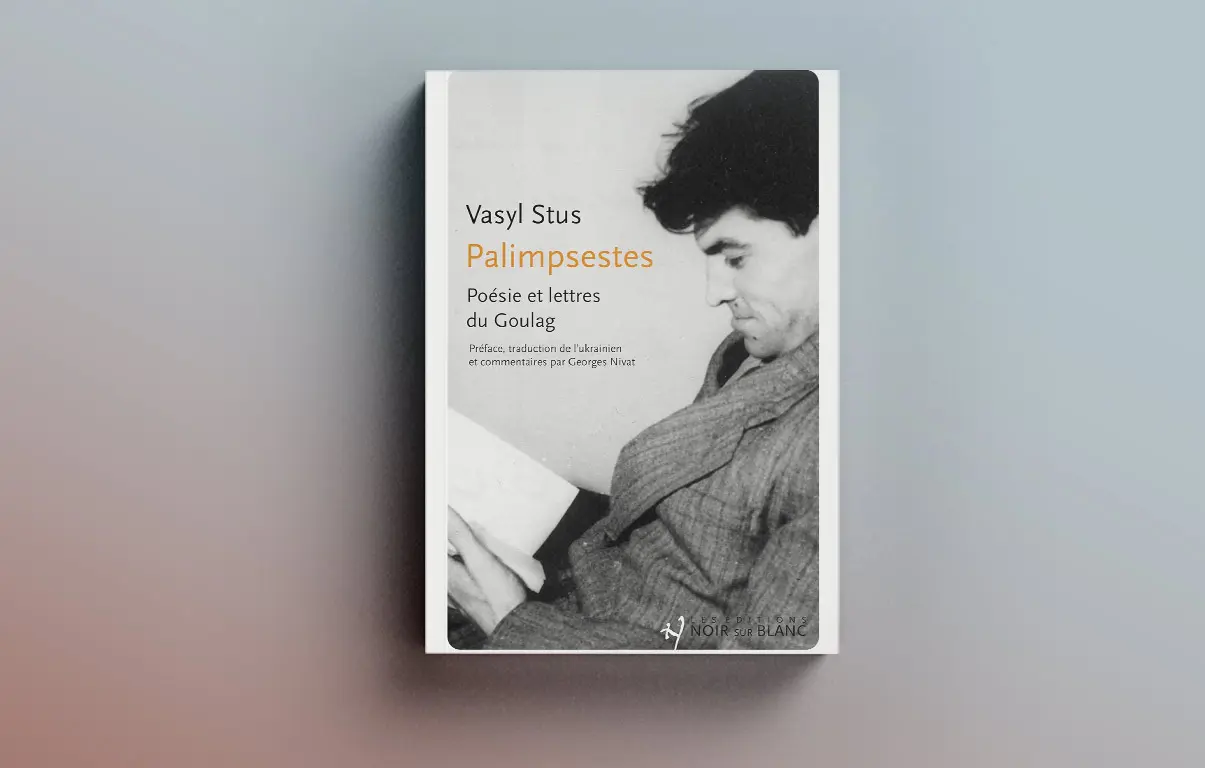
It is this late clandestine Gulag manuscript that served as the foundation for the French “Palimpsests: Poetry and Letters from the Gulag,” published by Noir sur Blanc, a Swiss publishing house with a long history of translating Ukrainian authors including Serhiy Zhadan, Yuri Andrukhovych, and Andrey Kurkov. This book is the first major collection of Stus’s poetry in French, and here, again, it is impossible to speak of the work without mentioning its translator, Georges Nivat.
Having dedicated his life to Russian studies, Nivat, at the age of 85, took up Ukrainian with a clear purpose: to bring Stus’s poetry, which he terms “a true masterpiece of world culture,” to a French-speaking audience. Never taken in by the Soviet system, Nivat belongs to the cohort of Slavists who are now fundamentally rethinking their relationship with Russian culture. In a recent essay for the German journal Lettre International, he disputed the position summarized in the 2022 (also Russian-originated) slogan “Putin, not Pushkin.” Having closely read Artur Dron, a 25-year-old Ukrainian writer and veteran whose front-line experience ridicules any attempt to separate Russian culture from the state’s centuries-old imperialist project, Nivat is now calling on his colleagues to undertake a rigorous, critical reexamination of the so-called Great Russian Culture. With this hefty, 600-page collection, Nivat makes a profound contribution to Ukrainian culture, a long-held aspiration he shared in an interview with Margarita Yehorchenko quoted in this article.
Still, however great Stus’s role in the Ukrainian dissident movement, it is his poetic language, magmatic, dense, raw, almost sore from the way he wrings every word to the last drop, that makes him one of Ukraine’s most prominent post-war poets. Translating him is no easy task (believe me, I’ve been there!) and requires a poetic sensibility that combines with a nuanced understanding of the surrounding historical, political, and geographical context. For both languages, the translators readily sacrificed form, rhythm, and rhyming system for the sake of preserving the density and richness. It is also curious how each translator’s background seems to have greatly influenced their work on Stus’s poetry, just as in his own translations we always hear Stus speak even louder than the author himself (“…as far as I know Rilke, he must have written it this way”).
For Nivat, Ukrainian is closer to Latin or Ancient Greek, in that they are learned as literary languages instead of spoken ones. This distanced position suits Stus’s language, somehow exotic even for Ukrainian readers, always oscillating between long-forgotten words and occasional neologisms bordering on freshly coined philosophical terms like self-pain or filling the self with self. French edition includes Nivat’s commentaries on the poems, though he points out that they are not meant for the reader’s first encounter with the author. He claims to have written them very cautiously: it would be sacrilege to dispel the obscurity of these texts, since “this obscurity is poetry itself.” He wrote, “it was a very personal choice for Stus to come up with this language and this manner of speech.” In his “Palimpsests” there is “a great mystery and a certain loneliness of the author.”
In a similar way, Tokarsky, who completed his PhD on the work of Stus, had the advantage of a scholar’s background, which sometimes made the process of translation more difficult as translations always require choices and losses. In his own elegant wording, he had to “consult the scholar first, but then politely ask him to wait in the next room while the translator got on with the creative work of making the poem.” Here, again, the point was to not let the light of knowledge illuminate the obscurity of poetic language too brightly.
For Murray, a poet herself, it was important to convey Stus’s “exquisite motion of thought and emotion” that she so often finds in his poems. She sees in his lines
“the poet breathing deeply, being quiet, and taking the world in, the rich, fecund life that is non-human and yet somehow also compelling to a human soul.”
And yet, it is in human interaction, sympathy, and support that Stus’s most vivid interests always lay. As Nivat puts it,
“in his poetry, he expresses not only personal suffering but also his sense of the fate of Ukraine, of the world in which both he and his country lived. It is precisely this that transforms his personal hardships into something far greater, driving his interpretation of history and lending strength to the voice he possesses within that history.”
Though he so often writes about empty cosmic depths — stars and suns, and that unreachable gap between worlds — these images are spurred to life not by the solipsistic pain of a lonely ego, but by a sincere ache for humanity. After all, it was Stus’s human rights activism and actions in defense of other political prisoners that cost him his freedom and eventually his life. Exposing the hypocrisy, cruelty, and absurdity of Soviet reality in a rather ironic way before the arrest, he then moved to exploring his imprisonment as an existential, almost mystical experience. That is why, in his poems, we see, in Tokarsky’s words,
“ethical intensity confronting both the limits of human existence and the violence of twentieth-century history.”
The “prison of nations” was fundamentally incompatible with Stus’s personal dignity, and it is this core intolerance of injustice that today makes Ukraine stand up against the same enemy Stus resisted. Modern-day Russia is everything that Stus fought against. I am writing this article in the November Carpathians, where I escaped with my husband and son to catch our breath away from the daily hardships of Kyiv. At home, there is hardly any electricity. No electricity often means no water, heating, or Internet. Even the new backup power station, our main hope for this winter, drained completely just before our departure (and it’s not even winter yet). At any moment, a missile or a drone could fall on our heads, yet we still have to navigate our daily lives and work under these conditions. It is clear that Russia is terrorizing the civil population to make us yield to their demands. Their mistake is probably never having read Stus — and here is why.
Ukrainians are adapting to the outage schedules and missile strike alerts, sharing life hacks, raising funds to set up safe communal spaces, giving each other rides to the other side of the river when the Russians bomb bridges, and helping one another in a thousand tiny ways. And — I state this not as a loud proclamation but as a simple fact — we are ready to live like this as long as we preserve the same dignity and human rights that Stus stood for, at a time when there were far fewer defenders of this cause.
Currently, there is a critical mass of people in Ukraine who are ready to sacrifice, if not their very lives, then at least their comfort and time with their families, for the sake of, as Stus himself put it, “elementary decency.” “Unhappy the land that is in need of heroes,” said Bertolt Brecht. Quoting him, Stus bitterly added that “of all possible forms of heroism, there is only one left under our conditions: the heroism of martyrdom, the forced heroism of a victim.”
Ukrainian realities are such that our country still needs heroes, yet great progress has been made. We are no longer confined to the martyr’s heroism Stus wrote about: we can also embrace the heroism of a warrior who resists and defends, the heroism of the battlefield. And when today’s poets fighting in this war, like Valeriy Puzik or Artur Dron, keep returning in their thoughts and writings to those they love and defend, don’t we hear in their lines Stus’s constant longing for his family and home? For “you cannot hide anything in poetry, which is probably the most intimate art of all.”
RELATED: S.T.A.L.K.E.R. 2 features soundtracks inspired by Vasyl Stus’ poetry
This material was prepared with the assistance from Krystyna Ubyikon
Copyediting: Terra King
Читомо» — це медіа про книжки й літературу, що підтримувало українське книговидання задовго до того, як це стало трендом. Ставайте частиною історії — доєднуйтеся до Клубу Читомо!
the more you read, the greater the possibilities

200
Academic Studies Press
Lyubko Deresh: ‘It’s appropriate to incorporate a myth to tell the story of our time’
23.10.2026 - Liubov Terekhova
115
Artem Chapeye
Artem Chapeye’s “T-Happiness” to be published in French in January 2027
20.10.2026 -