* ESC - close the search window
Academic Studies Press
Lyubko Deresh: ‘It’s appropriate to incorporate a myth to tell the story of our time’
23.10.2026

You see an error in the text - select the fragment and press Ctrl + Enter
This year, Ukrainian author Lyubko Deresh, 42, celebrates 25 years in his literary career. Deresh was only 18 when his debut novel, “The Cult,” was published in 2001. It tells the story of a young biology professor trying to solve the mystery of how his college students disappeared in the town of Midni Buky. This mystical intertextual book quickly won hearts of readers in Ukraine, inspired translations into other languages, as well as a radio play in Germany.
It solidified Derech’s reputation as a transgressive author who, using teenage black humor, is not scared to make readers uncomfortable and addresses complex themes such as self-harm and suicide. The characters in the writer’s five early novels are teenagers who straddle the boundaries between worlds and experiences, rebel against society, experiment with substances, explore their sexuality, and discover esoteric knowledge even in such mundane things as an algebra textbook.
Deresh faced a creative crisis at 23. He grew disillusioned with the material nature of human existence and to overcome these challenges, he set out on a journey to India. For an entire year Deresh lived in a community of downshifters (people who adopt a lifestyle of voluntary simplicity) in Egypt. “The Sinai Trilogy” (2013-2014), his next series that appeared after a five-year hiatus, are marked by a distinct allegorical quality and the influence of Hindu and Christian spirituality. Since then the author’s hallmarks have included mythological elements, symbolism, and philosophical depths.
His novel “Tam, de viter” (Where the Wind Is, 2021), about an author who, while in conflict with both himself and his literary community, follows a student rock band’s road tour as a reviewer. It blends the youthful recklessness that made the author’s early works so beloved and the psychological depth of overcoming professional and existential crises found in Deresh’s prose as a more mature author.

Photo from Lyubko Deresh’s personal archive
Deresh’s latest novel, “Medusa’s Gaze. A Little Book of Darkness,” originally published in Ukraine by Anetta Antonenko Publishing House in 2024 and by Vikhola in 2025, recounts the story of four former classmates and their partners through the real and metaphorical choices they make. Every action and emotion is deepened by the impact of war and the blackouts caused by Russian shelling.
Slavko, a philosophy teacher and adventurer, volunteered for the Ukrainian Army after the outbreak of Russia’s full-scale invasion. Myroslav, a creative writing instructor, fears his friend will judge him for not following his example. Businessman Yuzyk is trying to save his fourth marriage. Bizon, their fourth friend and a quiet family man, goes to the cemetery every day for no apparent reason. Is the gap in experiences between military and civilian friends unbridgeable?
“Medusa’s Gaze” won the Book Bloggers’ Award at the popular Knyzhkova Kraina 2025 festival and was shortlisted for the 2026 Taras Shevchenko National Prize of Ukraine.
Deresh’s books have been translated into German, French, Italian, Portuguese, Polish, Romanian, Bulgarian, Serbian, Armenian, Georgian, and Arabic. In December 2026, the American publisher Academic Studies Press will release the writer’s first English-language translation as part of its Ukrainian Studies Series. The novel “Medusa’s Gaze: A Little Book of Darkness” was translated by Dmytro Kyyan and Kate Tsurkan. The book will be sold in the United States, Canada, the United Kingdom, and Australia.
Chytomo discussed with Deresh the role of mythological narratives in literature, readers’ perspectives on understanding “Medusa’s Gaze,” and the changes to expect in the American edition.
Chytomo: Did you originally envision the novel including a retelling of the Medusa myth or did your vision for the story happen to coincide with the global trend toward literary retellings?
Deresh: I believe it to be a hallmark of the metamodern era we live in now. We suddenly find ourselves in a truly post-Christian world, where Christian virtues and the Christian narrative have little influence on the Western world’s perceptions. As a result, myths that underpin European civilization hold greater appeal than Christian virtues. As if our civilizational memory has been awakened and perhaps that is why Greek myths, rather than, say, Norse myths, have proven to be more significant today. Though just 25 years ago, in “American Gods,” Neil Gaiman explored precisely this turn toward Norse mythology.
I believe fantasy and mythology stem from the same need or responses to the same situation.
Fantasy is a more literal, straightforward inquiry into a certain ontology, fundamental values. Mythology is a more refined, mature approach. A myth places you on the edge. As if you believe and don’t believe it at the same time. This preserves your right to epistemological skepticism.
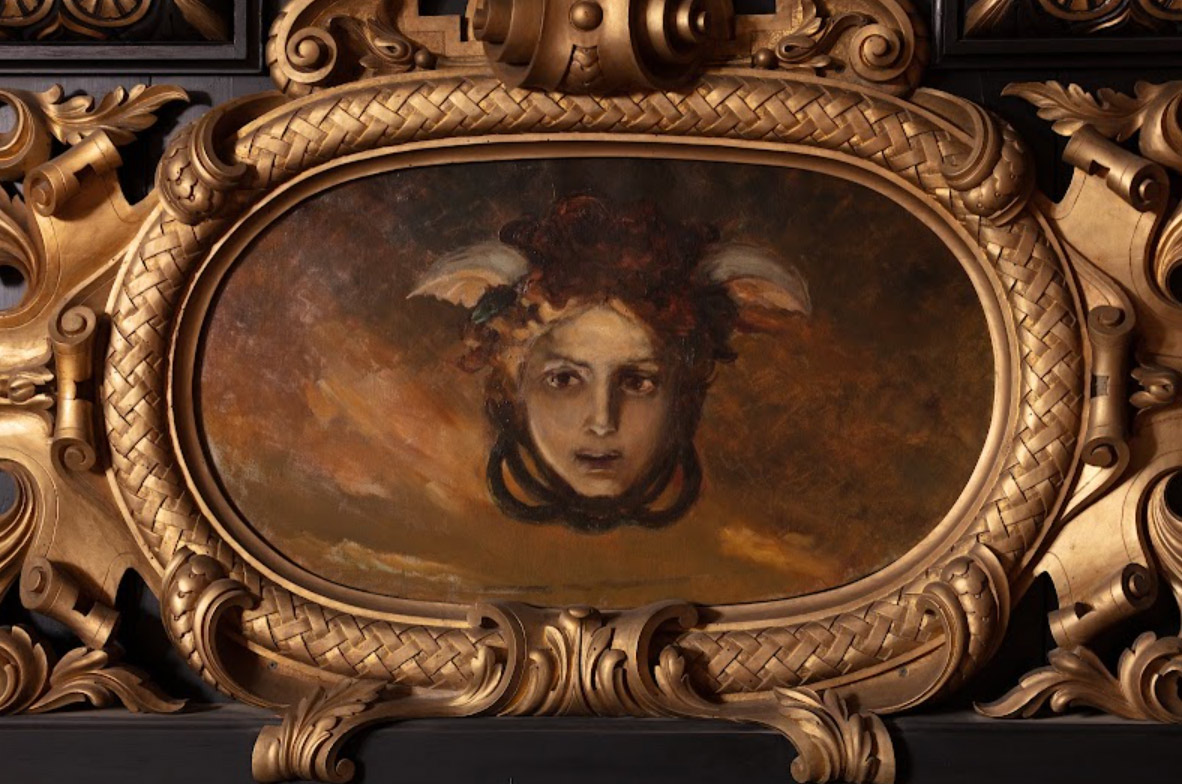
Wilhelm Kotarbiński, Desu-de-porte with Medusa. 1899–1900. Oil on canvas, 50 × 88 cm.
Khanenko Museum, Kyiv
At the same time, we have a profound need for grand narratives. Postmodernism feared and even fought against them, but we are returning to grand narratives: revenge, forgiveness, loyalty, duty, home, and war, as in the case of the Odyssey. In other words, we need these not merely as the stories of individual people. The personal story of an ordinary person must, at some point, evolve into a universal story. It must become a myth, and we keep coming back to it again and again. This mythical thread is our connection to this need, to this ontology. In today’s Ukrainian literature we have seen the emergence of Sofia Andrukhovych’s “Catananche” and Anna Bezpala’s “Cassandra Smokes Cigarettes.”
RELATED: ‘Enchanted Desna,’ ‘Radio Night,’ ‘The Gaze of Medusa’: New English translations in 2026
Writing “Medusa’s Gaze,” I hadn’t realized there was such a surge of interest in ancient Greek mythology, but I’ve always found this subject fascinating. The classes taught by Volodymyr Rafeyenko, my friend and teacher, instilled in me a love for both “The Odyssey” and the Greek tragedians. That’s why it seemed appropriate to incorporate a myth to tell a story of our time. It wasn’t a conscious decision, but rather an intuitive one. It was later that it became clear that it fit very well, because it turns out that the myth of Medusa and the themes of trauma are closely intertwined.
Chytomo: Which version of the Medusa myth did you choose for your novel?
Deresh: I mainly relied on the work by Ovid, but there are also versions by an Ancient Greek lyric poet from Thebes Pindar. A myth always exists as a matrix, or a set of variations. We know it to be an axiom: a myth is never one (story), it is always multioptional. Its nature ensures its longevity on any given occasion, a particular interpretation or plot variation comes to the fore. Who is looking at whom: Is Medusa looking at you or are you looking at Medusa? The same goes for who Perseus encounters along his path and in what order. For me, it was not so much a matter of arriving at a specific version — as the Greeks presented it — as it was of showing the multitude of interpretations of this myth — from a Jungian perspective, a Freudian one, through gender studies and other approaches, and through the themes of trauma and violence.
The interpretation can even go as far as the opposite: where Perseus is portrayed as a rapist and murderer, and Medusa — the victim. I tried to bring these different perspectives together so that they would be, if not equally valid, then at least simultaneously present.
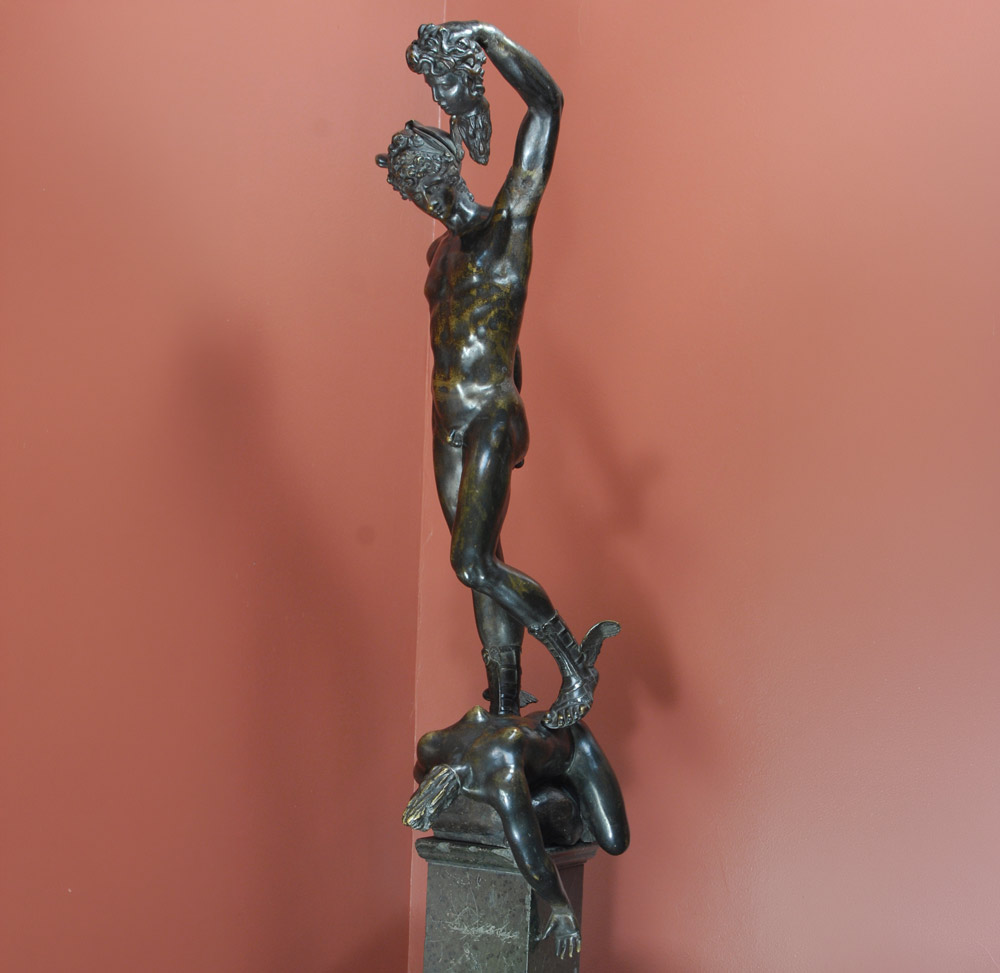
Perseus, replica after Benvenuto Cellini (1500–1571). Western Europe, 19th century.
Bronze and stone, casting and patination. Height: 64 cm.
Khanenko Museum, Kyiv
Chytomo: How do you interpret the myth of Medusa through the perspective of trauma?
Deresh: I viewed the myth of Medusa as everyone’s inner story. Athena, Poseidon, and Perseus are all parts of ourselves. Poseidon and the rape of the innocent Medusa — a priestess with beautiful hair in the temple of Athena — represent the encounter of the anima, our inexperienced “self,” with some kind of cruel reality, a certain traumatic situation.
Athena can be viewed as intellect in its purest form, which does not tolerate things that are wrong, denies and rationalizes everything, and says, “This could not have happened to me.” We will repress it. We’ll hide this now-cursed snake-haired Medusa somewhere out there in Hyperborea, in the far North, so we don’t have to see this traumatic part.
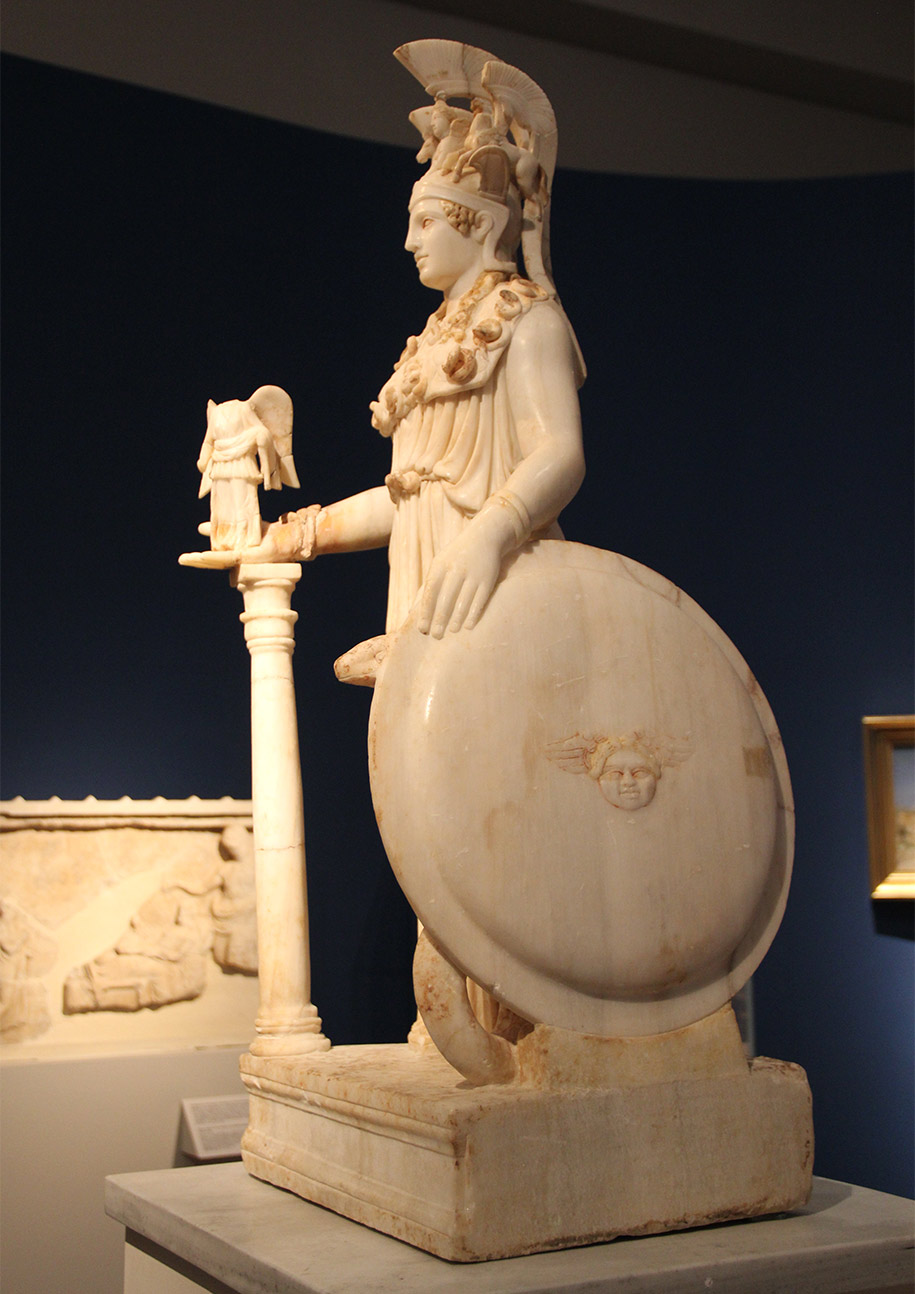
Athena Varvakeion, a Roman marble copy of Phidias’s statue Athena Parthenos, 200–250 CE.
National Archaeological Museum, Athens, Greece.
Photo: Gary Todd
Perseus represents curiosity, our heroic “self.” Athena banishes Medusa to the ends of the earth, yet she also helps Perseus find and kill her. Once defeated, Medusa becomes part of the emblem, a symbol on the aegis that is Athena’s shield. This can be interpreted to mean that our mind, in triumphing, cuts off the traumatic part, the dangerous, and transforms the event into a symbol. Trauma is transformed into experience. We then draw upon our experience in this symbolic form, and this gives strength. “I survived. I got through. I now know how to prevail in such situations.”
I applied the same approach to the novel’s polyphonic structure. Each chapter, told from the perspective of one character, flows into the next chapter, told from the perspective of another character, no period. This serves as a metaphor for how we, people, are connected into a single whole, at least on the level of a community, such as Ukrainians living through the war. Connected not only rationally, but also emotionally and intuitively when we feel other people’s pain and share an almost telepathic connection that helps them understand each other’s thoughts and emotions, though of course with certain caveats.
How else can we explain moments of solidarity, when we come together to, for example, clear rubble? That separation — walls of our “ego” — seem to melt away a little, and we see our neighbors more clearly. We see that another person might be feeling this pain.
That’s why humanity, the sense of inclusion, emerges. That’s why this story is a dialectic between a single consciousness that encompasses everything outside of which there is nothing, and subjective experiences. All the characters are parts of this unified consciousness. At the same time, each character exists as a subject, experiencing their own pain and, to a certain extent, even a sense of separation from this unified consciousness. After all, this is what Aristotle meant by tragedy as a departure from nous — the single, shared mind.

Photo from Lyubko Deresh’s personal archive
Chytomo: I feel that characters of the pacifist Myroslav and the veteran Slavko are opposites. At the same time, each of them is Odysseus returning home. Is that so?
Deresh: I wouldn’t call them opposites because I see them as complementary. Slavko is more about the body. He’s a very physical guy who loves physical expression, and in particular the female body. Myroslav is an embodiment of the mind, who might actually overlook the body. He walks out naked onto the street during one of his psychotic episodes, for instance. He disregards the body, and it becomes insignificant. Myroslav and Slavko complement each other, filling in what the other lacks.
As for whether they are Odysseys, I hesitated. The novel repeatedly evokes the image of a wine-dark or wine-faced sea, directly referencing Homer’s Odyssey [the ancient Greeks did not have a separate word for the color blue which is why, in Homer’s poem, the sea is described as dark, by association with the richness of wine — ed.]. At the same time, I held myself back from going down that particular narrative, because it’s too good to tackle so lightly. I haven’t seen Christopher Nolan’s “Odyssey” yet, but I’m already savoring the anticipation of watching it. Despite all the critical reviews that have come out, it seems to me that something important has happened in this film.
A truly moving portrayal of Odysseus can be found in a poem by Pavlo Vyshebaba from the collection “Marginalia.”
I think Vyshebaba has captured the image of Odysseus in poetry for our time, for Ukrainians. It’s such a powerful thing that I’ve tactfully decided not to touch on it. Let people who are more experienced and more attuned to this feeling do so.
Chytomo: Does the American edition of “Medusa’s Gaze” differ from the Ukrainian?
Deresh: There will be two significant changes. First I’ve added an entire section — a monologue by Karina, a military medic — about her civilian life in Mariupol during the invasion of the Russian troops. I had several drafts of this passage, and rewrote it many times, but I felt that I simply wouldn’t have time to settle on a version that satisfied me by the deadline. Karina’s story is both the story of a real person and the story of that very same mythical Medusa who finds herself here among us.
The details that appear in the added section are largely based on the account of one of my students who evacuated from Mariupol.
Second, I changed one of the final scenes, in which a woman named Marta appears. In the original version of the novel, she softens and changes. Marta arrives in Ukraine from France with a rather cynical goal. She wants to find herself a Ukrainian husband for the night, preferably a former classmate. In the English-language version, I shifted the emphasis slightly so that she strikes me as more realistic while still leaving room for hope that she has undergone a transformation. I hope these revisions will be incorporated into the new Ukrainian edition of “Medusa’s Gaze.”
Chytomo: There are numerous locations in Lviv (Rynok Square, Mars Field) and allusions and quotes from world and Ukrainian literature (even a macho, boyish Kendom from Greta Gerwig’s film “Barbie”) in the novel.
Myroslav, hiding in the Kyiv subway, has a phrase, “May it be upon you as the witch says,” circling in his thoughts. Ukrainian readers will definitely recognize this as a reference to “Vrazhe” (Enemy) by Ukrainian singer Angy Kreyda curse song based on Lyudmila Gorova’s poetry. Will there be any clues for English-speaking readers, perhaps footnotes?
Deresh: I’m a bit worried about how English-speaking readers will read and understand all this, but fingers crossed that it will be recognized. I trusted the publisher’s decision and the expertise of Max Lawton, the literary editor of the English translation. They didn’t want to turn the text into a collection of footnotes. I generally like the idea of footnotes, but I accepted the guidelines my publisher offered me. Therefore, the book will contain only three or four translator’s notes, which will be limited to explaining pejorative terms (rashysts, katsapy, khokhly, etc.). The translation process with Dmytro Kyyan and Kate Tsurkan went smoothly and with understanding.

Photo from Lyubko Deresh’s personal archive
If I could give commentary, I would need to write an entire text explaining the context from the Angy Kreyda song you mentioned to the allusion to Oles Berdnyk’s novel “The Star Corsair,” which gave its name to the board game featuring constellations in the book. I understand what prompted the decision to forgo editorial notes. There was some back-and-forth during the editing process over what we would and would not accept. For example, Lawton considered certain stylistic devices in the text less suitable for English-speaking readers, including the use of parentheses to convey deeper layers of the protagonist’s inner monologue, lowercase letters and the omission of punctuation. However, we came to a good understanding, and we managed to preserve most of the formatting as it appears in the original. That’s why I didn’t push too hard for the inclusion of explanatory notes in the American edition.
This September, a Portuguese translation of “Medusa’s Gaze” (O olhar da Medusa) was published in Brazil. While working, Volha Yermalayeva Franco and Paterson Franco Costa, the translators, took a different approach. They commented on these things. And, to be honest, I prefer that. My novel “Where the Wind Is” (Lá, onde há vento, translated by Emílio Gaudeda) was previously published in Brazil. It was well received by readers and achieved strong sales. I hope that “Medusa’s Gaze” will also do well.
Chytomo: I believe it wasn’t by chance that you brought up the topic of “Where the Wind Blows” (2011) and its translation. Is it your favorite work?
Deresh: “Where the Wind Is” and “Medusa’s Gaze” are the works I cherish most. But I must say that “The Cult,” like a grown up older son, keeps coming back to me again and again. It has enriched my life in so many ways and I can’t help but love and cherish it.
“The Cult” and “Worship of the Lizard” (2002) remain special among my early works.
Chytomo: In the short story collection “The Peacemaker” (2014), part of the Sinai Trilogy, you wrote about Robert Oppenheimer, the creator of the atomic bomb. Did you feel a certain kinship with Nolan, the director of the biopic about this physicist, given that you had also explored this topic?
Deresh: I’m particularly drawn to the 1930s and 1940s and, consequently, to cinematic portrayals of that era. It has always been a rich source of stylistic inspiration. There is something familiar about it, almost like being in a museum, yet somehow cozy, despite the turbulent nature of those years. The experiences of scholars during World War II also laid the groundwork for a sense of intellectual dignity. After all, at times, those who were not directly involved in combat sometimes had a greater say than generals in determining the outcome of that war — from cracking the Enigma code to creating the atomic bomb. That’s why this thread in Nolan’s “Oppenheimer” resonates with me. The film is majestic and well-made. What I felt was slightly lacking was the metaphysical dimension in this story.
While writing the short story “The Peacemaker,” I understood Oppenheimer not only as a man grappling with a civil or humanistic conflict regarding the creation of this weapon, but also as a man who ascends to a metaphysical level. Behind his quotation from the Bhagavad Gita, or behind Einstein’s statements, in particular, the one attributed to him, “God does not play dice,” I believe there is something more. When scientists reach a certain moral threshold, they evidently ask themselves about what they cannot know. What lies beyond that threshold? They answer this in different ways. Schrödinger in one way, Einstein in another, and Oppenheimer has his own. Actually, it was this very sense of “touching the boundary” that I felt was missing from the film.
Not only on a human level, but also in the beyond — this is a person who, by bringing such a devastating weapon into the world, unwittingly touches deeply and intimately upon the very foundations of existence.
Chytomo: Which works and authors have you kept coming back to throughout your writing career?
Deresh: I believe it is important to reread. You reread and find new layers, one by one. For my teaching in creative writing courses, I most often reread Sophocles’ tragedies, as well as Shakespeare’s “Hamlet” and “Macbeth.”
The main works I keep returning to are Yuri Andrukhovych’s “Recreations” and “Moscoviad,” Yuri Izdryk’s “The Island of KRK” and “Double Leon,” and various novels by Kurt Vonnegut though most often, I suppose, “Slaughterhouse-Five.” My teenage years of reading mysticism, science fiction, and fantasy culminated in Stephen King, whom I continue to love and admire deeply as an author. In some ways, I was also shaped by 20th-century literature: F. Scott Fitzgerald’s “The Great Gatsby,” the novels of William Faulkner, and, of course, Ernest Hemingway. I often turn to James Joyce. His concept of epiphany is important to me. I try to understand what he meant by it.
RELATED: Sex, escape, and rock ‘n’ roll: A review of ‘Radio Night’ by Yuri Andrukhovych
The publication is a part of the “Chapter Ukraine” project. The materials have been prepared with the assistance of the Ukrainian Book Institute at the expense of the state budget. The author’s opinion may not coincide with the official position of the Ukrainian Book Institute.
Copyediting: Ben Angel
Читомо» — це медіа про книжки й літературу, що підтримувало українське книговидання задовго до того, як це стало трендом. Ставайте частиною історії — доєднуйтеся до Клубу Читомо!
the more you read, the greater the possibilities
138
Chapter ukraine
Chapter Ukraine, a catalogue of hundreds of Ukrainian books in translation, adds new feature to help readers find their perfect Ukrainian book match
02.10.2026 -
44
English translations
English-language books are making some Latvian translations unviable, says Latvia’s largest publisher
30.09.2026 -