* ESC - close the search window
ambassadors of Ukrainian books
Hugh Roberts: Often I wonder who is supporting whom
17.03.2026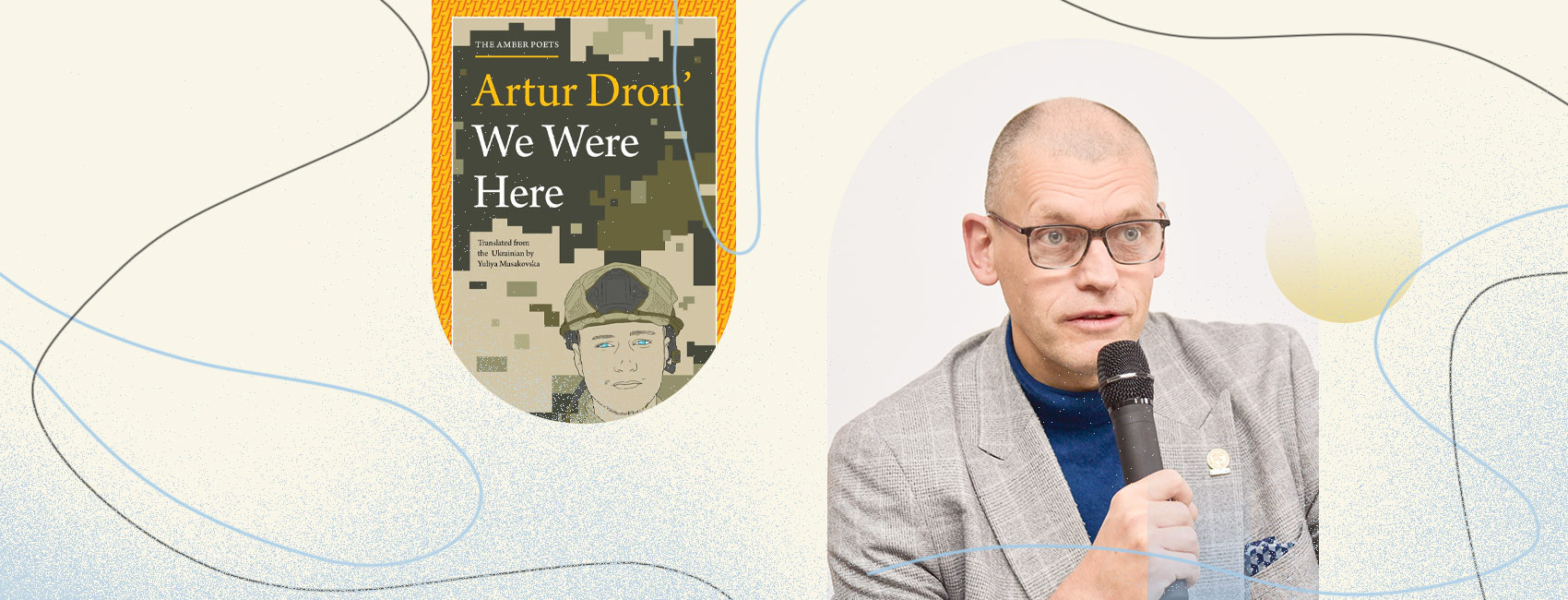
You see an error in the text - select the fragment and press Ctrl + Enter
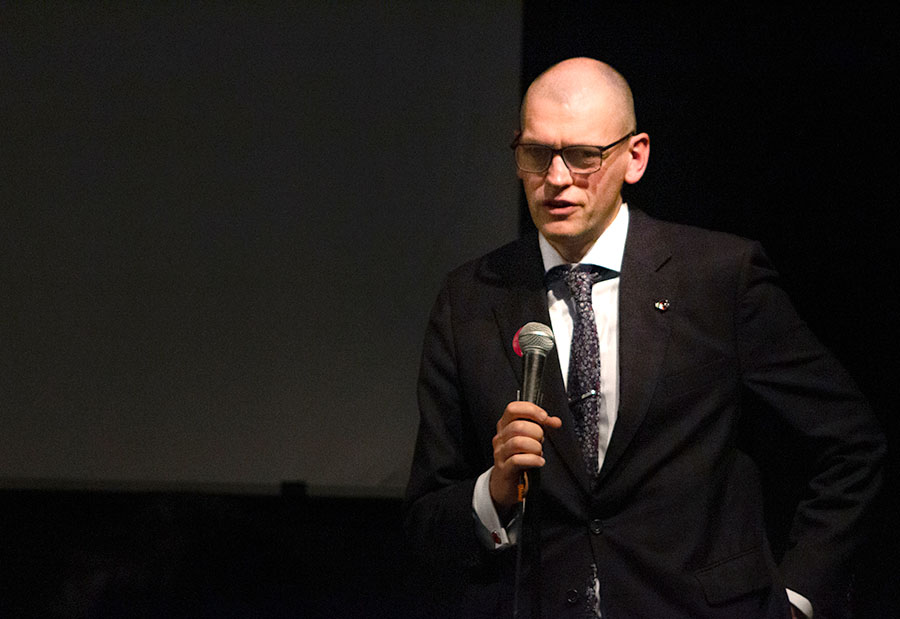
Professor of French literature Hugh Roberts greets me in Ukrainian — “Ну привіт, нарешті!” (Hello there, finally) — and I can’t help but smile. A few years ago, he knew little about Ukraine or the military; now he is a central figure in bringing Ukrainian wartime poetry to English-speaking audiences.
His work has been praised by senior military figures such as General Sir Patrick Sanders, who has highlighted the universal relevance of war poetry for armed forces communities. The World Literature Today has noted that projects like those he supports help lay bare “war’s psychological, mental, emotional, and physical horrors” while protecting Ukrainian cultural voices under existential threat.
From his base at the University of Exeter, Roberts has helped lead initiatives on Ukrainian war poetry, collaborating with UNESCO Cities of Literature and the Devon Ukrainian Association to amplify frontline and civilian voices. In 2026, he will head two major projects on Ukrainian wartime poetry and translation, using new funding to turn these fragile experiences into an English-language anthology and to build lasting poetic exchanges between Ukraine and the UK.
Olha Mukha: After everything you’ve learned about Ukraine over the years, how did the reality compare with your expectations during your first visit to Ukraine and the Lviv Book Forum in 2025? What did you find most extraordinary or unexpected?
Hugh Roberts: What moved me most was the welcome we received. I travelled with the poet Fiona Benson; you should see her fantastic article in The Guardian about the Lviv experience! And two others, the journalist and writer David Di Nota and his wife, Olivia Resenterra. Until summer 2023, I hadn’t thought seriously about Ukraine, so this encounter was very new.
On my first day I wandered Lviv alone, and that sense of discovery shaped all our Book Forum events. I was drawn to the memorials in the central square, with tributes, quotations, and biographies of people killed by Russia. We both found the Shevchenko statue, whose prominence underlines how central poetry is to Ukraine as a nation.
The cultural life is intensely active, and it feels much more alive than in the UK. That energy peaked during “Nich Poezii i Musyky” (“The Night of Poetry and Music”), the non-stop poetry and music night, where I saw how literally poets are “rock stars” in Ukraine. What I felt there was a powerful life force, the same force that drives Ukraine’s defence.
From a balcony I looked down thinking, “All of these people are basically targets,” yet they were partying, full of life, music, and poetry. It was tremendously inspiring, and it’s a kind of life force we in this country have a great deal to learn from.
In some ways, it was striking how normal everything felt and, at the same time, completely abnormal. After a bombardment, you still see families out enjoying a sunny day, the Book Forum back in full swing, and no one giving an inch. Life goes on in a kind of hyper-normal way, full of energy and resilience. Yet the war is everywhere: statues wrapped for protection, amputees on the streets, memorials at every turn. The ordinary and the abhorrent coexist in the same space.
Olha Mukha: And you experienced a night of shelling, right? That was the second night after you arrived. How did you perceive that — what was going through your mind?
Hugh Roberts: It felt uncanny. In a way, I’d almost expected it, because it was a high‑profile event and therefore a potential target. The alert itself was quiet, almost routine: no panic, just a measured announcement and everyone following instructions.
I was very moved by messages from Anna Khriakova of Lviv City of Literature, who kept texting, “Get to the shelter, stay in the shelter,” and updating us via the apps about what was heading our way. What I experienced was nothing compared to what Ukrainians endure on a horrifically regular basis, but on a personal level it felt right that I went through it. In a way, I could say: “Russia attacked me too,” because the aim was to shut down the cultural life we’d just been talking about, to crush that freedom and destroy it.
The attack was horrific, an absolute abomination, yet given that this is the reality we are facing, it mattered to me to be there. I work on Ukraine; if I never go and see any of it, what kind of witness am I? I had to experience as much as I could within the limits of the university’s risk assessment.
Olha Mukha: Let’s come back to the origins: you’re a Professor of French, and your Ukrainian is still in progress, yet since 2023 you’ve become a leading voice in translating and promoting Ukrainian wartime poetry. How did you even come to this topic, and how do you connect your background in French literature with Ukraine’s cultural resistance to find yourself under the Lviv shelling?
Hugh Roberts: It really starts in July 2023, when I organised an event called “Translating Cultures with UNESCO Cities of Literature.” Exeter City of Literature suggested inviting other Cities of Literature, and Lviv answered the call. From Lviv came Anna Khriakova, Yuliya Musakovska, and Olena Huseinova. They had sent poetry in advance to translate, including work by Artur Dron’ and “Mary to Golgotha” by Maksym Kryvtsov.
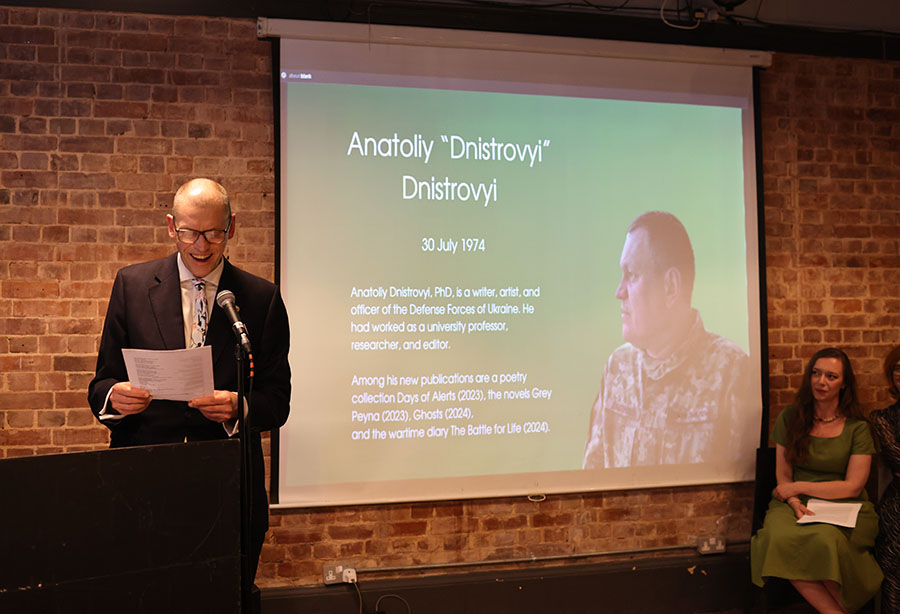
As I worked on that poem, I realised I was dealing with something of the highest order. I’d just published on Simone Weil, who argues that truth, beauty, and justice can unite in great works of art, and I felt Maksym Kryvtsov’s poem reached that level. When I read it aloud with Yuliya, Olena, and Anna, my only thought was: “Don’t get in the way of this. Just let the poem come through.” By the end, the room was silent; afterwards, Olena said, “We know Maria!”
From there, things moved quickly. We started a YouTube playlist, and my colleague in translation studies, Helen Vassallo, joined the project. Yuliya was eager to work on “We Were Here” because she knew how important Artur’s book is. We shared some translations online while looking for a publisher; when Helen saw that Mike Tate of Jantar had posted about Maksym Kryvtsov’s death, she contacted him, and he almost immediately said he wanted the book. With support from the Translate Ukraine programme, publication became possible.
For “We Were Here,” Helen and I worked closely with Yuliya over many Zoom sessions, then brought in Fiona Benson and Charlotte Shevchenko-Knight to refine the poetic voice; it was very much a team effort. We followed a similar model for “dasein” by Yaryna Chornohuz, this time with Amelia Glaser, again spending long hours on Zoom going through the text line by line. That’s how a Professor of French, thinking about Simone Weil and French philosophy, ended up working on Ukraine’s cultural resistance — and eventually standing in Lviv during a night of shelling.
Olha Mukha: Yaryna Chornohuz wasn’t in Lviv during your visit, but you did get to meet Artur Dron’, the other central figure in your translations.
Hugh Roberts: Yes, I was really looking forward to meeting Artur, and it was wonderful. We’d already been in touch, especially since he was invalided out of the military, and we’d done a joint book launch over Zoom between Exeter and Lviv, where his charm came across even through the screen. I read his poem “Partisan Street” there — about an angry Ukrainian woman chasing off a Russian soldier with her slipper — and afterwards he joked that, from now on, he would always hear it in my voice.
Meeting him in person was everything I expected and more. I saw much more of his wit, his intelligence, and his clear sense of himself as a writer. That comes through in his afterword to “We Were Here,” but I hadn’t realised how strong it was: he was always a writer, the war only interrupted that until he understood it was exactly what he had to write about. “We Were Here” is, to my mind, a masterpiece.
Olha Mukha: So you’ve built deep connections with Ukrainian writers, but when it comes to English-speaking audiences, what stages does a poem go through to reach the final version readers see?
Hugh Roberts: I live inside shared documents now. Years of literary analysis and teaching translation guide the process: first I ask what the poem is really saying, then how to let it speak naturally in English. With “We Were Here,” the voice is intensely personal yet collective, so the English had to feel as open and democratic as the original, while keeping certain elements unchanged. Sometimes that means adding a light gloss for a term like “evac,”* or checking details directly with Artur, such as the plural “sleeping bags” in “First Letter to the Corinthians.”
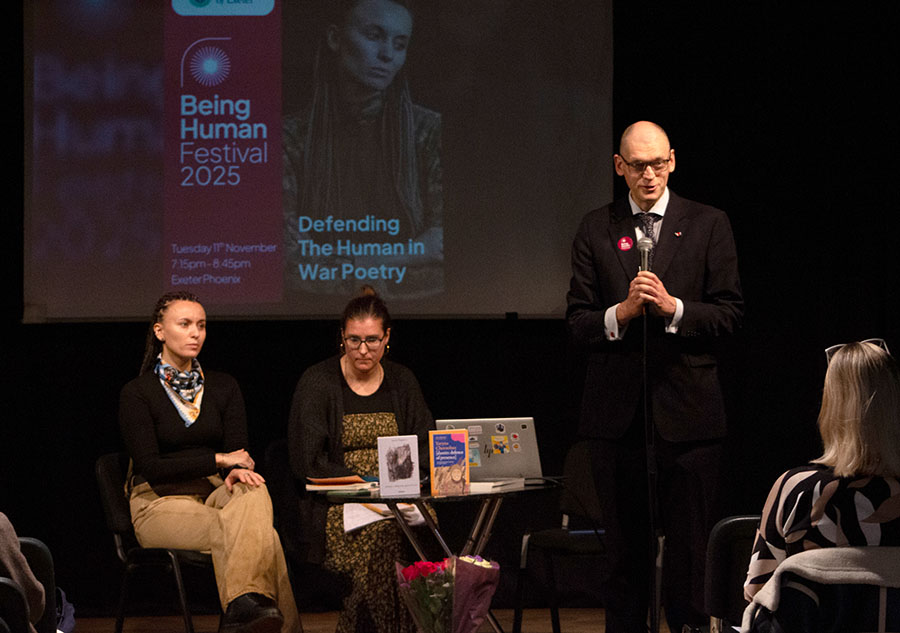
*Evac is a shortened, colloquial name for an armored evacuation vehicle used by the military to evacuate wounded from the battlefield.
In the foreword I anchored the book in Zelensky’s “We are all here,” because it is not overtly political yet clearly takes a position. With “dasein,” Amelia Glaser provided the initial translation, and Fiona Benson and I focused on poetic expression, where philosophy, surreal images, and raw experience meet, keeping it readable with only a short glossary. What I love is how distinct these poets are: Artur’s “We Were Here” is deliberately open and collective, while Yaryna’s dasein is far more intensely personal, shaped by grief for her partner — and you really don’t need Heidegger to feel either of them.
Olha Mukha: Your philosophical approach gives you an understanding of the urgency of cultural preservation, of how things are changing, of emerging challenges in culture. And there’s existentialism too. No matter which philosophical tradition French philosophers belong to, they still have very existential roots, right? I think that builds a deep foundation for translating this type of poetry.
Hugh Roberts: Yaryna explicitly describes herself as an existentialist, and she reads her own writing through that lens.
But beyond any “-ism,” one thing that unites this poetry and Ukraine’s defense, from an outsider’s perspective, is that the individual really matters. At the Frankfurt Book Fair, they quoted Maksym Kryvtsov: “If anybody asked me what war is, I’ll immediately reply: names.”
Olha Mukha: That line stays with you. Even if Maksym had written nothing else, it would have been enough.
I know you didn’t make it to Field of Mars*, and that may be for the best. It took me five or six trips to Ukraine after the full-scale invasion before I found the courage to go. I went first to pay my respects to Victoria Amelina, then to Yevhen Hulevych and Andriy Hudyma, all dear friends, and only there did I realise how many other names I knew — former colleagues, schoolmates, people I’d once loved. I naively thought that arriving at 7 a.m. would mean I’d be alone. Instead, there were already families: wives, children visiting their fathers before school, parents bringing flowers before work. The concentration of grief was overwhelming.
*The Field of Mars is the honorary burial (military) section of the Lychakiv Cemetery in Lviv.
It taught me that you have to prepare yourself; you can’t just decide to go the same day. Later, at a UNESCO event marking ten years of Lviv as a City of Literature, many international guests who had visited the memorial that morning struggled to process it. Once you confront that scale of loss up close, something in you shifts; you come away with an existential outlook, whether you intended to or not.
Hugh Roberts: Oh, I’m grateful you shared that. There’s a huge responsibility in translating this work, and ultimately a choice. With “dasein,” Amelia Glaser, the team, and I wrestled with how literal to be, how close to the pain. In the end, we settled on “a choice without a choice” to convey that there is, in reality, no alternative.
RELATED: Andreas Umland: The war on Ukraine makes a Russian breakup more plausible
As I wrote in the foreword to “We Were Here” by Artur Dron’, “Through the message his poetry carries across from the front line, we can be in no doubt about where we stand.” That feels especially apt here: the position is clear, beyond question.
At the same time, it’s important not to let the other side of that line — Russia — take center stage. The poems, and the lives and experiences within them, must remain the focus.
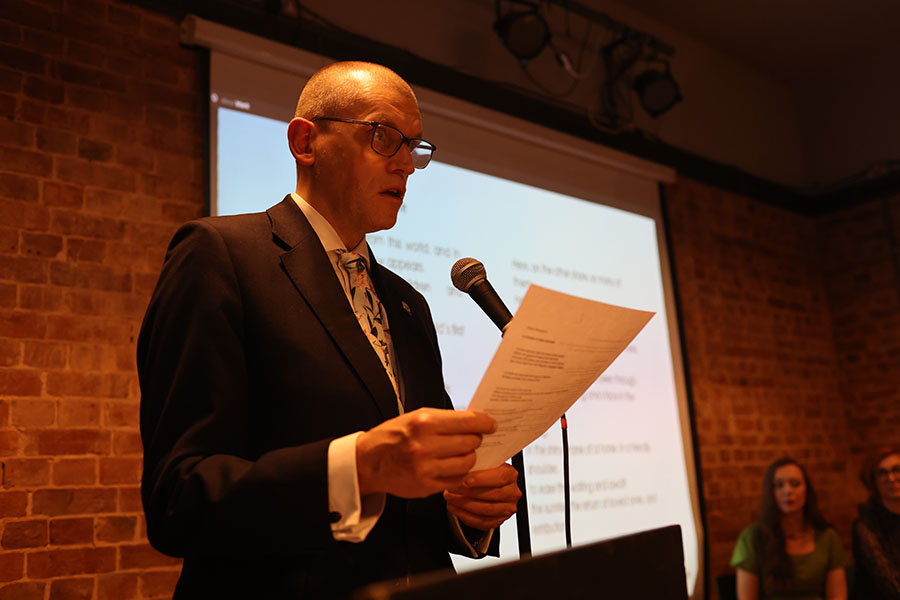
Olha Mukha: That was almost my first interview without mentioning Russia — until the very end…
But your point is crucial. Many “Slavic Studies” programmes, like at Oxford, still require only Russian and ignore Polish, Czech, Ukrainian, and others, collapsing a vast, diverse region into one “big Russian culture,” a Cold War relic of “knowing the enemy.” Professors whose careers are built around Russian often struggle to admit that this model is deeply flawed. How can academia change course when its own structures resist moving beyond a Russia‑centric framework?
Hugh Roberts: I know you’re going to ask tough questions. In some ways, I was in a good position because I had no institutional baggage in Russian or Slavic studies and could move into Ukrainian poetry without preset expectations or claiming expertise I didn’t have. I was even lucky not to know Russian. Until July 2023, I honestly knew nothing; even now my Ukrainian is minimal — just enough to order a coffee — which is embarrassing but pushes me to learn.
Ukraine had been a vast blank on my mental map, other former colonies that are so often overlooked. Then, in 2022, everything changed and attention shifted almost overnight.
Olha Mukha: Ukraine has burst onto the political map since 2022, but it is still fighting to be seen on the cultural map. People often mean well yet remain painfully uninformed — and sometimes lack tact. I’ve been asked, “Do you even have real art to protect?” or, “Why not just change flags, pay taxes, and save lives — what’s your problem with occupation?” That question froze me. They can’t imagine occupation as genocide, because Ukrainians don’t fit their stereotype of passive victims. We insist on recognition of our culture and our right to shape our own future.
Hugh Roberts: I’ve picked up a vibe that Ukraine’s resistance has been an inconvenience for some — especially those whose academic careers would be easier if Ukraine hadn’t pushed back. It’s infuriating when colleagues insist on “objective” scholarship that always includes the Russian perspective first. Rory Finnin wrote powerfully about this and said it makes him want to scream. And I feel the same.
But I’ve stopped expending energy on it. My focus is on promoting Ukrainian culture and supporting translators. UK higher education is under strain, so launching Ukrainian Studies programmes right now is unlikely. Yet I’m fortunate: I can win grants, connect with publishers, and have the full support of my faculty and University.
Olha Mukha: How can we deal with the fact that Britannica still presents Russia as beginning in Kyiv? This is blatant cultural appropriation and historical falsification. Britannica markets itself as a serious, peer‑reviewed reference work, so why does it keep reproducing this narrative — and what can we actually do to change it?
Hugh Roberts: I think it comes down to incomplete “decolonization” in this field; people simply haven’t recognized the issue.
There’s a tremendous amount of work to do, but it’s not my role alone. We must preserve academic freedom while encouraging colleagues to address these blind spots. Working on Ukrainian wartime poetry is important for the University, given the strategic imperative on global social justice. That institutional support opens up new horizons for genuinely inclusive and interdisciplinary scholarship, indeed I’ve been working with the University’s Centre for Public Understanding of Defence and Security and contributed an essay on Ukrainian wartime poetry to their recent compendium “Strategy in the Spotlight: Culture, Comradeship and Capability in UK Defence and Security.”
Olha Mukha: Many people realise Ukrainians don’t match their stereotypes of war victims or refugees and conclude, wrongly, that Ukrainians don’t need support…
Hugh Roberts: I often catch myself asking who is supporting whom. Yuliya Musakovska and others have been endlessly generous, and there is an urgent need to share their work now, as Ukrainian culture again faces deliberate destruction and the danger of yet another Executed Renaissance. When I told Yuliya, “You’ve given us great gifts,” she corrected me: “No, we gave ourselves.” That’s a profound responsibility to live up to.
Coming from a country that can feel spiritually adrift and driven by money, then encountering a nation fighting for the freedom that defines it, you learn humility. I’m the pupil here. I began with no clear idea of what I could offer; any platform or privilege I’ve gained through this project feels extraordinary, and I’ll use it however I can to support a nation of revolutionaries. Sometimes I genuinely wonder: who is learning from whom?
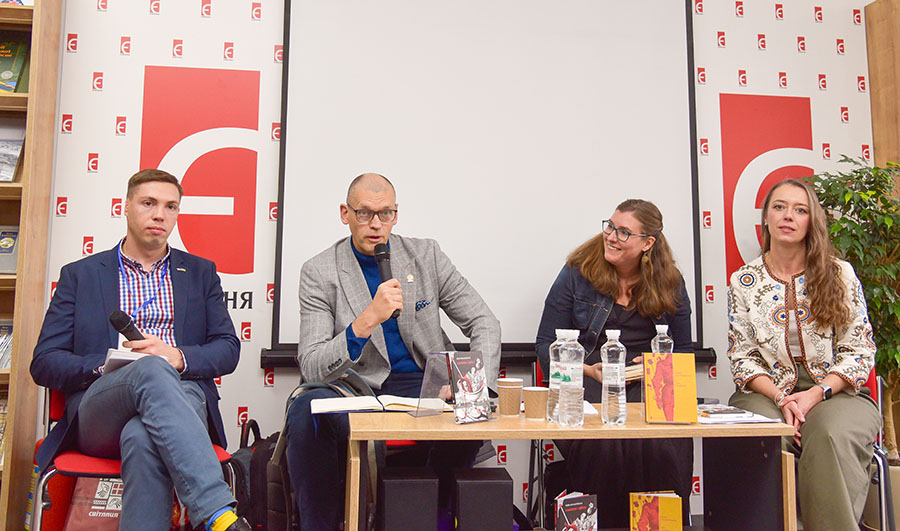
Olha Mukha: We all are. In our open dialogues we meet ourselves too. I just realised what I love the most about Ukraine by talking to you. And what is your favorite thing about Ukraine?
Hugh Roberts: That spirit. The same spirit that gives rise to poetry and drives us all.
Olha Mukha: Then quote your favourite poem!
Hugh Roberts: The final lines of the soldier with call sign “Jesus” in Maksym Kryvtsov read as his poetic testament:
In the final seconds of his life
Jesus
exhaled
summers and winters
universities and streets
pigeons and fish
museums and parks
sins and sorrow
solitude and trees
seas and rivers
love.
Ukrainian original first published as “Virshi z biynytsi” (“Verses from the Loophole” [the aperture for a machine gun in a trench]) (Nash Format, 2023), and I am quoting from forthcoming translation by Larissa Babij and Helena Kernan, slightly adapted by me, with thanks to them for sharing.
My favorite poem remains “Mary to Golgotha.” It’s the one I began with and the one that carries me through every challenge.
If translating war were easy, it’d be pointless — so the struggle is part of its power.
Copy editing: Terra Friedman King
Читомо» — це медіа про книжки й літературу, що підтримувало українське книговидання задовго до того, як це стало трендом. Ставайте частиною історії — доєднуйтеся до Клубу Читомо!
the more you read, the greater the possibilities
1112
culture
Yaryna Grusha wins Italian literary honor for novel about post-Chornobyl and modern Ukraine
13.07.2026 -
127
ambassadors of Ukrainian books
How to become an ambassador of Ukrainian literature: Five simple ways
15.01.2026 - Chytomo