* ESC - close the search window
E-BOOKS
Study shows how many Latvians read e-books and the two regions with the lowest interest
12.08.2026
Twenty-six percent of Latvian residents bought printed books during a six-month period, compared with 4% who purchased e-books, according to a new study by the Latvian Academy of Culture. The findings indicate that digital channels currently supplement rather than dominate access to books in Latvia.
The report, titled “Latvijas iedzīvotāju digitālā kultūras patēriņa paradumi” (“Digital Cultural Consumption Habits of Latvian Residents”), was prepared by the Institute of Culture and Arts at the Latvian Academy of Culture. It was produced as part of the CERS research project examining Latvia’s cultural ecosystem as a resource for national resilience and sustainability. The project was funded by Latvia’s Ministry of Culture and administered by the Latvian Council of Science.
The study used a mixed methodology. Its quantitative component was based on a representative survey of 1,050 permanent Latvian residents aged 15–75. The SKDS Research Center conducted in-person interviews at respondents’ homes across all regions of Latvia from Jan. 11–21, 2025, using a stratified random sample.
The qualitative component included 30-day cultural consumption diaries and in-depth interviews with 20 Latvian residents aged 19–84. The researchers noted that this part of the study was not statistically representative and was intended to provide a deeper understanding of individual experiences.
During the six-month period examined, 47% of residents used at least one of the listed methods of obtaining or reading books, while 52% used none of them. Printed-book channels remained the most common: 26% bought printed books, and 23% read or borrowed books during an in-person library visit.
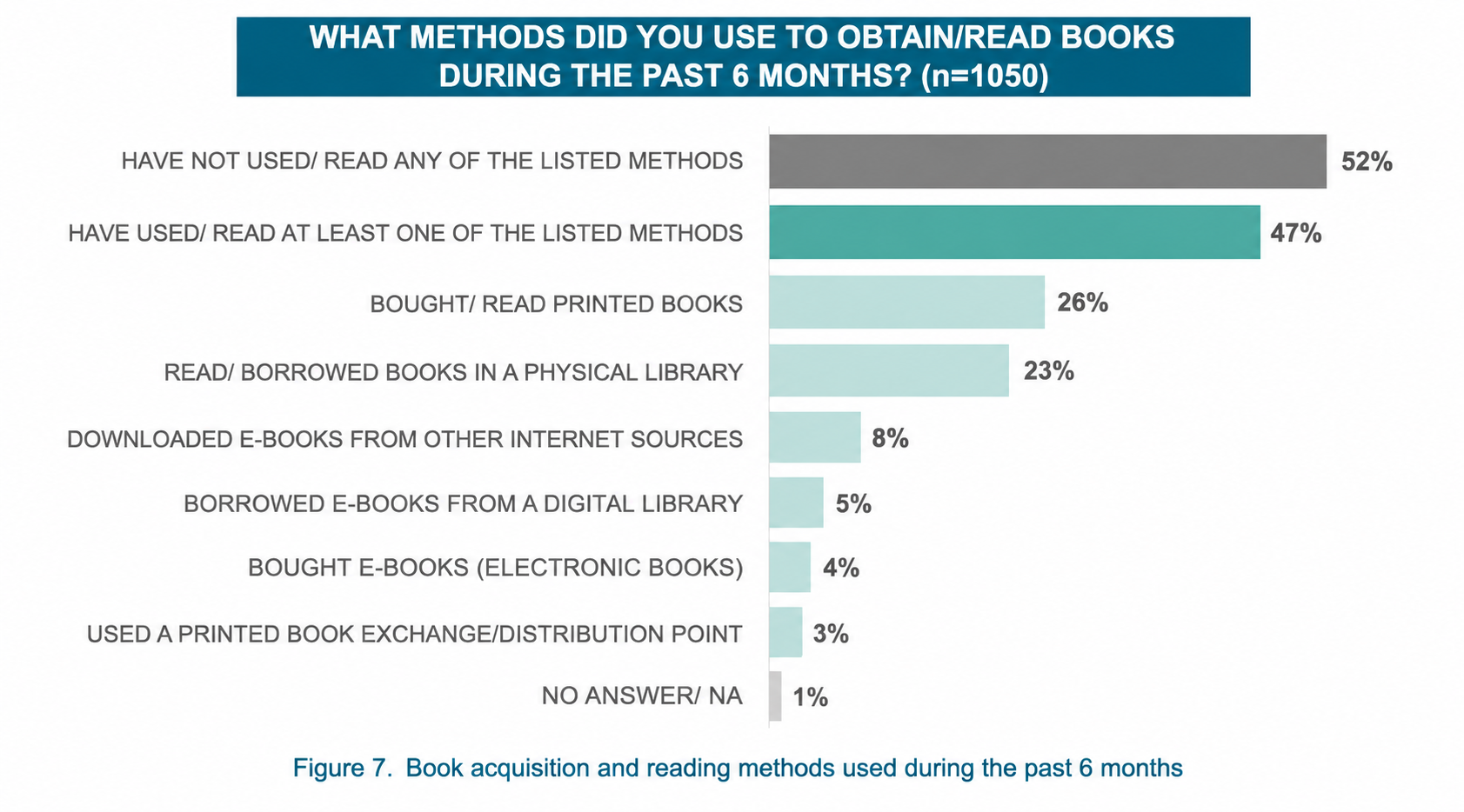
Digital methods were used less frequently. Eight percent downloaded e-books from other internet sources, 5% borrowed e-books through a digital library, and 4% purchased e-books. A further 3% used printed-book exchange or distribution points. The report concluded that digital channels were currently supplementary rather than dominant means of accessing books.
Paid e-book use was concentrated among a comparatively narrow and more economically secure audience. Eleven percent of senior and middle managers reported buying e-books, as did 10% of respondents whose household income exceeded 1,000 euros per family member and 9% of those with personal monthly incomes above 1,500 euros. The figure reached 8% in Riga and around 6% among respondents aged 15–24 and those with higher education.
E-book purchasing was particularly uncommon among rural residents, pensioners, respondents with lower levels of education, and residents of the Vidzeme and Latgale regions. Digital-library borrowing was also more common among younger people, students, higher-income households, and residents of Riga.
Downloading e-books from other internet sources was twice as common as purchasing them, at 8%. The researchers cautioned that this category could include legal, informal, and difficult-to-identify sources. They said the result nevertheless highlighted the importance of convenient access to digital reading materials outside institutional platforms.
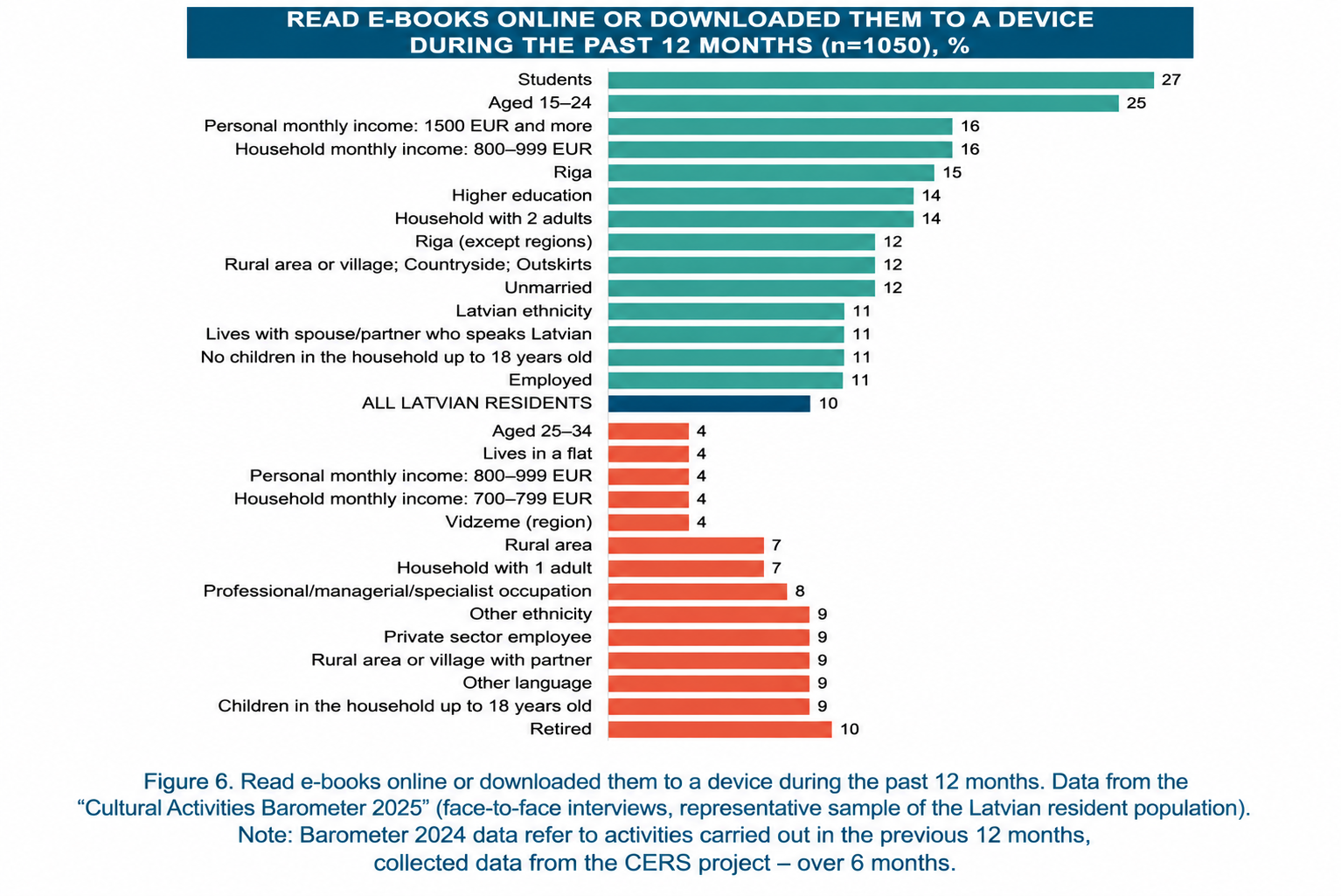
Data from the “Cultural Activities Barometer 2024,” included in the report, showed that 10% of Latvian residents had read an e-book online or downloaded one to a device during the previous 12 months. The rate reached 27% among school and university students and 25% among people aged 15–24, indicating that digital reading was more common among younger and more urban audiences but remained a minority practice overall.
Printed-book purchases had a broader social reach. Forty-six percent of respondents with higher education bought printed books, as did 44% of public-sector employees, around 40% of specialists, entrepreneurs, and managers, 35% of women, and 33% of respondents aged 35–44.
The report’s broader conclusion was that digital and in-person cultural consumption coexist in Latvia. It recommended developing digital culture as a complement to physical cultural participation rather than as its replacement, while improving access for older people, lower-income groups, audiences outside urban centers, and people with less confidence in their digital skills.
As reported earlier, data from Latvia’s Central Statistical Bureau showed that 50.3% of the country’s population aged 16 and older regularly read books. Reading was more common among women, people with higher education, and residents of wealthier households. The same survey found that 59% read in Latvian, 43% in Russian, and 25% in English.
Latvia introduced different VAT rates for publications based on language beginning Jan. 1, 2026. Printed and electronic publications in Latvian, Latgalian, Livonian, and the languages of EU and OECD countries retained the reduced 5% rate, while publications in other languages, including Russian, became subject to the standard 21% rate.
Main image: pexels
Читомо» — це медіа про книжки й літературу, що підтримувало українське книговидання задовго до того, як це стало трендом. Ставайте частиною історії — доєднуйтеся до Клубу Читомо!