* ESC - close the search window
books about war
Evgeniy Maloletka’s ‘The Siege of Mariupol’: Documentary books as a way to escape oblivion
09.04.2026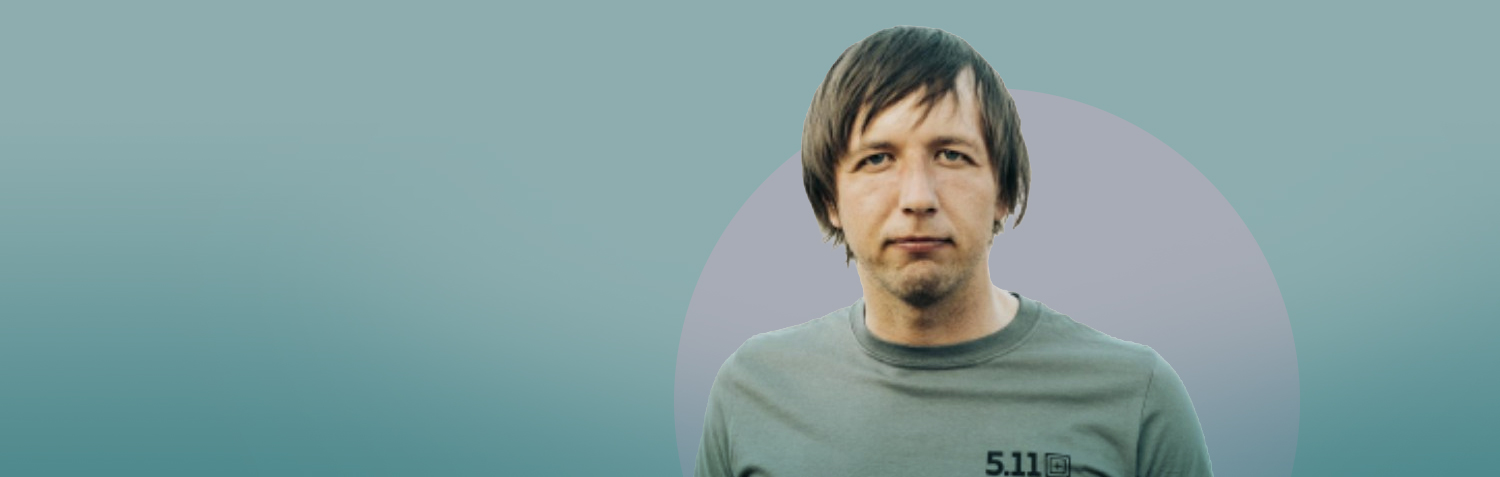
You see an error in the text - select the fragment and press Ctrl + Enter
War creates new symbols that are mostly scary. Unlike before 2013, Ukraine is no longer known by its national symbols, borshch, or boxers. The war — and particular incidents within it — have come to define how the country is recognized, portrayed by their most brutal and intense moments. The battle for Mariupol, accompanied by massive Russian strikes on civilians, is one of these terrible incidents, with the strike on a maternity hospital being one of the most horrible. Evgenіy Maloletka’s photo of a wounded pregnant woman on a stretcher quickly gained worldwide attention and became one of the symbols of this war. Symbols of Ukraine.
Maloletka works as a photographer for the Associated Press. Together with director Mstyslav Chernov and producer Vasilisa Stepanenko, he spent 20 days working in the almost besieged Mariupol, documenting and showing the world the brutal reality. He documented his experience in the photo documentary book “The Siege of Mariupol,” published by Ukraїner. Ukrainian writer Myroslav Laiuk co-authored the book. We met with the photographer at Veteran Hub the day before the book’s launch to discuss his hopes for it, the role of Mariupol in his life, and the essence of documentary photography during wartime.
“I wanted to draw attention to the responsibility a photographer has”
Chytomo: Being a photographer, you decided to share your experience through writing. Why?
Maloletka: After leaving Mariupol, I realized this project could evolve into something more significant — you simply can’t include that many photos in a single article. It could also become an exhibition, but a permanent one. There’s a beginning and end of the exhibition, but a book stays with you, just like a movie. A movie is watched over and over; a book is read again and again.
The idea only came to me after a while. I was thinking about how to reinterpret my experiences, and I didn’t want to rush into writing the book. I was trying to find the right approach because you have to start and end up somewhere.
It didn’t include events that happened later and were written about later. The original plan was for this book to be about the photographer, his journey, how he made his way through Mariupol, and ended up in the city. The project also aimed to examine why he undertook this work and why this story existed in the first place. The book presents several aspects meant to educate upcoming journalists about conflict reporting, illustrating how it was accomplished, as this is an exceptional case. Most importantly — to tell the stories of ordinary Mariupol residents whose lives were affected by the war.
Chytomo: That’s true. The book can be seen as a guide for photographers and journalists.
Maloletka: Yes, it includes numerous handy strategies. These are insights I’ve gathered over all these years of war in Ukraine and abroad. I’ve encountered this in Nagorno-Karabakh and Africa. I wanted to share that experience and to explain that wars are pretty much the same. Although context and location, as well as language, differ to some degree, the essentials are almost universal.
Chytomo: Notably, the book traces the subsequent destinies of people you met in Mariupol.
Maloletka: I wanted to share more, of course. Including highlighting the responsibility of a photographer after taking the photo. We’re responsible for the dissemination of information once it’s out there. You send it to an agency, the agency distributes it, and you have no idea what the outcome might be. In this case, photos went viral, and the outcome was shocking. Beyond the locals and police recording on their phones, there was no professional video or photography in Mariupol. Our work became the sole record, the evidence of what happened there. Those photos were posted immediately, and for viewers, these were unique images that, in general, most people had never seen. There was no communication, and people were isolated from the outside world. They couldn’t tell anyone what was happening in the city.
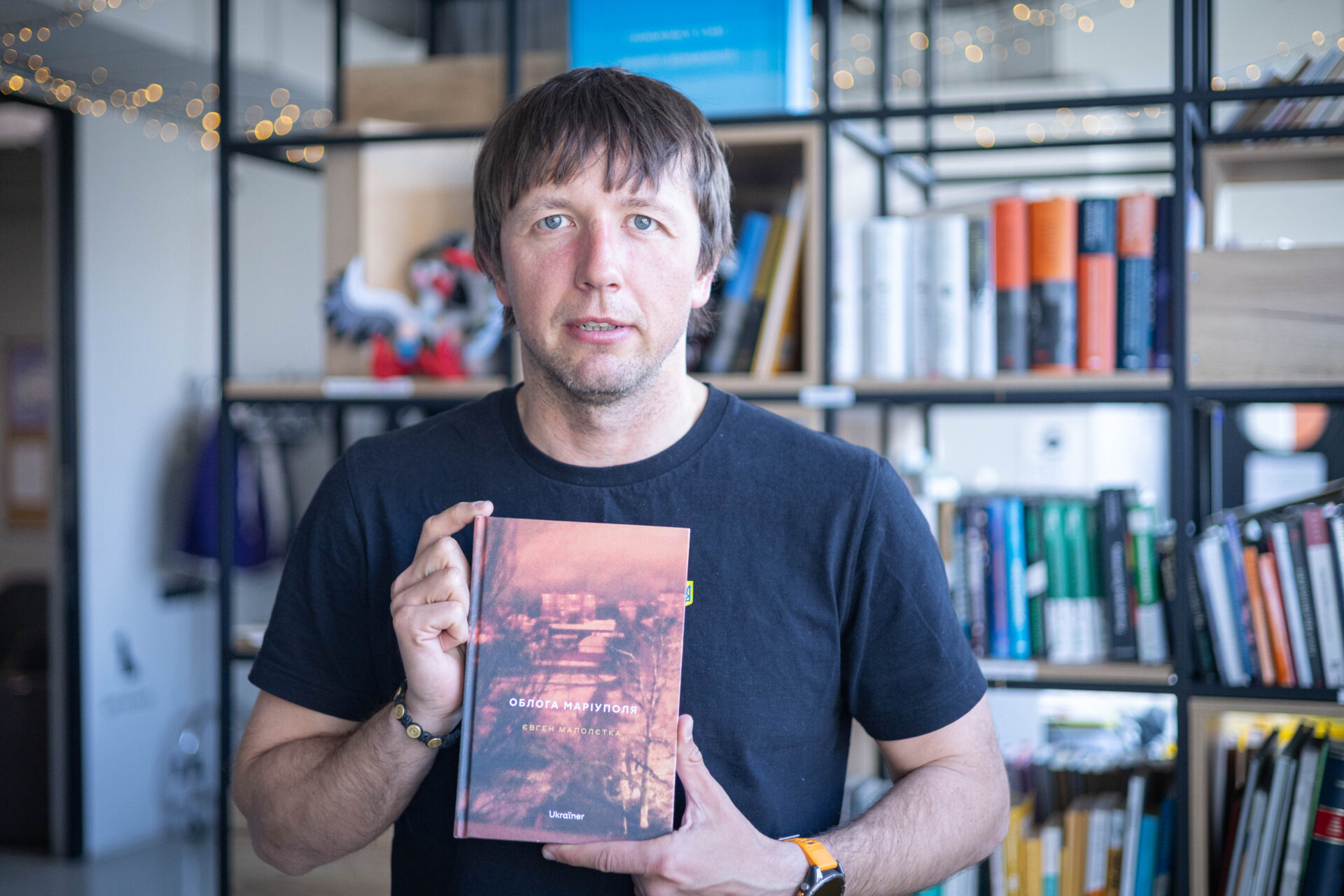
Photo credit Olena Maksymenko
Not everything can be described or shared. So much has happened, but you focus only on the things you see yourself. I wish I could have done more.
Chytomo: What you did seems beyond human capacity anyway.
Maloletka: At that moment, you think: Damn, we’re not filming enough. Not nearly enough! In the end, maybe it was enough, or not. I still believe there isn’t enough footage to show what condition Mariupol was in, or to learn more about the moments when things were getting really, really bad. There’s very little reliable footage of the city following our exit, only some scattered phone or drone clips from Azov or what we could see from the Russian side. There was an information vacuum, and you couldn’t see what was happening. It’s just like in Kostiantynivka now. There’s fighting going on there, but you still don’t see anything except drone footage, or you hear snippets of soldiers’ accounts. The same thing is happening in Kupiansk, because the Russians are advancing again. There’s no evidence coming from there either, and the situation is getting worse.
Chytomo: In your book, you mention the photographer Maks Levin, killed in 2022. Levin experienced the events in Ilovaisk, and that experience proved pivotal to his entire career. Until the end of his life, he worked on the After Ilovaisk project. Do you think Mariupol is a similar turning point for you personally?
Maloletka: Absolutely. You can’t erase Mariupol from your life and move on. It stays with you forever, like a scar etched into your skin. This experience is unique, and there have been very few like it in the history of journalism. Take, for example, Yannis Behrakis, photographer at Reuters. Surrounded in Sierra Leone, they made their way out through the jungle. The cameraman and reporter who were with Behrakis didn’t make it. He did.
Working in Mariupol was completely different from arriving at a post, doing your job, and leaving later. What you could do was rely on the resources that were available at that moment. The problem is they become fewer every day.
Ammunition and power running low, there are fewer intact buildings, fewer shelters. The siege is closing in, and you can’t tell where the front line is. It’s chaos. If you have a Deep State map now, you can track things, more or less, knowing you have some sort of line of communication, but at that moment we had absolutely no information. The military might have known the situation, but they weren’t concerned with us at all.
“Our job is to keep broadcasting and make sure people don’t forget”
Chytomo: I know Levin dreamed of making a photo that would put an end to the war. Do you?
Maloletka: I wish this approach still worked today. Today, a photograph can draw attention to a problem and bring it to the forefront, just as the photo from Mariupol did. History is full of such examples. James Nachtwey, for example, went to Somalia, and a famine was unfolding there at the time. It was largely unnoticed. Nachtwey took photos and sent them to New York, and after publication, relief efforts began delivering food. The famine in Somalia was stopped thanks to his photos. I wish this could stop war and genocide, but, unfortunately, it won’t, because Russia doesn’t care at all.
This photograph, showing a wounded pregnant woman on a stretcher, was published, and Russians tried to counter it, to convince local and international audiences that it was fake and that such a thing never existed. In fact, they did this more than once.
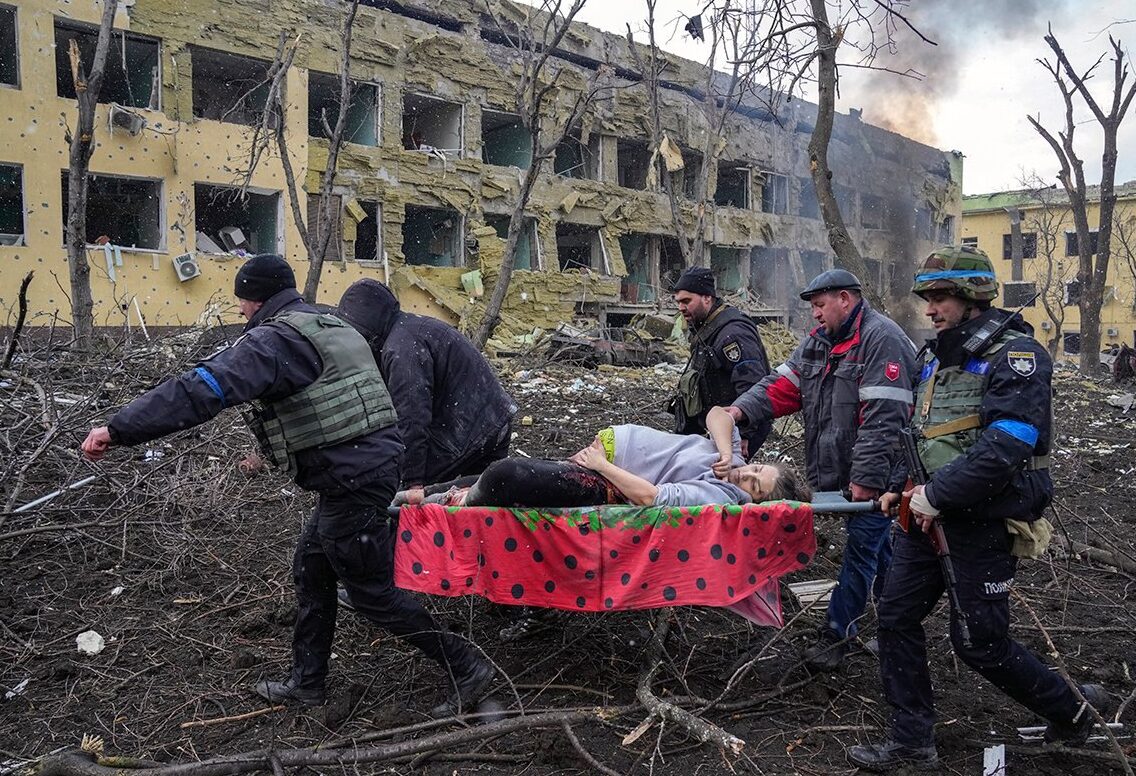
For this photo, Maloletka received the World Press Photo of the Year 2023 award (Photo by Evgeniy Maloletka / AP)
Chytomo: Actually, that’s why this IPSO (Information-psychological operation) caused confusion among people regarding the two pregnant women in the photo you took that day.
Maloletka: The same old story, yes. Russians spread messages of various kinds and in different variations only to confuse people so they can’t tell what’s true. Even Ukrainians regularly ask about Iryna Kalinina, the pregnant woman on a stretcher, and many still think she’s the one who became a propagandist. These are two different women, but Russian propaganda has been so effective that even Ukrainians think they are one and the same person.
This refers to a photo of another pregnant woman, Marianna Vyshemyrska. Maloletka photographed her as well.

A photo showing a different pregnant woman, which caused confusion in the media (Photo by Evgenіy Maloletka / AP)
Chytomo: The photo had a powerful impact. Do you think the response was enough? Could the world have done more?
Maloletka: Could we have done more? I wish the world could have seen more, that we could have stayed there longer and shown what was happening. There are limits to everything. I wish they would do something about Russia … after all. The UN pointed a finger at Russia, and that was it. Russians denied everything, saying it was fake. Our work from Mariupol attracted a lot of attention and sparked a global discussion, and that is something that rarely happens. It’s not often that journalistic work is discussed in international institutions. It’s very rare for a photo to have such a powerful impact.
At first, when the Russians were bombing maternity hospitals, it was easier to document crimes against humanity. The world wanted to see what was happening. Filming now is very difficult, not to mention everything else. The war in Ukraine has stopped being big news and is now seen as something constant and an ongoing stream of statistics.
The world isn’t as interested right now because there’s a war in Iran, and last year there was a war in Israel. Our job is to fill the broadcasting and make sure people still remember. It’s a huge challenge to get Ukraine back in the global headlines. We’re doing our best, and it’s not just me, but the entire photography and journalism community. We keep bringing this topic up again and again.
Chytomo: You travel and interact with foreigners a lot. Based on your observations, what stories seem to resonate with them the most?
Maloletka: In my opinion, when you show the suffering of civilians, it elicits more empathy and attention than when you show what soldiers endure. Soldiers understand what they’re doing and what they’re getting into; they know why they go and what they’re fighting for. Civilians, unfortunately, are the true victims of war. In most cases, journalists try to show the suffering of civilians, partly because the civilian population is protected by international law. Unfortunately, this happens in every war, and our job is to show what consequences this has for Ukrainians.
Chytomo: Recently, there has been debate within the media community and beyond about whether it is acceptable to take pictures of people in particularly vulnerable situations. Beyond safety issues, what constraints guide you? Is there anything you would never photograph?
Maloletka: In my opinion, you should film as much as possible. The issue lies in publishing footage because you have to be very careful about it. I believe that documenting these important moments, even if they are very disturbing, is crucial. You never know when they might come in handy. I’ve already encountered this several times. That’s why it’s better to take more photos, even if they’re traumatic and not pleasant to look at. You might not be able to publish them, but it’s better to have these photos than to close your eyes and walk away.
About a year ago, there was a debate following another shelling in Kyiv. People were emotional (some photos of the wounded sparked outrage and criticism). People who posted the photos, of course, become the targets of hatred. Russians are obviously too far away, and Ukrainians can always take it out on their own [photographers]. Photographers aren’t perfect; we’re humans too. But we’re also fighting to make sure the world sees how much our nation is suffering.
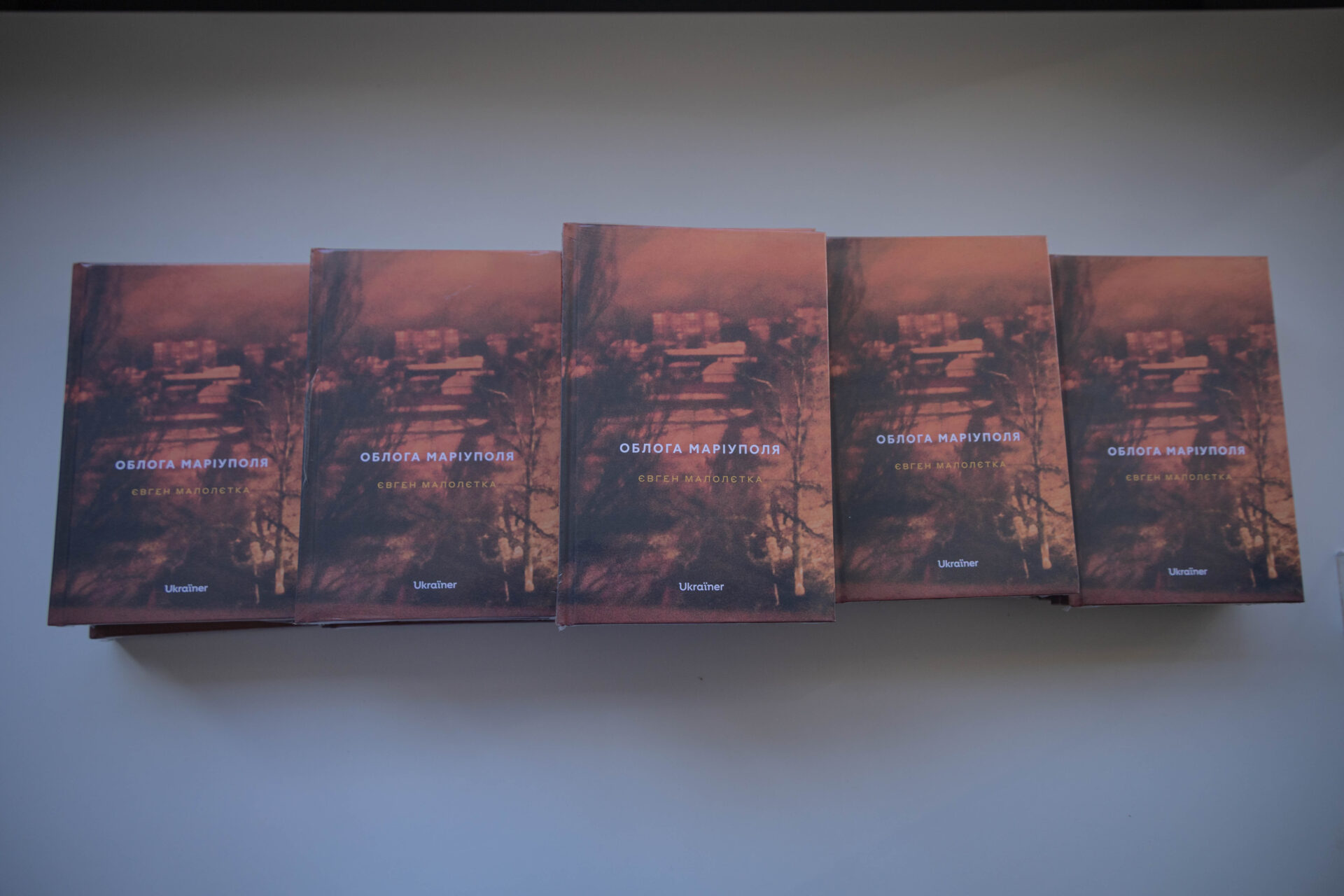
Photo credit Olena Maksymenko
There are photos that push the boundaries, and they’re very important. These photos resonate deeply with people precisely because they don’t want to see them. People want to wake up and see a pink pony with a rainbow overhead. But our reality is different.
For example, when there’s an airstrike, a bombed-out building, or people who are wounded, journalists often arrive after the rescue services — Ukraine’s Emergency Service, the police, and the ambulance — because the real-time information is unavailable. We rely on social media, guesswork, and connections to gather information. The key is to get there while aid is still happening — once the ambulances have cleared the wounded, we’re left with mere statistics and no visual record. There won’t be any documentary evidence that this or that happened. We document war crimes. You see a wounded person, then you find out their name, then you find out how many people are still trapped under the rubble, how they rescued this survivor, how they scream, “Damn, I’m going to live!” and so on. These are precious moments. They need to be preserved, because the history of Ukraine is built on this. And if they are not there, it means we are losing the information war. The Russians will rewrite history.
“Integrating text and images”
Chytomo: Could you tell more about the process of writing the book? What were the stages and challenges?
Maloletka: In September 2023, I was in Kostiantynivka and broke my leg. I had surgery, a plate was inserted, and I was trying to figure out how long my rehabilitation might take. The doctors didn’t say anything, but I realized I wouldn’t be able to work. I decided to use the time when I couldn’t work fully in the field. I used it to start working on a book. I met Laiuk, we agreed on the details, I explained what I wanted and why I was doing it, and we started working.
Chytomo: How did your collaboration with Laiuk work out? After all, he wasn’t in Mariupol.
Maloletka: On the one hand, Laiuk wasn’t there, but, on the other hand, I’m not a writer either. I’m a photographer. I can write something, but I can’t process large amounts of data or structure a book, whereas he has a lot of experience. I invited him to contribute to this book, and he willingly agreed. We talked, discussed, outlined the book, dictated sections, reminisced, reviewed everything, and then the writing began.
Chytomo: The book seems to be very important for an international audience. Is translation planned?
Maloletka: The book has already been translated into English by Virlana Tkacz and Wanda Phipps, members of Ukrainian diaspora in New York. They understand Ukrainian, and it’s their second native language, but English is their first. Tkacz had experience translating Serhiy Zhadan’s poetry, and translating poetry is even more difficult. It took a long time to wait for them to become available to work on the translation. Finally, the book was translated, and I wondered what we would do next — whether it would be published immediately in English or exclusively in Ukrainian. I wanted the book to be edited by Lori Hinnant, author, who had written all our stories from Mariupol, including the investigation into the drama theater. Hinnant is an investigative journalist and had already had a solid foundation on Mariupol. She knew the subject; she knew the story. We worked with her for a very long time, and she agreed to edit it. That took time, too. Then it had to be translated into Ukrainian, with Hinnant editing the English version. She also made a huge contribution to improving this book. Hinnant smoothed out all the rough edges in the book. It started to read completely differently. It really did get better.
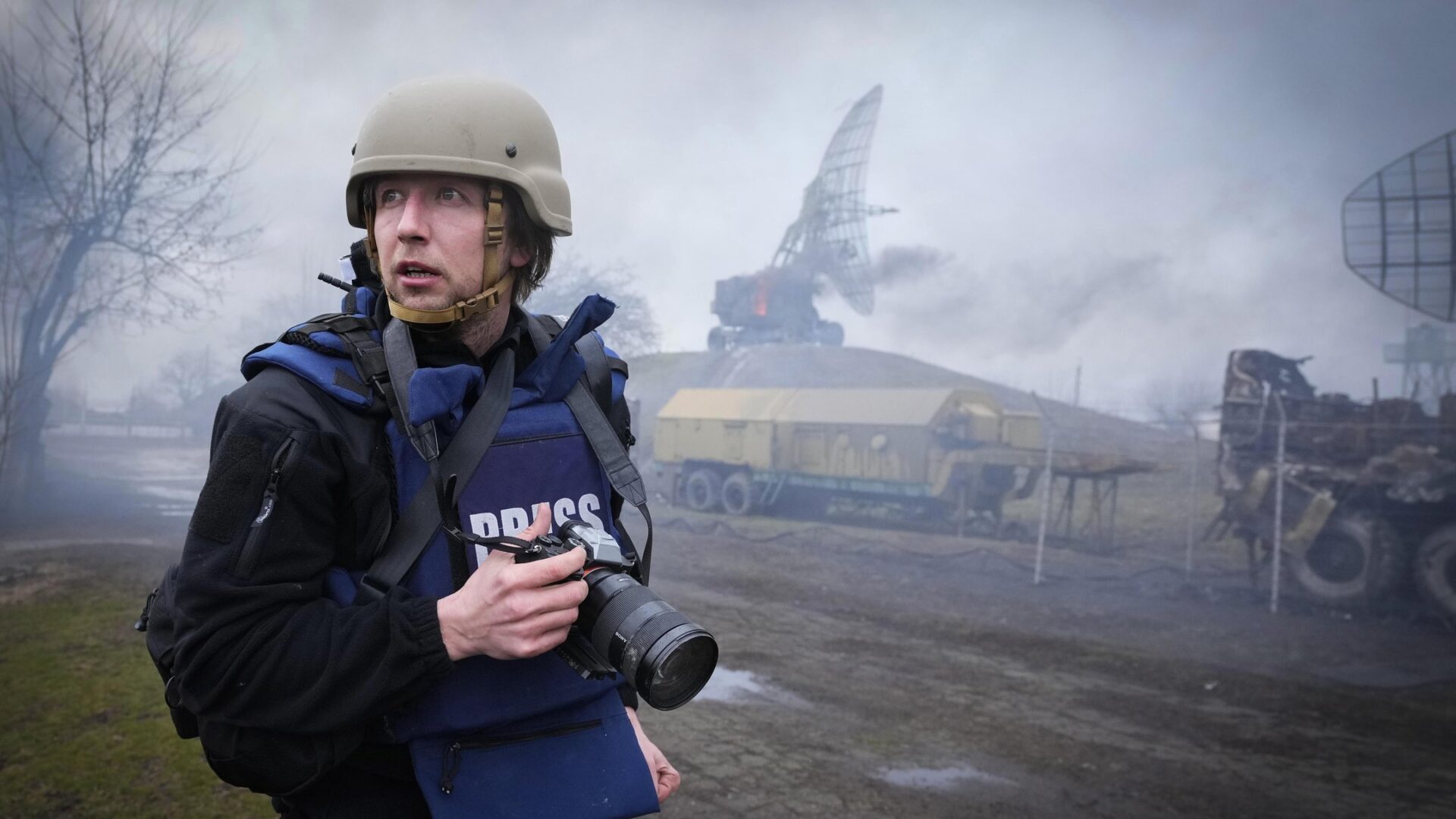
Evgenіy Maloletka in besieged Mariupol (Photo credit Serhiy Hrits)
The idea was not to describe every photo in detail, since that wouldn’t make sense — you can see them yourself. Instead, we chose to focus on conveying the story. Once the text was written, we began working with a designer even as the translation was still in progress. Bill Marr, a creative professional who served as a Creative Director for National Geographic magazine for 10 years, had extensive experience in photo books. He asked to review all the materials. I outlined the technical constraints, explaining that the photos couldn’t be rearranged; they had to remain in chronological order. Even if moving an image might improve the composition, the sequence couldn’t be altered. The timeline had to stay intact. Finding a way to integrate the text and images so they complemented each other without disruption was another challenge.
A magazine format, featuring both text and photos, was also an option, but then the photos would have drawn too much attention, and people wouldn’t have read the text. I wanted to make sure it wasn’t just an album with text descriptions, but a book.
The text and the photos were divided into three sections accordingly. We had to experiment with that as well. In the end, the book’s layout turned out to be just right. We added small inserts so people could see how many shots were taken. Although we took more than that, it was simply to show how the shoot actually happened and confirm it was authentic, not staged.
The book hasn’t been published in English yet, but the design is ready. It’s identical for both the English and Ukrainian versions. Currently, our team at Ukraїner is deciding on the timing and next steps — whether it will be printed abroad, or whether we’ll print it here and then distribute it abroad. There are pros and cons to both options. Of course, we’d love to have the support of a foreign publisher. The problem is that few people want to publish military books. And even less so such traumatic photographs — people abroad don’t like to look at them. I want to believe that there will be demand for the book, that people will want to buy it and keep it, because it’s a document, a testimony. I’d like there to be more support so we can distribute it to as many countries as possible, so it can be published in different languages — perhaps German, Spanish — so it reaches Latin America and beyond. I want people to see and read this.
Storytelling as therapy
Chytomo: You deal with so much pain. How do you keep your mental health?
Maloletka: It’s pretty easy. Don’t suppress your feelings; talk about them whenever they come up. I think people who’ve gone through such a traumatic experience need to talk about it constantly. When I hear a crazy story like that, I want to tell as many people as possible. I can’t write about it because it’s just surreal; no one would understand. I just want to tell everyone right away so it gets out of my head and I can let it go.

Mariupol under Russian shelling (Photo by Evgenіy Maloletka / AP)
Chytomo: Would you say that writing the book was therapeutic for you?
Maloletka: Partially. It’s not exactly therapy, but it’s about not being able to keep feelings suppressed inside. There are moments I want to forget, but there are also episodes I don’t want to forget. That’s why they’re in the book. I simply forgot about many of those moments while writing the book. We looked at each photo and were trying to remember what’s there. What was here? And I’d recall this moment, that moment, another one … We reread texts, looked through photos on my phone. We carefully went over all records from that time to recall as much as possible. Memory is a funny thing, especially when so many events happened afterward. At the moment, a year and a half had passed since leaving Mariupol; there were battles for Donbas, Bucha, Chernihiv, the liberation of the Kharkiv region, Kherson, and then you came back … but I had to pull it all out of my memory, lay it out on the table, and sort it into categories, somehow summarize it all and figure out what information was needed and what wasn’t.
Chytomo: While you were working, Chernov directed “20 Days in Mariupol,” which went on to win an Oscar. This year, Chernov’s next film, “2000 Meters to Andriivka,” did not win an award. Instead, it went to a Russian filmmaker. Do you feel that, in this context, the information environment has worsened or diminished?
Maloletka: It’s a shame, of course; Chernov’s film is very powerful. It’s about battles, about the war as it is. It’s about his experience, how he saw it. It’s very difficult to draw attention to the military. The international audience mostly reacts to the suffering of civilians. That’s shown too, but mostly it’s about the war and the front lines — how soldiers advance, liberate territories — and that summer counteroffensive. I actually broke my leg while it was being filmed, during the airstrike on the Kostiantynivka market.
I believe we’ll succeed in the long run, with more films pushing back against Russia’s narratives. “Navalny” won before (a Russian documentary that won an Oscar in 2023). It’s simply a technical process. The film went through many stages to get there, just like “20 Days in Mariupol.” It’s a complex process to reach Oscar. A whole year of work, a lot of money. Chernov tried a second time, but, unfortunately, not everything depends on him. There’s an international jury that lets nothing pass unnoticed. I wish they showed more understanding for Ukraine, but that doesn’t mean we should surrender or stop fighting.
Chytomo: Do you have time to read non-fiction books by various authors? Any must-reads you would suggest?
Maloletka: I’ve been looking through books about the war that have been published. Just now, I was given a copy of Oleksandr Ivantsov’s “Flashback: Mariupol.” It’s about a soldier who flew in by helicopter and went into hiding in Mariupol. I have that book, and the author signed it for me. It’s interesting to hear about his experience. It’s hard to read about all that horror again, but it’s important. A lot of books have been published, including diaries. But the more of them there are, the more we’ll remember this war.
News on the website may be temporary, but books persist in libraries. Let’s hope that good books will stay with us for a long time. I’d like to see more good books published about this war. It’s important for people to make time to write about what they’ve been through. I urge everyone who has experienced this ordeal to put their story on paper. When you read about “470 Days in the Trenches” (Serhiy Tyshchenko, a soldier of the 30th Mechanized Brigade, spent 471 consecutive days at a combat position in Donetsk Oblast), you realize it’s mind-boggling! Unbelievable! A man went in during the winter and didn’t come out until a year later, in the spring. How did he endure? That’s what movies will be made about — about stories like this. About the guy from Mariupol, the people in the trenches, just like in World War I; stories will be told about this. And now we need to write them down so we don’t forget. Because, unfortunately, none will live forever …
Chytomo: I wish people would actually read these books.
Maloletka: In a period of transformation, people are interested in reading about such significant changes. These changes affect everyone — not just the cities, but the people themselves. They are changing. They will never be the same as they were before the war. Like my parents, who became displaced persons; it changed them, changed their way of life. Doctors are the same. Some lost their property; some lost their loved ones. The war completely changed the course of events. We will never be the people we used to be.
Chytomo: In the book, you said Mariupol had changed you. What exactly has changed?
Maloletka: It seems you haven’t really changed, but you’ve grown up. You’ve gained so much experience, reevaluated a lot of things that happened to you during that time, and you’ve let go of what’s unnecessary. Now your attention is on what’s doable and necessary immediately, instead of putting things off. Doing what’s most important right now is the key. Priorities have shifted. Once I left Mariupol, I lost all interest in material things. I don’t care what kind of computer, camera, or desk I possess. They’re just things, and they might burn up. I’ve seen how it all gets destroyed, and that expensive desk turns to ash in a second. What’s the point of these expensive things, phones, and so on?
Chytomo: How does it feel to hold your first book?
Maloletka: I still can’t believe it’s actually out! Despite electricity outages and all conditions, it was printed. It’s nothing short of a miracle! We can print high-quality books here in Ukraine. I’m still processing it. But it’s very nice, very! I’m rejoicing like a child right now, but I don’t fully understand it yet. I’ll just be happy if people connect with it, if they cherish the memory of Mariupol. This is a very important story for us.
Chytomo: As a photojournalist, do you have a dream? Is it about returning to Mariupol?
Maloletka: I want to return to Mariupol, Donetsk, Luhansk, and Crimea, of course. I want to return to all the occupied cities that were dear to me. I hope we’ll be able to defeat Russia, whether through military means or diplomacy. We’ll keep working to reveal as much of the truth as possible about what’s happening. The only strength I have left is people’s trust in the content we produce.
RELATED: Grieving a vanished Mariupol: when statues depart and myths endure
Translation: Iryna Savyuk
Copy editing: Joy Tataryn
Читомо» — це медіа про книжки й літературу, що підтримувало українське книговидання задовго до того, як це стало трендом. Ставайте частиною історії — доєднуйтеся до Клубу Читомо!
the more you read, the greater the possibilities
113
Book Chamber
Russian attack on Kyiv damaged Book Chamber of Ukraine premises
22.10.2026 - Olesia Boiko
324
Russia's attack
Russian drone strikes Ukraine’s National Academy of Sciences in Kyiv, killing two and damaging historic headquarters
30.09.2026 -