* ESC - close the search window
children
French children and teens spend 10 times more time on screens than reading books, CNL study finds
08.07.2026
The Centre national du livre (CNL) has published the fifth edition of its study “Les jeunes Français et la lecture” (“French young people and reading”), showing that French children and teenagers still spend 10 times more time on screens than reading books for pleasure.
The study, conducted by one of the world’s leading market research companies, Ipsos bva, surveyed 1,500 French children and teenagers aged 7 to 19. The nationally representative survey was carried out online from Jan. 28 to Feb. 9, 2026, and examined young people’s reading practices, motivations, barriers, and the factors that could encourage them to read more.
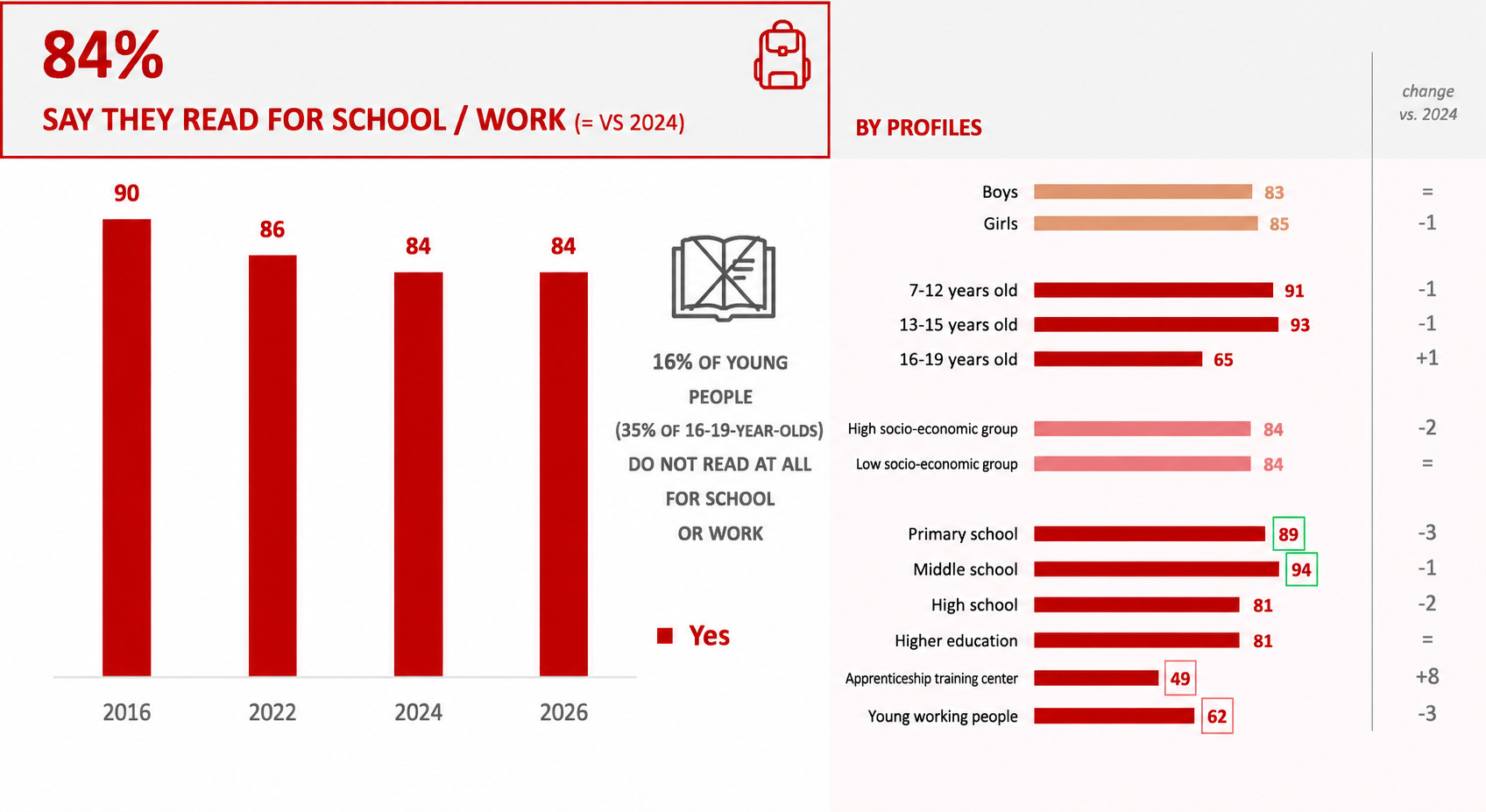
According to CNL, the overall number of young readers remained broadly stable compared with 2024. Eighty-four percent of respondents said they read books for school, studies, or work, while 81% confirmed reading books for leisure. At the same time, the study found that reading levels remain significantly lower among older teenagers, with more than one-third of 16-to-19-year-olds not reading at all. The drop is especially visible in leisure reading. Among boys, 76% read for leisure at ages 13 to 15, compared with 56% at ages 16 to 19. Meanwhile, 78% of girls aged 16 to 19 read for leisure, compared with 56% of boys in the same age group.
Young people’s reading is increasingly fragmented, with 41% of leisure readers doing something else while reading, including sending messages (30%), watching videos (26%), and going on social media (23%). Among 13-to-19-year-olds, the last book read for school, studies, or work was well understood by 75%, found easy to read by 60%, and liked by 53%.
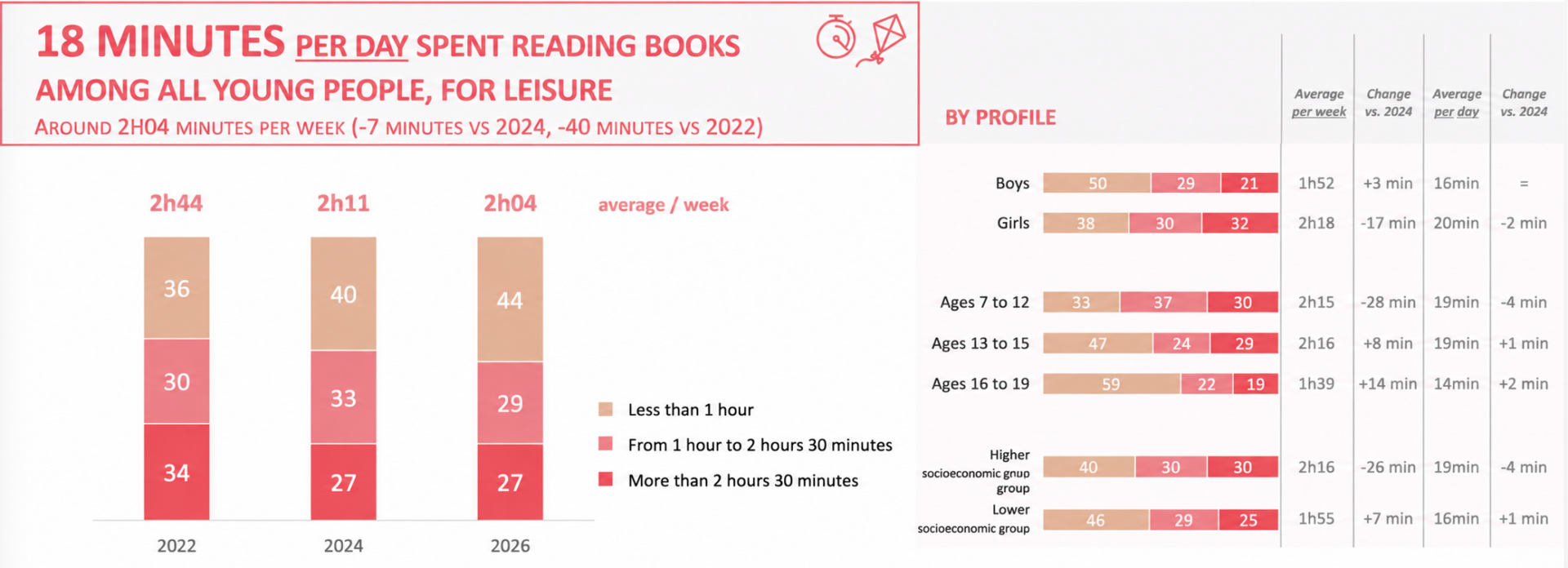
For leisure, French children and teenagers spend an average of 18 minutes per day reading books, down one minute from 2024 and eight minutes from 2016. By comparison, they spend an average of 3 hours and 1 minute per day on screens, excluding time spent reading e-books or listening to audiobooks. Daily screen time exceeds five hours for 16-to-19-year-olds.
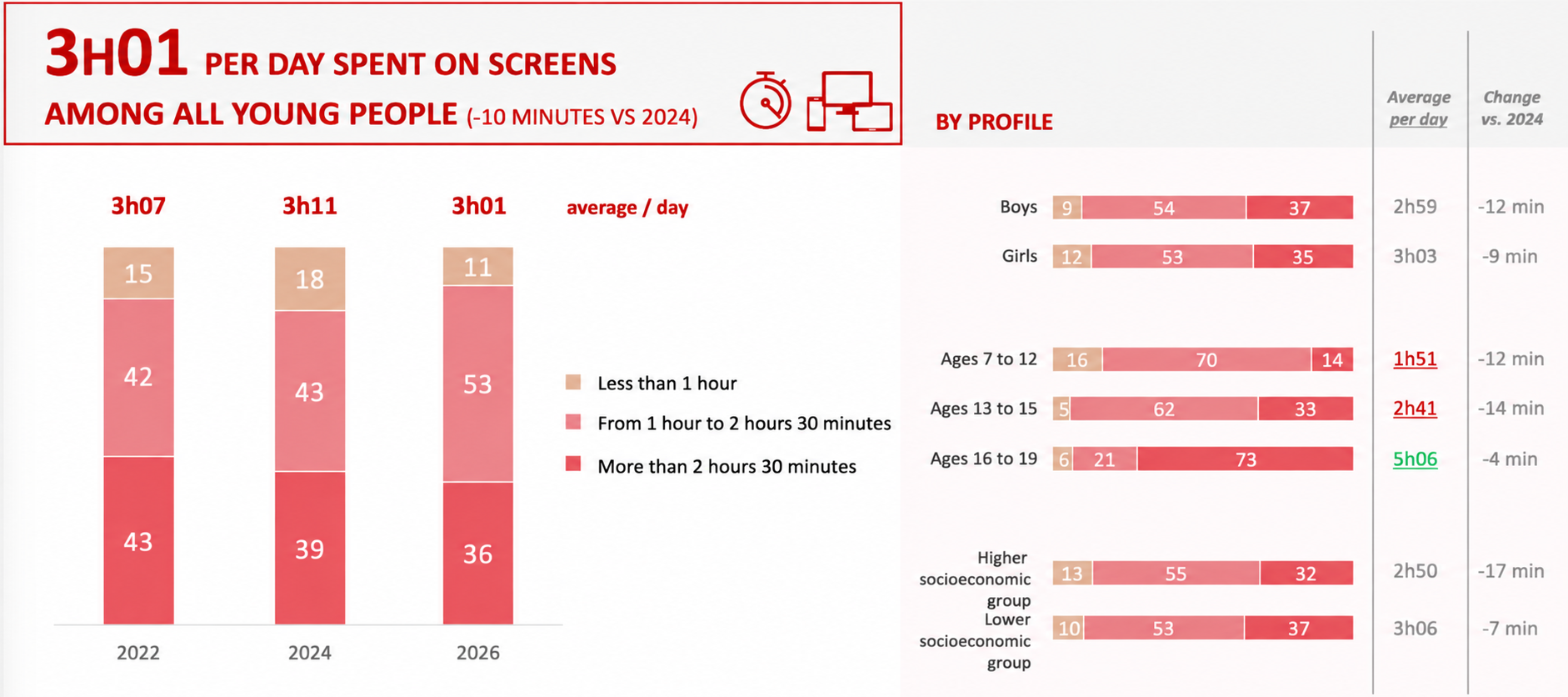
The gender gap is also visible in the time spent reading and using screens. Girls aged 16 to 19, practice leisure reading on average 19 minutes per day, while their screen time reaches 5 hours and 24 minutes. Boys of the same age read for an average of 10 minutes a day, compared with 4 hours and 48 minutes of screen time.
The report shows that when young people are on screens, they rarely use them for reading. Only 16% read books, including manga, on screens, while 21% engage in what CNL defines as “active reading,” including research, books, manga, webtoons, and the press. By contrast, 56% watch short videos, 46% listen to music, 43% watch films or series, 41% chat with friends, and 36% play online.
Social media use is widespread, with 80% of 7-to-19-year-olds spending time on at least one social network. This includes 56% of children aged 7 to 9, 72% of those aged 10 to 12, 90% of those aged 13 to 15, and 99% of those aged 16 to 19. The most used platforms are YouTube at 70%, TikTok at 43%, and Snapchat at 43%.
CNL also found that young people mostly read Franco-Belgian and European comic books, at 57%, followed by novels at 47% and manga at 46%. Girls were more likely than boys to read novels, while boys were more likely to read Franco-Belgian and European comic books and manga. Among 16-to-19-year-olds, novels ranked first at 65%, followed by manga at 36% and Franco-Belgian and European comic books at 30%.
For young novel readers, adventure novels are the most popular genre, followed by science fiction and speculative literature, crime and suspense, romance and new romance, and stories about family or daily life. CNL also notes that dark romance remains especially popular among girls aged 16 to 19, reaching 57%, up 7 percentage points from 2024.
Personal recommendations remain one of the main ways young people choose books. 44% of leisure readers choose books based on advice from someone close to them, while 42% are influenced by the cover, and 41% by the hero or character. CNL also found that adaptations on screen and online exposure influenced 28% of leisure readers, with online exposure rising to 51% among 16-to-19-year-olds.
Secondhand book purchases are also growing. Young people are increasingly turning to used books, up 5 percentage points compared with 2024 across all age groups and especially among 7-to-12-year-olds, where the figure rose by 7 percentage points.
Régine Hatchondo, president of CNL, said the findings show several worrying indicators, including the gap between screen time and reading time, the decline in regular reading, fragmented attention, and weakening parental transmission.
“It is our shared duty to reaffirm the central place of reading in our lives. Reading is essential time, time for oneself, which must absolutely be preserved,” Hatchondo noted.
She added that permanent social media stimuli distance young people from reading, fragment their attention, and affect their ability to concentrate. Hatchondo also said the decline in shared reading between parents and children is a major challenge for CNL and called for stronger support for books and reading across all territories and audiences. CNL works to support reading through national initiatives, including “Quart d’heure de lecture national” (“National quarter-hour of reading”), “Les Nuits de la lecture” (“Reading Nights”), “Partir en Livre” (“Set off with a book”), the pass Culture program, and author visits to classrooms.
As reported earlier, a study by Gradus Research and Ukraine’s Ministry of Culture identified family and school as the two key environments for forming reading habits. The study found that the critical age for developing a reading habit is 13 to 14, after which competing leisure activities make it harder to bring teenagers back to reading.
The decline in reading for pleasure among children and teenagers was among the major industry concerns discussed in 2026. In the United Kingdom, 2026 was declared the National Year of Reading, with the “Go All In” campaign encouraging people to connect books with their existing interests, including sports, music, gaming, and cooking.
RELATED: 10 + 1 ways to get non-readers interested in books: A study by Gradus and the Ministry of Culture
Main image, images: The Bookseller / Shutterstock, Centre national du livre (CNL) / Ipsos bva, “Les jeunes Français et la lecture,” 2026.
Читомо» — це медіа про книжки й літературу, що підтримувало українське книговидання задовго до того, як це стало трендом. Ставайте частиною історії — доєднуйтеся до Клубу Читомо!
the more you read, the greater the possibilities

68
PISA
PISA 2025 shows declining reading scores across much of Europe, with Latvia among hardest hit
09.10.2026 -
382
children's books
35 books from Ukraine and Central and Eastern Europe selected for international children’s and young adult literature catalogue The White Ravens 2026
01.10.2026 -